2/21/2018 12:20:00 PM | Football, General, Women's Gymnastics, Features
By Steve Kornacki
SALINE, Mich. -- The doorbell rings and the visitor bearing a pot of soup that will warm the stomach, heart and soul of Jim Plocki is welcomed through the front door of the home. Sarah Harbaugh's smile and caring touch make her the perfect visitor on a cold winter's day for Plocki, the University of Michigan football team strength coach experiencing the early stages of a 100-day adjustment and strengthening period his doctors set up for his recovery.
Plocki has leukemia, and has been down a challenging, horrifying road ever since learning the reasons behind his being out of breath after simply walking up the steps, while also experiencing burning sensations in his limbs. He's a powerful man who has spent the last 30 years making Wolverines bigger, stronger and faster. But, just like that, he lost his power and is undergoing a battery of chemotherapy treatments at the University of Michigan Hospital days after being admitted Sept. 28.
Then comes an emotional stem cell transplant from his older brother from California on the day after Christmas. It turns out Dave Plocki and a 26-year-old woman in another part of the world were the only perfect matches for Jim in the transplant process that adds considerably to his odds of beating this cancer.
He's gone through this, first and foremost, with his children and his wife, Bev Plocki, whom he met in the weight room in 1990, not long after she became the women's gymnastics coach at Michigan. Bev spent many nights, more than a couple weeks-worth, sleeping on the couches in the hospital waiting rooms so she could be there with him as late as possible, and be there with him when he awoke.
It was such a scary time, and really still is. Bev, seated next to Jim on a big, comfy couch in their spacious living room, repeats one line several times over the course of a long conversation: "But Jim's not out of the woods yet."
Getting on the other side of those "woods" is the ultimate goal, and Bev notes that it will probably take two years to hear the words they long for -- that Jim hasn't had the cancer return and appears headed toward a full and complete life.
When Jim gets home from his third stay in the hospital in January, he feels as if he "has no taste buds" and doesn't feel much like drinking or eating anything.
Then Sarah Harbaugh comes calling with a steaming pot of homemade soup "with a cheddar base, rice and all kinds of vegetables" that smells so good.
"Sarah brings over lunch for me," says Jim. "She's such a sweet person."
Bev adds, "She's amazing."
Jim and Sarah talk, and she cheers him up before leaving him to eat.
"I had lost my taste," Jim says, "and she made this soup that I finally wanted to eat. That soup really turned the corner for me."
He spoons it down and says, "Oh, my God, this is great! I want two bowls."
Jim writes a thank-you note: "Sarah, that was a home run. It's unbelievable. I haven't eaten that much since…forever."
Two days later, Sarah brings a bowl of homemade chili. Then, after returning from San Diego just before Valentine's Day, she apologizes for being "a slacker" and brings more soup.
"Keep cookin!' " Jim tells her.
Sarah is a great starting point for telling the part of their story that the Plockis agree is the most important.
"All the people around you are what help you get through this," says Jim.
SUPPORT COMES KNOCKING
Nicole Artz, one of Bev's former All-American gymnasts, sometimes makes meals and sits with Jim when Bev goes to practices. Several of the current Wolverine gymnasts organize cooking meals for Bev and bringing them to the hospital, aware that she pretty much coached them or stayed with Jim every waking hour.
Matt Godin, a defensive lineman who was on the injured reserve list this past season for the NFL's Houston Texans, circulates a get-well card that numerous former players sign while offering encouragement. Katie Dierdorf, whose father, Dan, was an All-American lineman at Michigan and now is the team's radio analyst, played basketball for the Wolverines when he worked with her team, and sends Jim "an unbelievably beautiful letter" with a Shania Twain CD that he used to blare in the weight room.
Jim has worked for all the legendary coaches at Michigan -- Bo Schembechler, Red Berenson and Carol Hutchins -- and numerous teams, and so word of his condition spreads quickly throughout the athletic department. Members of the women's cross country team call Jim to tell him they'll be running down Fuller Road "in three minutes" so he can watch them out his hospital room window, and bring him a Big Ten championship hat.
"They said, 'You pushed us, Coach. Now it's our turn to push you,' " says Jim. "It was just unbelievable."
Bev adds, "Jim never realized prior to this the impact that he had on people's lives. This has been one of the eye-opening things. People reached out with calls, texts, baskets, whatever, and it made Jim realize his impact."
Jim nods and says, "People start telling you that you affected or changed their whole life, and you don't realize you even did that. It's just like, 'Wow.' "
They encourage Jim by saying he's going to "kick cancer's butt" just like he kicked their butts in training.
Bev adds: "We're not through it. We're not out of the woods yet. But the doctor recently told him he should be the poster-child for transplant because everything's gone great without major setbacks."
She raps her knuckles on the wooden coffee table in front of them.
Doctors have told him that his recovery chances are increased by having been healthy before getting leukemia, and having an extremely positive attitude.
Jim says, "I had to joke with Jack Harbaugh because you know how Jim always says, 'Attack the day with enthusiasm unknown to mankind?' That kept me going through all this chemo and stuff. I laughed with Jack (Jim's father and the mantra originator) about that and he was so glad it helped."
Bev says, "He'd make himself get up every single day. He had it measured that 17 laps around the hospital floor was one mile."
He begins physical therapy in the hospital, and continues it at home.
Jim recalls how the whole trip into these "woods" of cancer began, when it was hard to see the forest for the trees.
"It started with going up the stairs at Schembechler Hall and going into heavy breathing," says Jim, taking deep breaths and exhaling to emphasize his point. "A couple of players were saying, 'Hey, Old Man!' I was like, 'Shut up!' Chase Winovich was one of them, and I just told him, 'Man, I'm getting winded. Damn, I'm exhausted.' "
He'd had a sinus infection and was on medication. So, he initially dismisses it as still being weak from that illness. Then, on Sept. 28, everything changes. Bev gets home that night to find Jim "huffing and puffing" from carrying the laundry basket up the stairs. His face is ashen.
"My arms and legs are burning," he tells Bev.
She guesses from the symptoms that he might be experiencing a heart blockage, and Bev drives him about 20 minutes north to the hospital emergency room. Tests are run and his heart is fine. That's a relief. But his hemoglobin, white blood cell and platelet counts are all extremely low. Jim is told he's lucky he hadn't "passed out" at this point, and is admitted for further tests.
Their daughter, Elizabeth, a recent Michigan graduate now living in Valparaiso, Indiana, makes the three-hour drive to the hospital. They are told Jim could have cancer, and that he needs to stay the weekend for more tests, including a bone marrow biopsy. He's moved to the oncology wing and begins chemotherapy treatments Tuesday.
They learn that Jim has acute myeloid leukemia.
"Am I going to die?" Jim asks the doctor.
He looks at Bev in disbelief, and they immediately hug and cry.
They ask one another: "How are we going to get through this? Are we going to get through this?"
Further tests reveal a mutation that puts him at an even higher risk for death. This is a lot to handle, but Jim quickly decides to take it one day at a time. His background in athletics and training has taught him how to deal with challenges, and this is the biggest one he's ever faced.
Those connected to the football program get word and are very concerned. Calls come. Get-well cards come. Visitors come.
Football coach Jim Harbaugh, Sarah's husband, tells Jim: "You know you can kick this."
"Coach Harbaugh was just fantastic," Jim says. "(Athletic director) Warde (Manuel) came, too. They were both: 'Whatever you need, give me a call.' The whole athletic department has been awesome."
Jim thanks everyone for their support, which lifts his spirits.
Yet, chemo awaits.
Nurses inject him while wearing what Jim describes as "hazmat suits" and he notes, "This stuff is straight-up poison." His immune system is wiped out, and caution is taken to assure no one who is ill visits.
Ten days after Jim enters the hospital, their son, Tyler, a freshman fullback who has made the Michigan team as a walk-on, gets to dress for his first game. Bev and Elizabeth are there on a rainy night, but No. 49 wishes his father, the biggest influence on him in the sport, could've been there. Tyler understands, but it just doesn't seem right without Dad.
Dad says, "He comes over quite a bit. He's a good kid. He has a full schedule of classes, study hall and football, and was here for one hour the other day. He keeps me connected."
Jim gets out of the hospital after four weeks, and asks if it's OK to return to work. Doctors say he can do so for a couple hours a day, and going to Schembechler Hall and visiting with the coaches, players and others brings him sunshine.

Jim poses for a photo // Bev and Elizabeth with Tyler at Michigan Stadium
IF NOT FOR SCHEMBECHLER ...
Schembechler Hall was called the Center of Champions and had just opened when Jim began working full-time at Michigan because of the place's namesake.
Bev and Jim never would've met if Schembecheler doesn't convince him -- actually, orders him -- to become a graduate student strength coach intern while pursuing a master's degree in exercise physiology. Members of the Penn State coaching staff, whom he'd served as a student assistant strength coach for four years, had encouraged him to visit Michigan.
After telling Schembechler he was also considering Penn State and Vanderbilt, Bo says, "No, you're not. You're staying right here at Michigan. You're going to be a Michigan Man."
Schembechler becomes athletic director and ends up hiring Plocki full-time in 1990.
Jim, during that same year, notices Bev going through a workout one day, and gets on her for missing a station. He thinks she's a student-athlete, but she promptly informs him that she's the gymnastics coach.
They talk and learn they grew up 20 miles from one another in Pennsylvania. Friendship develops over workouts, and Bev later learns that he skips lunch hours to keep the facility open so she can lift.
Jim is smitten, but unsure of how to approach Bev. One day, he informs her that he's finished his master's degree.
"We should go out and celebrate!" Bev says.
The pressure's off Jim, and they go out. They get married in July 1992. The rest is history.
Jim gets leukemia the same year they celebrate their 25th anniversary and become "empty-nesters".
He returns to the hospital for a second time in November for "consolidation chemo" that lasts about 10 days, and is home in time for Thanksgiving.
Jim gets blood and platelet transfusions, but what's really needed is a stem cell transplant, which will greatly increase his chances for survival, and he's back in the hospital for more chemo prior to that process taking place.
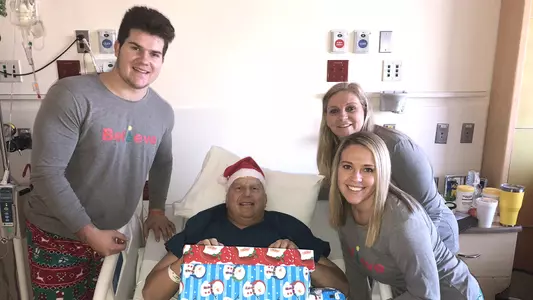
A small Christmas tree with lights is placed near his bed, and Jim wears a Santa hat while hugging Elizabeth, who drives home virtually every weekend, for a photo during their celebration in his private room. However, one last "present" comes Dec. 26.
"We said he got the best Christmas present ever from his brother," says Bev.
But he feels "miserable" for three to four weeks after the transplant, and his heart rate rises to a point of concern.
"Holy crap," says Jim. "Am I going to die? This is crazy."
He gets ulcers, sores in his throat and painful cramps.
Jim comes home Jan. 9, still feeling awful. The dining room table becomes his treatment center, and is covered with dozens of plastic prescription bottles, masks, IV needles, tubes and medical paraphernalia.
Doctors inform him that he will spend the next 100 days at home under 24/7 care-giving from family members only, whom doctors say are best because they have "vested interests" in returning a loved one to full health. Keith, another older brother and a retired doctor just like Dave, and his wife, Mary, a retired nurse, come from Santa Fe, New Mexico, for a combined two-month stint. Bev's three younger sisters -- Brenda, Barbara and Bridget -- are coming after that.
Meanwhile, Jim continues working with new head strength coach Ben Herbert, whom he's yet to meet, by talking on the phone and helping by ordering pieces needed for the new strength and conditioning facility.
His 100 days at home are just past the half-way point now, and he hopes to ease back into his job in April.
"But 100 days doesn't mean he's out of the woods and everything's good to go," cautions Bev. "What they said is that if it's going to reoccur, the highest percentage of a chance for it to come back is the first 18 months.
"So, if he gets to two years, and there's not been any relapse, the percentage that he lives the rest of his life fine and healthy, goes up to 85 percent."
Jim adds, "But for two years, you just don't know."
They are certain about one thing, though.
"What has been special for me is the incredible amount of support from my team, my staff, administration, his football people and former athletes," says Bev. "The only reason I have been able to continue coaching my team is because of all of the rest of them.
"We feel like we couldn't have been in a better place with more support between the athletic department, athletes, alumni athletes, and our families."
Jim says, "The people at Michigan have really helped Bev and I get through all this stuff. The family here is unbelievable and the sayings Jim and Jack Harbaugh have really help us get through this. Like they say, 'Who has it better than us?' "
He smiles and his eyes twinkle.
Jim can't wait to get back to Michigan football. The games are great, but the people are family.
When he walks you to the door and shakes your hand, the strength in the grip makes you wonder just how strong this guy was before getting hit with this. His handshake remains firm. His smile still lights up a room, too.
Jim Plocki might have lost his hair to chemo, but he's not letting it take his chance to love life and attack each day with enthusiasm unknown to mankind.