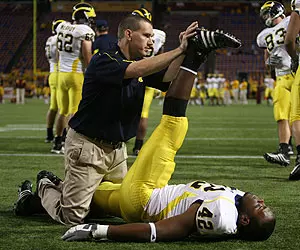
Dennis Murray: Behind the Scenes with Barwis' Glue Guy
7/28/2009 12:00:00 AM | Football
By Leah Howard, U-M Athletic Media Relations
Listen to this feature on iTunes
Weight rooms weren't meant to be empty. Like an empty stadium, the weight room breathes an eerie silence thick with the echoes of past workouts. The weight room in Schembechler Hall, pressed up against the construction of the new indoor facility, rumbles with the anticipation of future workouts. But in its present state, the empty weight room is restless. A row of darkened flat screens hang high on the wall over unused treadmills and elliptical machines. The countdown to kickoff clock, displaying the days, minutes and seconds until the Wolverines' season opener against Western Michigan, makes its proclamation to no one, and lonely rows of equipment -- cleaned and prepped -- stand at attention, just waiting.
Fill the weight room with people, just as we have on this particular July afternoon, and it comes to life. A steady stream of music -- loud and hard -- provides the pulse, muffling the sounds of grunts and gasps, coughs and barks, as the players navigate through the maze of bodies and machinery. It's a light workout on this day, and, between exercises, the Wolverines playfully stalk around, flexing and eyeing each other under furrowed brows. Coaches shout encouragement, players breathlessly towel the sweat from their eyes and the speed bag that occupies the center of the room receives a hard rap with each passerby. The scene is one of organized chaos.
Amidst the chaos, assistant strength coach Dennis Murray quietly leads his charge from station to station. Starting at the free weights along the far wall of the room, he studies technique in the mirror, providing guidance and support as players redden and strain with each additional rep. Later, stationed at one of several racks, he frowns slightly as he adjusts positioning of a pupil before leading him through another set of exercises. As the workout passes the hour mark, Murray has made his way across the room to the near wall. Dribbling a stability ball with one hand, he directs with the other, sharing an occasional laugh with a player while standing guard over abdominal work. The weight room is in its proper and innate state, and Murray looks at ease in the hustle and bustle of the workout.
But it's in those aforementioned quiet moments thathe does some of his best work.
Enter the weight room in Schembechler Hall, and it's impossible not to notice the thick blue words printed upon the sign above your head.
Through these doors walks the best conditioned, most disciplined, and hardest working football team in America.
The same words could easily describe Mike Barwis and his staff. Working in a building known for burning the candle at both ends, they're often the first to arrive in the morning and the last to leave at night. It's a grave misconception, says Barwis, to assume that five hours of training entails five hours of work each day. Five hours of training requires more like 12-14 hours of work, and the Michigan staff pays its dues to ensure an environment that is conducive to optimal effort and its correlated performance on the playing field.
With what Barwis estimates is 50-100 jobs spread among each member of his staff, they certainly have plenty of work to occupy the hours. Each staff member has a unique job description and a different role within the program. If Barwis is the architect, Chris Allen is the supervisor and the speed development specialist and Parker Whiteman is the high-energy motivator, then Murray -- charged with a bulk of the administrative work -- is the glue that keeps things running smoothly behind the scenes.
"That administrative stuff drives me virtually crazy," said Barwis, "but Dennis loves it. He can stay in here all day and do it nonstop. He's very punctual, and he's organized with it. That's a difficult task to organize things, make sure things happen and get all the jobs that I have done. I'll be honest, I give a whole hell of a lot of jobs out, and Dennis handles that and makes it all work. He really does a tremendous job with everything."
Murray's background in strength and conditioning is not unlike that of most of his coworkers. He worked up through the ranks, first as an unpaid intern, then as a graduate assistant before eventually landing a coveted full-time position within the country's premiere program. But, like several of his coworkers, he didn't initially set out on his chosen career path.
Raised on a cattle farm in small-town Weston, West Virginia, about an hour south of Morgantown, Murray started out in electrical engineering during his first semester at WVU before tiring of the math classes and opting instead for a pre-physical therapy course load through the school's exercise physiology program. Four years later and in need of internship credits, he jumped at an opportunity to work with Barwis and the Mountaineer football team. A former athlete himself, who dodged cow piles while perfecting his hook shot off an old rim attached to the barn back home, Murray fell in love with everyday interaction with the West Virginia student-athletes.
The internship translated into a two-year graduate assistantship that provided him with a master's degree in athletic coaching along with continued practical experience. But at the end of two years, Murray was at a crossroads. He could leave for permanent employment elsewhere or, with a little string pulling from Barwis, he could stay on as a graduate assistant and pursue a second master's degree. That's when a unique and unexpected opportunity presented itself.
"I got a phone call around 1 a.m. from Mike," said Murray. "He was on his way back from Michigan. He told me that he liked it and laid out what would be available for me if I decided to join him. I just had to give him my decision the following morning. Needless to say, I didn't get anymore sleep that night. My wife and I stayed up talking, and we decided that whatever Mike was going to do, we were going to do."
Barwis' wife, Autumn, was his second in charge for years, overseeing the entire strength program at West Virginia. When she decided to step aside upon their arrival in Ann Arbor, she taught Murray most of the administrative responsibilities.
Those responsibilities are as varied as the drills in a two-hour Michigan training session. He oversees the room's nutrition center, working with vendors, ordering product and providing players instruction for its optimal use. He manages the program's budget, working closely with the department's business office, placing orders, filling out purchase forms and organizing invoices and receipts. He assists Barwis with his excess of email, answering questions where he is qualified, providing coaches assistance with workout advice and communicating with business partners and vendors. He coordinates the summer coaches clinic and kids camp, organizing advertising, processing applications, scheduling lectures and exercises, assigning staff to particular jobs and overseeing things on the day of the event.
That's in addition to the preparation duties he shares with his coworkers: setting up for workouts, cleaning and sanitizing the equipment, fixing equipment and updating individual player workout sheets.
That's in addition to his work during actual workouts -- with both Michigan players and professional players that work out in the Schembechler weight room during the lunch hour.
That's in addition to coordinating all aspects of the strength program for the men's soccer team, last season's surprise NCAA Sweet Sixteen participant, with whom he has worked since last September.
"During the workouts, we're all working out our guys," said Murray. "So, we're basically all the same; we're not specifically in charge of one thing or another. But, outside of the workout, we all have our little duties that we take care of and oversee. So, everything really comes together smoothly. It's really kind of cool having those dual roles.
"With the way Mike has everything broken down, it really helps us branch out and learn. I was never a business major or anything like that, but I've always been good with organizational skills. Mike's pretty particular about everything. He likes everything to run as smoothly as planned. If I need help with anything, I'll usually go to Autumn or my wife. My wife is a computer engineer, so she's taught me all the computer stuff. I'm the internet guru, always on all the message boards, always looking for new ideas. Mike will always ask for our opinions and ideas. It really helps you be creative."
Learning is one of those primary catchwords associated with Barwis' program -- just as important as the others, like toughness, sacrifice and family. The day you stop learning, he likes to say, you're either dead or dumb. So, he encourages active participation among his staff members, who, in turn, take it upon themselves to expand and incorporate their knowledge to make changes and corrections, come up with new ideas and lay out programs and designs.
"I love their input," said Barwis. "I try to get these guys to give me ideas every day, and even when I make suggestions, I'll lay it out and ask for their opinions. The dimensional training we do is very complex, and they're all still learning. But, at the same time, they teach me. Thomas Edison didn't think of everything with the light bulb. I have certain walls and blockers in my mind that don't allow me to see things. Nobody is perfect, and nobody sees everything. The goal is to take the attributes that I have and the knowledge that I have and, over time, learn those things and become better at it. If your goal is to be as good as me, then you're selling yourself short. I hope for every one of them that they will be better than me, and I expect them all to be better."
Barwis holds his staff powwows in his office -- the one he shares with Murray and Whiteman -- and they discuss some scheduling, review progress on their individual tasks and bounce around ideas about different drills. After the meeting breaks, Murray grabs a quick lunch at his desk, peruses the internet and his email, makes a few phone calls and fills out a form or two. He can't afford to sit too long though; the players will begin rolling in soon. Equipment needs to be laid out, workout sheets need to be printed and music needs to be cued up. The weight room is finally starting to awaken from its restless slumber.