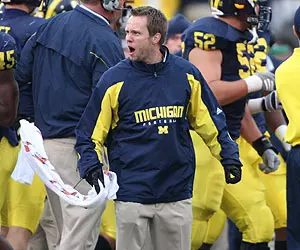
From Appalachia to Ann Arbor: Jesse Miller Seeks the Simple Life
8/13/2009 12:00:00 AM | Football
By Leah Howard, U-M Athletic Media Relations
Listen to this feature on iTunes
Settled into conversation, assistant strength coach Jesse Miller's voice twists and turns and twangs through a deliberate selection of words. He laughs freely -- often at his own jokes -- and speaks slowly, segueing between an assured drawl and accented excitement. In the weight room, it's a different kind of combination. That same voice -- now louder and an octave lower -- alternates between short, staccato bursts and a flattened, breathless growl as the players unquestioningly obey its every command.
His accent is born out of Appalachia -- deep in the mountains of southern West Virginia -- and it's a head turner around these parts. But that's the way he likes it. And the further north he travels, the more he clings to it. That accent represents who he is, and he will not let it change. If it ever does, well then perhaps it's time to head back home.
Ask Miller to identify his hometown, and he'll quickly point out that he's not from a town. He grew up on a mountain, in the country. Step out the front door of his parents' house, and you're surrounded by leafy green trees with those far-reaching mountaintops peaking up over the tips and extending off into the horizon. You get on top of a mountain, he'll say, and you can see forever. And it goes forever. It's natural, and it's beautiful. Heck, it's almost heaven. You don't have any of these buildings obstructing the view.
For our technical purposes, Miller hails from Jumping Branch, W.Va., about a 10-minute drive up the mountain from the county seat of Hinton. Like many towns in West Virginia, Hinton's history has been shaped by coal. It was once a hub of the railroad, established as a terminal for changing and serving the coal trains that carried the resource down through the mountains. But as the railroad transitioned from steam to diesel and the nation's dependence on coal declined over the years, Hinton was cleared of much of its population.
There isn't a whole lot to do there in Hinton, and if you don't embrace it, there's not a whole lot of opportunity. There are no big-city lights. So, it's what you make of it. For Miller, of course there was school and work. There was church -- every Sunday morning, Sunday evening and Wednesday evening -- and that was not optional. There was the outdoors and its associated activities: hunting, fishing and camping. And then there were sports. His specialties were football and baseball.
"Those were our summers," said Miller. "Fish in the morning, work around the house during the day and play American Legion baseball at night. That was it. There wasn't anything else to do. But that was good enough for us. That's all you wanted to do, and that's all you needed to do. That's all you cared about. Still to this day, that's all I care about. I would live the simple life every day if I could."
The simple life essentially meant sports and fishing, the preferred pastimes of his youth. It was his father, Mike, who taught him football and baseball -- the same sports that he coached for years at the high school and junior high level. It was also his father who taught him to fish. Growing up, Miller would often accompany him to practice, and if he wasn't out shagging balls or sleeping in the truck, he'd cast a line, pulling smallmouth bass out of the mighty New River behind the bleachers of the football field and about 40 feet or so from home plate on the baseball diamond.
Breaking free of the family tradition of coalmining, his father had become a teacher -- his mother too. So education was emphasized in his household. Miller was good at sports because he liked the challenge. He was good at school because he had to be; that was the message. His parents told him to do his best, and that meant he'd better study, try hard and get good grades. In the end, it was his academic pursuits that carried him out of town.
"I was blessed to have my parents," said Miller. "As far as I'm concerned, they're the greatest parents in the world. They raised me well. I was always thickheaded. I think they realized as I was growing up that if I felt like there was something I wanted to do, they had better let me make my own decisions. If I messed up, I learned from my mistakes. So, they had to be patient with me. My mom prayed every night, every morning and every day for me. And I guarantee she still does it to this day."
The scenery is quite different now for Miller. It's a bit flat and there are a few too many buildings, but he's adjusting. His preferred fishing hole is now a big old pond behind Mike Barwis' house. Not quite the same, but it'll do the trick. He'll head over there a few times a week in the summertime, grab his rod and head down the hill. His visits aren't announced -- he certainly doesn't need any assistance from Barwis -- and he'll stay out there for hours, searching for bass and bluegill. The neighbors raise an eyebrow, and some of his Ann Arbor friends don't quite get the intrigue. But they don't need to. It's what he cares about -- perhaps his attempt to recapture some of the simple life.
Miller was with Barwis off and on for three years before they packed up and moved to Michigan. He first started as an intern while in graduate school at West Virginia. During his previous four years, he had dabbled in a variety of subjects -- math, science, health and education -- which ultimately led to the realization that he no longer wanted to be a teacher. Teaching had merely been a means to get into coaching anyway. So, taking a different route, he enrolled in WVU's exercise physiology program. There he met classmate Kentaro Tamura, who suggested he contact Barwis about working in the Mountaineer weight room.
Long story short, he says, he stuck with it and ended up here in Michigan. Well, not so fast. First there was sacrifice. After graduating in 2006, Miller moved into a full-time job training high school athletes at a specialized sports center in Virginia. It was a good job, but he felt like he could do more. He wasn't learning, and he wasn't developing. If Barwis would have him, he would quit, return to Morgantown and work for free. And when Barwis complied, Miller did just that, eventually earning a position on staff as a graduate assistant. A little more than a year later, he was in Ann Arbor.
"We all sacrificed to get here," said Miller. "People might think I'm crazy, but I don't look at it as a bad path. I just look at it as what I needed to do. I don't think I'd be as good a coach if I wasn't in this system with these people. They're the ones I learned from coming up through. I'm comfortable with this staff, and there's nothing I can't do in my personal or professional life around this staff. No matter what flaws I have, I can do anything in front of them and not feel ashamed. They are my greatest strength as a coach."
Barwis' staff prides itself on its diversity. They like to refer to themselves as the United Nations, representing all parts of the world. Tamura is from Japan, Chris Allen is from Jamaica, and the rest are spread from all over the country. All bring their own backgrounds and their own cultures and philosophies. It helps them connect with different types of athletes. Unique even among a building full of West Virginia natives, Miller brings his own culture into the room. And he certainly has plenty of philosophies to share.
Settled back into that aforementioned conversation -- and between brief rants about the whole premise of ice fishing, the unemployment rate and his distaste for interviews -- he tackled education (You're going to get what you want to get out of it), circumstance (Everything in life happens for a reason; you don't have to understand it, you just have to accept it and embrace it), and fortune (The further you make it in life, the more headaches you get). Each digression was followed with a grin and a 'You make sure you put that in there.'"
Perhaps he couldn't quite shake that teacher mentality. Or maybe it's more like a preacher mentality. One thing's for certain: he sure can command a crowd in the weight room. Among his athletes -- those on the football and wrestling teams -- Miller is described as "funny, hard-nosed and motivational in the same breath" and "more intimidating than he looks" and "someone who commands respect while always remaining approachable". He is equal parts intense and persistent, optimistic and fun-loving. More comfortable in the wilderness or with a fishing pole in hand, Miller claims he's not much of a people person. But he has a soft spot for those student-athletes. They're the reason he got into coaching after all. And his athletes, who are quick to crack a smile at the mention of his name, absolutely adore him.
"Jesse does a great job with people," said Barwis, "and he's got a great personality around people. Jesse is a country boy. He's kind of laid back. He's kind of a joker. He's got a sarcastic sense of humor. That demeanor really draws kids in. They like his jokes. They like the way he moves and the way he talks. But at the same time, he'll coach his butt off. He'll get in there and get after them. He's energetic and makes sure they're doing what they need to do. But he'll make light of it, so they really enjoy it. That's a good environment he provides."
That environment is bred from his upbringing. It's bred from the hills and rivers and trees of southern West Virginia, and it's bred from the traditions of toughness and endurance within the mountain people. But Miller had to move out of the mountains to fulfill his professional aspirations, and he had to step outside himself to get to where he is now.
"I was blessed," said Miller. "I was able to get out, go to college, make something of myself and wind up here. But I don't ever forget where I'm from, and I never will. I've never forgotten who my parents are, who my friends are and all those people I grew up with. That's who I am. I'd love to get back there one day, but I don't think they've got too many colleges in Jumping Branch, West Virginia, for me to work at."