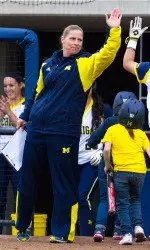
Kornacki: A Lot of Blue in Brundage's Gold
7/20/2016 12:00:00 AM | Softball
July 20, 2016
By Steve Kornacki
ANN ARBOR, Mich. -- Jennifer Brundage put a new spin on the term "player-coach" as she prepared to play in the 2000 Sydney Olympics for the U.S. softball team that won a gold medal.
She rose most days at 6 a.m. to prepare as a player before reporting to the University of Michigan athletic department offices around 9 a.m., taking on the demands of her full-time position as the Wolverine pitching coach. Some afternoons, she got head coach Carol Hutchins to throw batting practice to her after team practices.
Brundage leaned back in her chair and laughed about bringing the gold medal back to show assistant coach Bonnie Tholl and Hutchins while thanking them for helping her realize a dream.
"Hutch dropped it, and now there's a ding in my medal," said Brundage. "She came back into the office Bonnie and I shared then at Weidenbach (Hall), and Hutch was holding the ribbon or something, and it slipped through her hands. She dropped it right on the computer hard drive, but it's no big deal.
"We laugh about that. I bring it up every once in a while and harass her about it. The kids loved it and thought it was pretty neat. I took it to practice for them, but otherwise I don't parade it around."
Brundage said a few others also coached and played for the Olympic team, including Lisa Fernandez, her former UCLA teammate who pitched the U.S. to victory in the 2000 gold medal game against Japan.
How did Brundage juggle the two demanding roles to make it all work?

the Olympics
"Hutch and Bonnie were great working with me on that," said Brundage, 43, who also earned a master's degree in sports management at Michigan. "They took on a lot of the recruiting load from me so I could play all summer. They covered for me on the recruiting trail.
"But during the school year, I just had to get up early and do my training before coming to work."
She would do weight training, run and hit off a batting tee alone in the mornings. Occasionally, she got someone to show up early to soft toss balls for her to hit into a catch net.
"Sometimes Hutch would throw to me after practices," said Brundage, "and Bonnie would hit me ground balls. I had to take live hitting when I could get it, and that was pretty tough to get because I couldn't have Michigan pitchers throwing to me. I didn't want to hurt them, and they had their own training to do. They had to get ready for Michigan and not for me."
It all worked out fine, though.
Brundage led the U.S. in batting average during 10 games of Olympic competition in 2000 and played primarily third base with some left field and designated hitter action.
"My top memory was actually being on the medal stand," said Brundage, "and having the gold medal put around my neck with all of my teammates. Nothing beats that, but the whole experience was incredible.
"Walking in the opening ceremonies, walking through the Olympic Village and just hanging out there, just being able to do all these things was incredible. With an athlete's credential, you could pretty much do anything in town and go anywhere. You were, essentially a VIP, and various sponsors provided places to go and hang out and watch the Games with food and drink. The hospitality was fantastic."
The powerhouse U.S. team -- with pitchers Fernandez and Michele Smith -- started slowly in Sydney, going only 4-3 in round-robin competition. Then they beat China, 3-0, in the semifinals before beating Australia, 1-0, in the finals. The gold-medal game was termed the grand final, and it came against Japan.
The Americans triumphed, 2-1, to claim the country's second consecutive gold medal in as many Olympics that included softball.
"In that game," said Brundage, "my biggest contribution was on defense. I didn't have any hits or move anybody over offensively, but I was playing good defense at that point in time. It was such a close game, and we had a walk-off win on a ball hit to left field that was misplayed.
"But the pitching distance at that time was 40 feet (it's now 43 feet), and so there wasn't the offense like there is in the game now. International competition also had a dead ball, and so the game was a lot different and very much a pitcher's game."
Brundage said she only pitched five games at UCLA because the Bruins were loaded at the position. Fernandez, her teammate on the school's 1992 NCAA champions, was the undeniable ace.
So, Brundage chose to become a position player and focus on third base, and the move paid off handsomely. She led all major college players with a .518 batting average in 1995, when she won the Honda Award as the national softball player of the year, and UCLA once again won the World Series. She set school career records for home runs, RBI and doubles and finished second in batting average.
"I grew up pitching," said Brundage, who was born in Orange, California, and raised in Southern California. "I knew pitching, and most schools recruited me as a pitcher. UCLA was overloaded at pitcher and said I wouldn't even get a chance there until my junior year. But they said, 'If you hit, we'll find a place in the lineup for you.' "
And she sure could hit.
Brundage was an alternate on the 1996 Olympic team, when she also spent the first of two seasons as the pitching coach at Tennessee-Chattanooga. She wanted to return to Southern California and joined the coaching staff at UCLA as a volunteer for the 1997 and 1998 seasons -- working with hitters and training for the Olympics -- before joining the Wolverines' coaching staff in 1999.
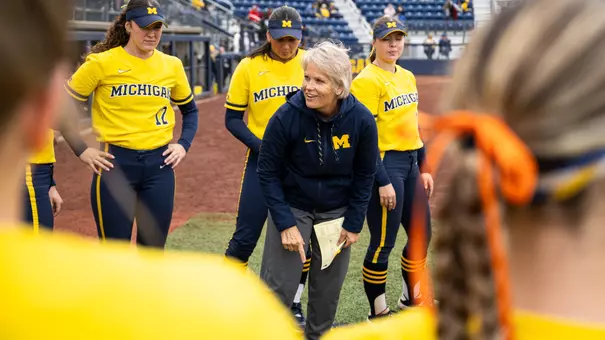
She works with hitters and handles other duties on the coaching staff but is the primary pitching coach for Hutchins.
"I had met Hutch over the years, and our paths crossed a few times," said Brundage, "and I'd had some conversations with her and Bonnie (Tholl) at a coaching convention. Hutch was out recruiting in the summer of '98 and had an opening for a pitching coach and was talking to Kelly Inouye(-Perez), who was the assistant at UCLA at the time and is now the head coach.
"Kelly and I were teammates for two years, and I was on the coaching staff at UCLA with her. Kelly tossed my name out to Hutch, and came back and asked me if I would be interested in Michigan. I said, 'Yeah, actually I would be.' Hutch and I then had a conversation, and it all fell into place over a week or two weeks. I'd never been to Michigan before and had watched Michigan football on TV. I remember cheering for (Wolverines receiver) Tai Streets in games. I loved Tai Streets!"
Brundage said Hutchins made an impression on her back in 1995, when the Wolverines came to UCLA and beat the Bruins to end a long home winning streak.
"So," said Brundage, "I committed to Hutch, sight unseen, and the rest is history."


Brundage has guided Michigan pitchers to 17 All-America citations in 18 seasons as the pitching coach, with junior Megan Betsa being her latest star.
Brundage, Tholl and Hutchins coached Michigan to a Women's College World Series win in 2005 with pitching ace Jennie Ritter, coached by Brundage, being so central to a team that beat UCLA for the championship in an extra-inning thriller.
Hutchins has had a great impact on Brundage, who lives in Ann Arbor with her husband, Rich Boys.
"She impacts every facet of people's lives," said Brundage. "She helped me grow as a coach and with different ways of communicating with players based on who they are and what they need. That was a big eye-opener for me. She's also helped grow me up and become a better person, coach and leader for our kids. She's a great support as a friend as well."
Hutchins also had a pivotal role in that gold medal Brundage won.
"She helped me be a better softball player initially by learning her approach and philosophy to the game," Brundage said. "She helped make the game fun again, and when you're having fun, you're not feeling the pressure.
"I was in the process of tryouts to make the Olympic team when I came to Michigan, and that process can become individualistic and self-centered. That's not good, and Hutch helped me to remember to have fun and enjoy the process and my teammates. That took the pressure off and enabled me to make the team and excel when I did make the team."
Brundage -- who hopes softball is reinstated in the 2020 Olympics after being out since 2008 -- said the gold medal is hidden in a box at her home. Offers have come to build her a nice display case for it, but she doesn't want to "show it off" that way.
"I want to be able to take the gold medal out and show it to somebody who really wants to see it," said Brundage.
Handing it over to Hutch again, however, might be out of the question.