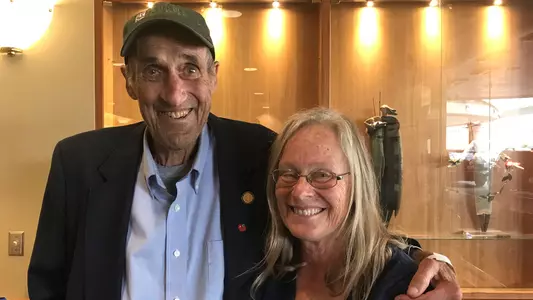
Cancer Research Near and Dear to Former Football Captain
10/5/2017 1:56:00 PM | Football, Features
By Steve Kornacki
TRENTON, Mich. -- George Mans sits in a chair on the wood-planked porch of his two-story house in the downtown of his hometown along the Detroit River. He once served Trenton as mayor, school board member and later as a state legislator, returning to his roots to raise four children with Carol, his wife of 48 years.
Life would indeed be good if he wasn't dealing with non-Hodgkin's lymphoma, melanoma, and other health challenges. Still, Mans, 78, insists, "I'm a very lucky man." He adds that he's "blessed" to have experienced all that he has, and a warm smile creases his face when discussing the people and things he loves.
He views a photo from 1961, when he was the football captain at the University of Michigan and standing next to Wolverines coach Bump Elliott, wearing a T-shirt, pressed trousers and a baseball cap. Mans has a crew cut and is wearing No. 82 and holding the winged helmet under his right arm at Ferry Field.
"I look young," says Mans, eyes lighting up at the memories the photo conjures, "but Bump really looks young. Wow."
He chuckles and nods, tipping the cap on his head up ever so slightly.
Mans was recruited out of Trenton, which he recalls as a small town with only 4,000 residents when head coach Bennie Oosterbaan offered him opportunities for "a wonderful education" as well as "a chance to play football" and "a chance to associate with ladies and gentlemen."
Mans laughs and adds, "How often do you hear that?"
Elliott became the head coach during his sophomore season, and Mans recalls coming off the bench in the second half of the 1959 win over Ohio State after the first- and second-stringers were injured. That was one of the highlights of his career, which included 24 catches for 289 yards and two touchdowns in an era when offenses were geared to running the ball.

The captain was good enough to get invited to the prestigious North-South Shrine game in 1961, and was drafted in the 14th round by the St. Louis Cardinals.
He returned as an assistant coach for Elliott and was retained in 1969 by the new coach, Glenn Edward "Bo" Schembechler. They upset the No. 1 Buckeyes, a 17-point favorite, that year and a photo was taken of Mans and others celebrating on the sideline as the final seconds ticked away.
All-America tight end Jim Mandich ("He was a great leader") raises his arms in triumph while being lifted off the turf by a teammate. Frank Maloney, the other Elliott assistant Schembechler retained, shouts for joy, and wingback John Gabler, who later brought Mans into his business as a manufacturer's representative for a software company, jumps for joy.
Schembechler is being raised onto the shoulders of his players immediately behind Mans.
"They were carrying the man off the field like he deserved," says Mans, chuckling as he views that celebratory photo. "A lot of great memories. I was so glad for Bo to be able to get that win. It established him right off the bat."
He helped Schembechler build the Wolverine football dynasty before leaving in 1974 to become the head coach right next door in Ypsilanti at Eastern Michigan University.
Michigan football has stayed in his heart ever since, and on Saturday (Oct. 7) he returns as a captain once again. This time to lead the fundraising efforts of the Victors Melanoma Research team at the request of his doctor, Scott McLean, from the Division of Head and Neck Oncology in the University of Michigan Comprehensive Cancer Center.
"Tailgate to Tackle Melanoma" takes place at the University of Michigan Golf Course's brand new Richard Postma Family Clubhouse across Stadium Boulevard from Michigan Stadium, beginning four hours before the kickoff at 7:30 p.m.
Mans has battled cancer for about 10 years since being diagnosed with non-Hodgkin's.
"Then, five years ago, I developed the melanoma, too," says Mans. "So, we've had a double-dose. I'm just so glad to be able to participate in this fundraiser and give something back to the University of Michigan Health System because they've kept me going for 10 years.
"I'm going there once a week for treatments. I've got a little fluid on the lung because of the melanoma settling in there, and so they take that off."
Mans left football coaching after leading the EMU program in 1974 and 1975, and finished with an 8-12-1 record in the years when the Hurons transitioned into Mid-American Conference membership and Division I football.
"The greatest pleasure of my life has been being able to have enough time to enjoy my family and watch the kids grow up," Mans says. "Coaching is very demanding on time, and in the final analysis, the main reason I left it. I enjoyed it, but just was spending more time with other people's children and families than my own.
"I lost my enthusiasm for it, and the most fair thing to do was to leave. But I had a great run with the game, and loved football."
He treasures the experiences he had at Michigan, and valued the invitation from the Cardinals for a shot at the NFL. Passing on that would've been too much for most, but Mans says he asked for the opinion of his position coach, Jack Nelson, after getting drafted.
Mans recalls his response: "You're not big enough for defense (at 6-foot-4, 212 pounds) and you're too slow for offense. Stop playing."
So, he became an assistant coach at Michigan Tech and returned to Ann Arbor in 1965 as an assistant to Elliott.
"Bump was a real quality man and a great guy to play for," says Mans. "He was always concerned about his players, and when he took over, because Bennie (Oosterbaan) did not do a lot of recruiting, we were down a little bit.
"When I was a sophomore (in 1959) we went 4-5. But I have a great memory from that year because we beat Ohio State, 23-14, in Ann Arbor. I got to play a lot in that game because it was hard-hitting, and the first two guys went down in the first half. That was a lot of fun."
The Wolverines improved to 5-4 and 6-3 in his junior and senior seasons, when Mans was one of the squad's top performers. He coached receivers upon returning to Michigan.
"I got to work with (1966 All-America) Jack Clancy," says Mans, "who made me look like a pretty good coach (laughter). I was never as good after Jack left.
"And then I had a chance to stay with Coach Schembechler, and it was a great honor to be retained by that man. He had a plan and was going to go with that plan, and I had no doubt in my mind that he was going to be successful.
"A lot of people overlook how well-organized Bo was. He was a great detail guy, and there was never anything that came up in a game that we hadn't talked about or covered. That to me, beside his personality, which was very demanding, and great leadership were what really impressed me."
Their crowning moment came on Nov. 22, 1969, when the Wolverines upset Ohio State, 24-12.
"By the time we got to Ohio State," says Mans, "the players believed in the system Bo installed, and they had not forgotten getting beat up like they did the year before, 50-14, in Columbus. I think we were hungrier, and we shocked them, no question. They didn't expect that.
"Bo really had that team masterfully prepared, mentally and physically, with a great game plan. They waited for us to roll over, and it never happened."

In the celebration of the 1969 upset of Ohio State, assistant coach Mans is to the direct right of No. 12, wingback James Schmitz. Coach Bo Schembechler is directly behind Mans and being hoisted onto the shoulders of his players.
Mans says Schembechler's legacy stretched beyond the football field:
"If you go to the University of Michigan Cardiovascular Center -- the Frankel Center it's called -- there's a bust of Bo in there. It notes that when Bo was being treated for his heart problems, he got with a group of doctors who wanted to know how he built a team. The bust goes on to say that they put together a team in a medical setting.
"And I know it worked because when I first met Dr. McLean, the host of this fundraiser, he came into the room with four other people and introduced himself to my wife and I. Then he said, 'I want you to meet my team.' And I thought, 'Well, Bo, wherever you are, here's another one that you did right.'
"That concept of team is a lot of what they're trying to do in the medical setting now. They used to ship your report on non-Hodgkin's or melanoma to just your doctor. But they don't do that anymore. They sit down and collaborate together. It really inspired me and I'm thankful to be involved in that."
The story of George Mans was originally profiled by the U-M Health System:
• Former U-M Football Captain Teams Up with Doctor to Tackle Cancer Research
• Tailgate to Tackle Melanoma