Tackles Record Holder Simpkins Humbly Entering Hall of Honor
11/11/2019 3:29:00 PM | Football, Features
Football captain and consensus All-American Ron Simpkins will be inducted into the Michigan Athletics Hall of Honor during a Friday (Nov. 15) ceremony along with Erick Anderson (football), Hal Downes (ice hockey), John Fisher (wrestling), Lara Hooiveld (women's swimming & diving), Stacey Thomas (women's basketball) and Nick Willis (men's track & field, cross country).
By Steve Kornacki
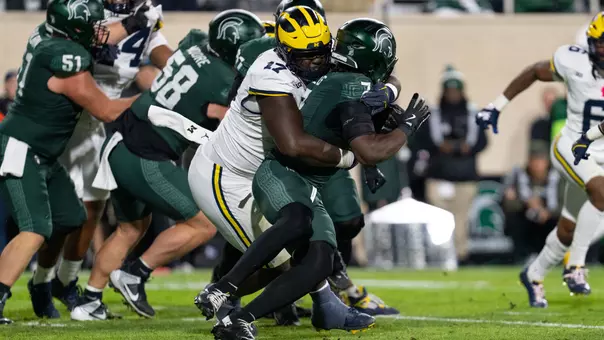
ANN ARBOR, Mich. -- Linebacker Ron Simpkins set two records at the University of Michigan that have stood 40 years or more. His 174 tackles in 1977 and 516 career tackles remain atop those statistical rankings at a school that's had some great defenders -- including four All-America linebackers.
However, the 1979 All-American remains the standard for Wolverines who have played in the four decades since. His achievements as a hard hitter, great teammate and the leader of some of the greatest teams Michigan has produced led to his induction into the Michigan Hall of Honor on Friday night (Nov. 15).
Getting Simpkins, who went on to play seven seasons in the NFL for the Cincinnati Bengals (1982 Super Bowl) and Green Bay Packers, to take a bow for his accomplishments is about as hard as it was to get past him on the field. He chooses to mention teammates more than his accolades.
"Calvin O'Neal initially was my idol, and I got to play with him -- that was really an honor," said Simpkins, now an administrator at Wayne State in Detroit, who also was the head football coach at his alma mater, Detroit Western. "John Anderson was one of the most athletic linebackers I've seen and was a great punter. Curtis Greer was an outstanding defensive lineman, a small football player with a great skill set. Gene Bell, strong safety, could do it all against the run and pass.
"Mike Harden, Mike Jolly, Mike Trgovac, Mel Owens -- just such a list of guys, so many guys that I could (add). They were so outstanding that I had to make some plays. Almost everybody who started on our defense played in the NFL. I had to make some tackles or get embarrassed -- one or the other. Yeah, it's a record I have, but these guys made it easier."
Michigan had 24 NFL Draft picks from the four seasons Simpkins played.
"It's not about me," said Simpkins, a 1979 co-captain. "It's about my teammates. The things I accomplished was because of them. So, I look at it as them going into the Hall of Honor as much as it is I'm going in. I take so much pride in playing with these guys at Michigan that it just means the world to me."

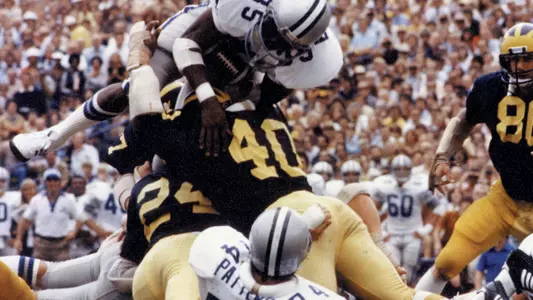
Simpkins became the tackles king. However, the one tackle and forced fumble he made in the Jan. 1, 1979, Rose Bowl that he did not receive any credit for remains perhaps his most memorable moment for longtime Wolverine fans.
Southern Cal tailback Charles White, who won the Heisman Trophy the next season, went up the middle and Simpkins squared up on White as he began vaulting toward the end zone. The ball came out a few yards short of the end zone before White reached full flight, and Michigan linebacker Jerry Meter recovered it.
"I remember him going up in the air and him not having the football," said Simpkins. "I remember Jerry Meter standing up with the football and they call it a touchdown. I was stunned. 'What just happened?'"
It was dubbed the "Phantom Touchdown," and it gave the Trojans a 14-3 lead in a game they won, 17-10.
"The ball comes out before he crosses the goal line," NBC-TV announcer Curt Gowdy told viewers, "but it was ruled a touchdown."
Simpkins added, "Without that touchdown, it's a totally different football game. I've never been a fan of instant replay (reviews) because it slows down the game, but if we had it then, that would've been a totally different football game. That play would've been reversed."
White and Wolverine quarterback Rick Leach were that Rose Bowl's co-MVPs. Leach lauded Simpkins after his Hall of Honor announcement in July, saying, "He was the BEST LB I've seen at Michigan until Mr. Devin Bush came along -- two peas in a pod."
Simpkins said it was a special moment when he got the phone call informing him about the Hall of Honor, with his daughter, Elena, also in the room.
"I was shocked when they called," said Simpkins. "I was sitting in my office with my daughter, and she was working for me this summer. I was on speakerphone and she heard I was being inducted, and she was jumping up and down and was so excited. I said, 'You've got to quiet down. I can't hear!'"
Simpkins laughed. He's the third Hall of Honor inductee from the four teams he played on, joining Leach and All-America tailback Rob Lytle.
"It was humbling, first of all," he said. "But her excitement got me excited."
He added that Elena received both her undergraduate degree and Ph.D. from Michigan.

Simpkins played on three Big Ten champions and three Rose Bowl teams while making all those tackles and garnering so many honors. What meant the most to him?
"I just go back again to all those guys I played with," said Simpkins. "They became great friends then and we're still friends. We talk about the rivalry games all the time, and knowing that these guys are excited about what's still going on with me means so much in my life.
"The success we had under Bo Schembechler took the program to an even different level. We didn't dream of being No. 1 in the rankings all those times. We took winning the Big Ten, going to Rose Bowls and being in the Top 10 for granted. But it's so hard to win a Big Ten championship, so hard to get to the Rose Bowl.
"And there's nothing like the Rose Bowl. Going to three Rose Bowls in a row spoiled us, and going to the Gator Bowl (in his senior year), it was hard to get up for that after the Rose Bowls."
His personal best was 20 tackles against Ohio State in 1977, but Simpkins also fondly remembers the Texas A&M game in 1977 when he made 14 tackles and recovered a fumble.
"That's when I realized I could play Division I football," he said. "I believe they named me the Chevrolet Player of the Game."
Simpkins said practices at Michigan "were much harder than the games" and were why they usually were able to dominate opponents.
Schembechler impacted him in numerous ways on the field but had an even bigger role in developing Simpkins off the field.
"Bo made you a man," said Simpkins. "You go there as a kid and he teaches you how to be a man in your family. So, it wasn't just about football. They are lessons you carry the rest of my life. He turned us into men."
Simpkins has three daughters -- Elena, Maria and Maya -- and is so proud that all graduated college and have gone on to successful careers.
"My daughters are my greatest success," he said.
Gary Moeller was initially his position coach and defensive coordinator, and Bill McCartney replaced him when Moeller became the head coach at Illinois.
"Mo on technique and technology, the one-on-one sessions we had were incredible," said Simpkins. "I learned so much from him. He was so organized and a great teacher. I ran into him at the Atlanta airport and got a chance to thank him. I said, 'You set the foundation for me to be successful, and I appreciate everything you ever did for me.'
"McCartney, who also recruited me to come to Michigan, took it to another level. Our relationship was tight and intense. We would go at each other but then grab and hug each other after games. He taught me how to break down film and communicate with teammates, and made me the signal-caller out there."

Simpkins graduated from Michigan in 1980 and earned his master's degree in sports administration at Wayne State after finishing his NFL career. He is a director in Wayne State's kinesiology department and works as a research assistant in the education department by running outreach programs while facilitating financial grants for inner-city youth.
Antonio Gates, an eight-time NFL Pro Bowl tight end, was one of the youngsters he worked with. Simpkins also was the football head coach at his alma mater, which became Detroit Western International High. Simpkins coached track and field and was an assistant basketball coach there, too, for 15 years while also working at Wayne State.
"Being around young people keeps you young," said Simpkins, 61, who also was a consultant for the city of Detroit's immigration services department.
Michigan, he said, set him up for success.
"Michigan was a life-changer for me," said Simpkins. "I was really a student-athlete, and it wasn't just about football but the academic side of it. Teachers and coaches both helped guide me to where I've gotten.
"And my success at Michigan really inspired other guys at Western to go on and do successful things. It not only inspired me to go to Michigan but changed other guys' lives. And then, everybody who played football for me from their freshman year on at Western graduated high school and went on to do other good things.
"It's all about paying it forward."