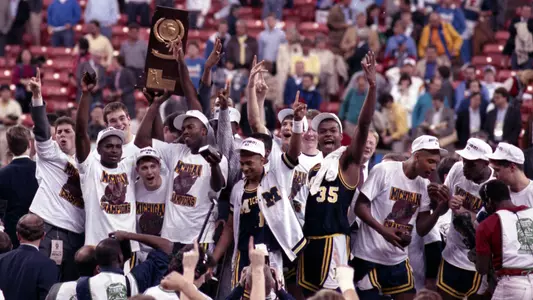
Thirty Years Later, '89 NCAA Basketball Champs Reflect on Feat
2/22/2019 12:00:00 PM | Men's Basketball, Features
As part of its reunion weekend, the Michigan men's basketball program will welcome back and honor the 1988-89 national championship team on the 30th anniversary of its memorable season. That team will be recognized during halftime of Sunday's (Feb. 24) game against Michigan State at Crisler Center.
By Steve Kornacki
ANN ARBOR, Mich. -- Thirty years have passed since Glen Rice became an unstoppable scoring machine and led the University of Michigan to its only NCAA basketball championship.
Today, Rice's No. 41 jersey and the 1989 championship banner hang from the rafters at opposite ends of Crisler Center. Nearly all of those champions, including the four NBA first-round picks from the group -- Rice, Terry Mills, Rumeal Robinson and Loy Vaught -- have turned 50, and so much has changed.
One thing remains the same, though, and that was just how unlikely their precarious climb to the top was.
Those Wolverines got pounded in their regular-season finale at what was then called Crisler Arena by a highly talented Illinois team nicknamed "The Flyin' Illini" by Dick Vitale and then rebounded to beat them in a national semifinal game at the Kingdome in Seattle.
Who saw that coming?
Michigan won that game on a rebound and quick swish from along the baseline by Sean Higgins with one second remaining. Higgins had been bombing from behind the three-point arc with Rice all tournament long, and then he advanced his team with a bunny shot after grabbing the carom from a long cast from Mills, the versatile 6-foot-10 force who led the Big Ten in shot blocking that season but didn't make a three-pointer in his college career.
Who drew that up?
The championship game two days later, on April 3, was a classic seesaw contest with Seton Hall that required overtime. With three seconds left in the extra session, the outcome rested in the hands of Robinson, who had been fouled driving to the basket. He was the weakest free throw shooter in the six-man rotation at 65.6 percent. However, he had taken to shooting 100 from the line after each practice after costing his team a win at Wisconsin in January, and he calmly swished both free throws to provide the final points in an 80-79 victory.
Who predicted that finish?
And, after news leaked that Wolverine coach Bill Frieder was going to take the job at Arizona State for the next season on the eve of the "Big Dance," assistant coach Steve Fisher was named the interim coach. Fisher impressed athletic director and football coach Bo Schembechler so much in six tourney wins that began with knocking off Xavier, South Alabama, long-time nemesis North Carolina and finally Virginia in a 102-65 Elite Eight blowout, that he got the full-time position and would take the Wolverines to two more Final Fours (since vacated) with the Fab Five.
Who could've imagined any of that?
So, at every turn of the page, with each new chapter in the run to a national championship, it was such an unlikely tale.
Steve Fisher, his family and Wolverine players celebrate winning the Southeast Regional.
From Third in the Big Ten to No. 1 in the Nation
Michigan finished third in the Big Ten that season behind champion Indiana and runner-up Illinois and was a No. 3 seed in the NCAA Tournament. So, they were hardly a likely national champion. While this wasn't a Cinderella story, it wasn't one anyone anticipated.
"That was craziness and the surreal part of the whole story," said Fisher. "But if you look at the really terrific talent we had, beginning with Glen Rice but not ending with Glen Rice, the fact was that people were more surprised. But internally, we weren't shocked. We knew we were good. The talent level was there."
Fisher coached eight full seasons at Michigan, briefly was an assistant coach for the Sacramento Kings, and went on to turn around a struggling San Diego State program. He had future NBA star Kawhi Leonard on the 2011 Sweet 16 Aztecs, went to eight NCAA tourneys with them, and won 11 Mountain West regular-season or tourney titles.
He pushed all the right buttons as the Wolverines won two Final Four games by a combined three points -- an all-time record for the smallest two-game margin of victory by a champion in the national semifinal and final games. They are one of six teams to win the title in overtime and one of six teams to win it by one point.
"You can't get much closer than three points," Fisher said.
Ironically, it was Rice, the scoring star, who ended up with the ball as time expired in both Final Four wins. He intercepted an Illinois pass and rebounded the final Seton Hall shot, both desperation heaves.
Rice, now a scout for the Miami Heat after a 15-year NBA career that saw him average 18.3 points and included one championship with the Los Angeles Lakers, scored 2,442 points, a Big Ten record at the time, at Michigan in four seasons.
He scored 184 points (30.7 per game) in the 1989 NCAA Tournament for a record that still stands. Rice, who scored 31 points in the championship game, said the basket that meant the most to him was his fourth of five three-pointers late in the second half. It provided a 64-59 lead and allowed him to surpass Bill Bradley for the NCAA scoring record.

Glen Rice and the Wolverines made the cover of the April 10, 1989, edition of Sports Illustrated.
"The one that I see over and over and over again in my mind is the one where we needed a bucket and I was wide open," said Rice. "[Seton Hall's Michael Cooper] kind of leaned into me late, and I shot and I fell, and that ball went straight through to the bottom of the net.
"We were down a little bit and needed some momentum, and that was a momentum bucket. I was like, 'Damn! It was silky smooth.' Now, I don't talk about myself like that, but I felt, 'They don't know it, but that was a momentum changer.' And still it was a beautiful, beautiful shot."
Rice was an easy selection as the tournament's Most Outstanding Player, but the title his team acquired far outweighed that.
"Being known as the national champions was the best," said Rice, who was a co-captain along with reserve forward Mark Hughes. "But what was really my favorite thing was how we came together without our head coach going into the NCAA."
Schembechler declared that "a Michigan man is going to coach Michigan" once Frieder had accepted the Sun Devils' offer, and he tabbed Fisher for the job.
"Coach Frieder was so supportive of us through the whole ordeal," said Rice. "Even though Mr. Schembechler, God bless his soul, didn't allow him to coach, in spirit he was there and in person he was there with us. He just could not coach, but he had instilled enough in us, and with Steve Fisher we were going to be fine. It was a huge step up for him, but Coach Fisher was prepared for it and was so underrated. He doesn't get the credit he deserves.
"Now, people look back and say, 'Damn, you know what? Steve Fisher was a good coach.' He's one of the most genuine people you will come across, and nice, and so down to earth. That was part of what made him successful."
Mills and Higgins agreed that Fisher doesn't get the credit he deserves for taking charge of the squad by assigning each of them roles for the tournament.
"Coach Fisher was a no-nonsense guy," said Higgins. "He had the most influence on me in terms of my role. He came into my room before we played (Xavier) in Atlanta and told me he wanted to bring me off the bench because we didn't have much scoring coming off the bench. He made me realize it was a team game, and I know that's what helped me survive in the NBA. I was able to find my niche on different teams."
Mills said, "Fisher defined roles for us in regard to what he expected."
Mills played 11 NBA seasons, including six with his hometown Detroit Pistons, and averaged 10.6 points and 5.4 rebounds for his career. He coached at Henry Ford Community College and a semi-pro team for several years before becoming the radio analyst for the Wolverines in 2013-14.

The 1989 national champions were recognized on March 1, 2014, during a game at Crisler Center for a 25th anniversary celebration.
"I love being around the program again," said Mills. "I always wanted to get back into coaching or broadcasting, and this was a dream job for me to actually come back and do it for the University of Michigan, my alma mater, because this is a team I watched every single day. I didn't miss a single game."
Higgins was a second-round pick of the San Antonio Spurs and played six seasons for six teams in the NBA. He did some coaching and scouting after that and is now the director of Nine Star Basketball, which provides development and exposure for male and female high school players. Higgins lives in Las Vegas, Nevada, and also is a managing partner in a real estate company and the CEO of his late mother's health and wellness non-profit organization.
They will attend Sunday's (Feb. 24) 30th anniversary celebration at the Wolverines' game against Michigan State.
Mills still has the nylon twine he snipped from the Kingdome net that day and has a box full of memories at his home in Canton, Michigan, that include hats and the No. 52 game jersey from the championship game.
"I don't have the twine," said Fisher, "but I have the net. I was the last guy to cut it, and I kept it. I kept one and Rumeal kept the other one."
Higgins gave the twine to his mother, who died of cancer in 2016, along with most of his Michigan mementoes, but said the twine can't be located.
"But I do have my rings," Higgins said of the championship rewards.

Back Row: Trainer Dan Minert, graduate assistant Joe Czupek, Mark Koenig, Demetrius Calip, Rob Pelinka, Chris Seter, James Voskuil, Kirk Taylor, Rumeal Robinson, assistant coach Brian Dutcher, equipment manager Bob Bland. Front Row: Coach Steve Fisher, Mike Griffin, Sean Higgins, Glen Rice, Loy Vaught, Mark Hughes, Terry Mills, J.P. Oosterbaan, assistant coach Mike Boyd.
Overcoming the Illini
Michigan lost at Illinois, 96-84, on Jan. 14 and then got drubbed, 89-73, by the Fighting Illini in the regular-season finale on parents day at Crisler on March 11, just six days before the start of the NCAA Tournament.
Illinois had dynamic players in Nick Anderson, Kenny Battle and Kendall Gill, and the Illini had beaten the Wolverines twice by a combined margin of 28 points.
"We got swept off our court by Illinois in the final game of the season," said Higgins. "It was embarrassing, and like Terry Mills said, 'You don't want to get beat up in front of your parents.' But it woke us up; we'd never been beat like that.

Terry Mills puts up a shot against Illinois in a regular-season contest.
"But it's hard to beat a team like ours three times -- with our length, size and talent. That's a tough gig, but they almost pulled it off. We escaped by the skin of our teeth."
When it mattered most, the Wolverines came out on top, 83-81.
"We'd gotten caught up in playing their brand of basketball in the first two games," said Mills. "They were called the 'Flyin' Illini' for a reason. They'd get three dunks and go on a 10-0 run. So, our game plan in the Final Four was to control the tempo of the ballgame. If they got a dunk, we weren't giving them the momentum of the game. We took on almost a boxer's mentality."
Mills had a modest eight points and six rebounds in the game, but he had a huge defensive impact by leading the team with three blocked shots and two steals.
"Coach Fisher, during the timeout, drew up a play that was trying to get Rumeal a shot going to the basket and see if he could make a play or make one for one of us," said Higgins, a 6-foot-9 swingman. "But Rumeal got stuck on the baseline, and as athletic as he was, he skip-passed it to Terry Mills on the weak side, who was spotting up for a three-point shot. We had to take what we could get at that point. A lot of people, at that time, didn't know Terry was an above-average three-point shooter."
Mills was 0-for-4 on treys at Michigan, in the days before big men like Moritz Wagner and Jon Teske were stretching defenses with three-pointers. However, Mills went onto make 533 treys in the NBA with a .384 shooting percentage.
"I thought it was dead on," said Mills.
Higgins agreed: "I thought Terry's shot was going in. He had his feet square and it was lined up. But to be on the safe side, I went and got in position for a rebound. Nick Anderson, fortunate for us, didn't box out. I'm 6-9 and Nick is 6-6, but I was able to secure the rebound, and that shot was one of the toughest in basketball, one of those chippies. There was no rim noise -- it went straight in. Most bank that shot, but you can ask my (Los Angeles Fairfax) high school coach, and he'll tell you that was my sweet spot along the baseline."
Higgins scored 14 in that game and averaged 17.3 points over the last four games of the NCAA tourney.
He combined with the 6-foot-7 Rice to provide opponents something nearly impossible to defend -- two big gunners on fire. Higgins made 11-of-22 treys in those four big wins, while Rice was 19-for-33.
They would spot up on opposite sides of the court, and it was pick your poison. One or the other would often get double-teamed.
"It was an opportunity to give Terry, Loy and Mark Hughes opportunities in the paint," said Higgins, "and it gave Rumeal opportunities to get in there, too. You couldn't really help off Rice and me. So, that was the beauty of our team, having two guys with height and length who could spread the floor. That's what separated us from other teams."
Rumeal's Free Throws

Rumeal Robinson

Eric Riley
Robinson entered the game shooting 64.2 percent at the free throw line but was 90 percent in the title game by making 9-of-10 and the classic final pair.
"I had confidence that Rumeal was going to make those," said Higgins. "Rumeal was mentally tough at crunch time. He was upset with those free throws he missed at Wisconsin. It was all he would work on before and after practice after that."
Mills concurred, "I had seen the work that Rumeal had put in. I can still remember him on the flight back from Wisconsin, telling Coach Fisher, 'I need you to meet me tomorrow to rebound for me when I shoot free throws. I don't want that to happen again.' In the huddle before, Coach Fisher said, 'Here's what we're going to do after Rumeal makes these two free throws.' Everything was positive, and we felt as if he'd already made them."
Fisher said, "I had a moment of very calmness about myself because I sensed that in Rumeal. I reflected back to playing at Wisconsin earlier in the season when he went to the line in a similar situation and missed both free throws and we lost. He said, 'I'm not going to let that happen to me again,' and I rebounded a lot of post-practice free-throw shooting for Rumeal.
"He prepared himself for a moment that none of us thought would happen the way it did, and then he embraced it. You could almost feel it as you looked at his body language coming to the bench for the timeout before he shot them. Everybody says they want that moment, but when it's there, how many of them are going to have the calmness to deliver?"
Seton Hall had three seconds left after those free throws, and Daryll Walker caught an inbounds pass that covered about 70 feet. He was tightly guarded but got off a shot that hit the backboard and bounced into Rice's hands as the horn sounded.
Michigan had its national championship. Rice had put the Wolverines on a mission "to shock the world," and they did just that.
Higgins said, "It was like an out-of-body experience. Man, I was just floating around the court, running with my arms up in that air. I Google that game sometimes just to reminisce. The only other time I had that kind of feeling was when my children (sons Marielle and Jamari) were born."
Frieder, Fisher & Bo
Mills said he and roommate Hughes received a phone call from Frieder between 1 and 2 a.m. on March 15, several hours before Frieder boarded a flight for Phoenix and two days before Michigan's tournament opener in Atlanta.
"Coach Frieder told us that he loved us and that someday we would understand that you have to make decisions like this as a man," said Mills. "But we felt like he would coach us in the tournament. Then the next morning, when guys like you started writing about it, we started thinking, 'No, he's not going to be coaching.' And Bo said that he 'wanted a Michigan man to coach a Michigan team' and that Fisher was our coach now."
Schembechler issued V-neck sweaters to every player with a message on a patch sewn over their chests: "Michigan on the Road to the Final Four."

Bo Schembechler announces Steve Fisher as interim basketball coach
"Bo challenged us all," said Mills. "Fisher put it in perspective, but Bo told us he just wanted us to get it done. I don't want to say Fisher sugarcoated it, but Bo just intensified us with that voice he had. He made his point clear when he said Fisher was going to be the coach."
Schembechler issued something altogether different to Higgins: an ultimatum.
"There was some rumbling in the paper saying I was going to transfer or potentially go pro if I didn't like the new (coaching) hire," said Higgins. "My words were taken out of context. And so Bo came down on me with that raspy voice: 'Son, if I hear one more word out of you I'm going to have the transfer papers on my desk by lunch!'

Bill Frieder
"It was said that it turned my game around, but what it did was turn the whole team around. He chewed into all of us. He didn't just single me out. He just got into my butt a little harder. But I was just amazed that Coach Schembechler knew who I was because to me, it was, 'Man, that's Bo Schembechler.'
"What people don't realize is that I grew up in Ann Arbor and went to Bryant Elementary. That's why I went to Michigan. I used to wake up on Saturday hearing the band play from University Townhouses. I played Vince Lombardi Football for the Ann Arbor Packers, and Bo Schembechler came and spoke to our team when I was 8 or 9 years old. Football was my first sport, and Bo was like a god in Ann Arbor."
Schembechler traveled with the team the entire tournament and was in the locker room before and after games.
"Bo was the associate head coach," said Higgins. "He gave us mentorship and encouragement. After we beat North Carolina (in the Sweet 16), he was one of the first people in the locker room. It's amazing the influence he had, and I still connect with his son, Shemy, a little bit."
Frieder, who now lives near Fisher outside of San Diego, had a knack for recruiting blue-chippers. He won one NIT and two Big Ten titles in nine seasons but got knocked out in the second round of the NCAA Tournament three straight years before losing in the Sweet 16 in 1988.
"Coach Frieder was like our dad," said Higgins, "and Coach Fisher was like our uncle. And (assistant coach) Mike Boyd kind of played the neutral role. I liked Coach Frieder's personality. He was a fun guy but at the same time demanded you be accountable. He treated us like his kids; it was like he had 15 sons."
Mills said, "Coach Frieder brought us all together, and he contacted us via phone from the hotel before or after every game in the tournament. He would say, 'Hey, Mills, you're going to be guarding (North Carolina's) J.R. (Reid) and J.R. likes to do this.' He would give us breakdowns on every player we might face. He'd say, 'You guys can win it all. I knew you were always capable of playing like that.' I felt like he should've been a part of it because he brought us all together and recruited us.
"We wished he was a part of the celebration, and, 'Why couldn't he be a part of the celebration?' You didn't understand the whole dynamic then, but you understand it now."
When it was all over, they were champions, not only for 1989, but for life.
"It impacted me tremendously," said Higgins. "People come up to me all the time and still congratulate me like it happened yesterday. But it resonates. I work with young players and they Google and find out I won a national championship. That gives you instant credibility in doing player development stuff.
"But just personally, that's the biggest achievement of my career. When I was recruited, that was the premise Bill Frieder used. He would use my name with Gary Grant (1988 Big Ten Player of the Year as a senior), Glen Rice, Terry Mills and Rumeal Robinson. He'd say, 'We can win two or three championships with this roster.' He was always talking championships and so was my dad (Earle Higgins, who played at Eastern Michigan and in the NBA). My dad always told me, 'You're a national champion. Nobody can take that from you for the rest of your life.'"
Mills said, "It impacted my life a whole lot. When you're young, you have no idea what the impact is that it would have. People still talk about that national championship. You get so many stories about where people were when we won it. What I cherished the most about it is that it puts you in elite company, and championships like that form a brotherhood. I'm still close to almost everybody on that team.
"People are always shaking our hands in stores and restaurants and saying, 'Thanks for 1989.' And I say, 'Thank you! It was great times.'"
More on the 1989 National Champs
Wednesday (Feb. 20): In a lengthy conversation with MGoBlue.com, Steve Fisher discusses when he felt confident that Bo Schembechler would name him the full-time head coach, the wild ride to the championship, life in San Diego and current Wolverine coach John Beilein's role in bringing him back for the 30th anniversary celebration. » Story
Monday (Feb. 18): MGoBlue.com's Steve Kornacki, the Detroit Free Press Wolverines beat writer in 1988-89, recalls breaking the story on Bill Frieder leaving for Arizona State, his unique insights into new coach Steve Fisher, the closest Final Four games ever, and the team's trip to the White House for a lively time with President George H.W. Bush. » Story