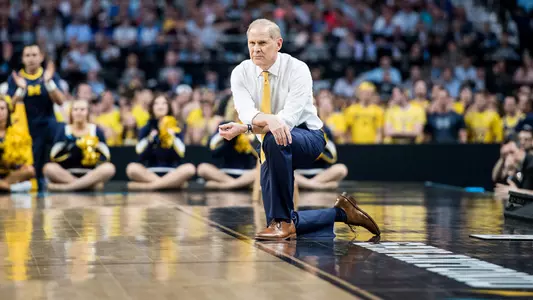
Looking Back at What Made Beilein Special, Why He Was So Successful at Michigan
5/15/2019 10:42:00 AM | Men's Basketball, Features
By Steve Kornacki
ANN ARBOR, Mich. -- His Wolverines had beaten Michigan State one day and Purdue the next day in convincing fashion. Madison Square Garden had rocked with University of Michigan basketball fans rejoicing in winning the 2018 Big Ten Tournament, but in a postgame locker room in the storied arena, John Beilein was a quiet, solitary figure sitting there in a folding chair while reading out of a small journal.
I had stopped in to pick up my laptop bag before boarding the team bus for the charter flight back to Michigan. And I was struck by the focus Beilein had in such a celebratory time, wearing a trench coat, ready to leave when the last call to board came, maximizing every second of his time.
Beilein looked up and smiled when I entered, and I asked if he was reading a devotional of some sort, apologizing if it was too personal to discuss. He chuckled and said, "Not at all."
So, I asked the coach for some specifics.
"I have a list of things I'm thankful for," Beilein said. "I'm going down the line and thanking God, sincerely, for each and every blessing in my life. It's important."
We talked a bit more, and it was time to get on that bus.

When I heard Monday (May 13) that he had been named coach of the Cleveland Cavaliers, that was the first memory that flashed into my mind. Waving nets from atop ladders after winning championships is for show, but what you do when nobody is looking is the true mark of a man, the window into his soul.
Beilein provided me unbelievable behind-the-scenes access to his teams, and what resulted was trust and friendships with him, his assistants, staff and players. Many talk the "family" line, but John walks it, and does so every second of every day. He has loyalty and love for those on his team and in his program, and when you are going through a difficult trial in life, he will console and light candles for you after Catholic mass.
His father-figure approach to building a special culture produced great men as surely as great players -- seven NBA first-rounders, including 2013 National Player of the Year Trey Burke in 12 seasons and counting -- and championships. His Wolverines won two Big Ten regular-season titles, two Big Ten Tournaments and made two Final Fours.
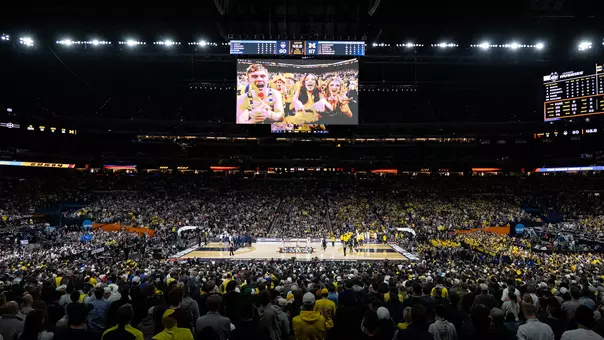
Beilein's college career ends with 829 wins, and he leaves Michigan with 278 victories, the most by any basketball coach the school has had. He took the Wolverines to nine NCAA Tournaments after inheriting a program that hadn't been invited to the "Big Dance" in nearly a decade, and reached the 2013 and 2018 NCAA championship game.
It was after that crushing loss to Villanova in the title game in San Antonio last year that the essence of Beilein shined through so clearly. Virtually every player was sobbing, crushed at coming so close to winning it all, and trying to come to grips with it. Beilein offered his captains and seniors opportunities to say something. He wasn't sure if Moritz Wagner was up to it, but he asked, and "Moe" pulled it together with a very heartfelt message, punctuated by, "I love you guys."
Few, if any, moments in 40 years of covering major college and professional teams have made a greater impression. Then it dawned on me that there actually was something more important than winning the biggest game. I realized that it wasn't what teams win that matters most, it's what they represent.
Thanks, John, for exhibiting the true meaning of sports, where you sacrifice nothing in terms of morals or ethics to grab for the highest rung.

It all goes back to the mantra Beilein drills into his players and staff: "Do the next right thing."
Life is pretty simple if you get right down to it, and he didn't try to reinvent the wheel in terms of a philosophy for winning. He just demanded dedication, teamwork and accountability both on the court and in the classroom. His players succeeded at high levels as both students and athletes.
Beilein got results because he gave the same 24/7 efforts he asked for from his team.
"He just teaches us and really cares for us," said senior guard Charles Matthews. "He shows us he cares by staying committed to give us his all. A guy like that, you love to play for."
Love is at the center of everything Beilein does.
"My dad fell in love with the man Coach Beilein was in addition to the school," said big guard Austin Hatch. "He said, 'I know this is a place where my son will be coached hard, but he'll be loved.'"
Hatch lost his father and all five members of his immediate family in two plane crashes, but he survived despite massive injuries and Beilein honored his scholarship commitment. Hatch made an unbelievable comeback, but his unbelievable talent was gone. So, he became a volunteer assistant to Beilein and his staff while obtaining his degree and meeting his wife, volleyball star Abby Cole.
Austin scored only one point, on a free throw against Coppin State in 2014, but was the one player Beilein selected as his presenter in April, when the coach was honored at the Final Four with the John Wooden "Keys to Life" Award for outstanding character and leadership on and off the court.
And Beilein, though conservative by nature, also thought outside the box.
The biggest reason the Wolverines became regular national title contenders -- only Michigan, Kentucky and Gonzaga have appeared in three consecutive Sweet 16s -- is because Beilein, a widely-acclaimed offensive genius, decided to hire Billy Donlon as a defensive coordinator three seasons ago.
Donlon's aggressive "Pit Bull" approach helped bring that first conference tourney title before he left for Northwestern for family reasons, and finding Luke Yaklich coaching at Illinois State to take the defense to even higher levels was the best example of Beilein unearthing coaching talent. Beilein didn't know Yaklich at all, but liked his application and was sold when watching a tape of Yaklich coaching the Redbirds in practice.
Beilein knows the goods when he sees the goods, and that goes for players, too.
Who else could've found Spike Albrecht and turned him into a hero in a national title game?
Who else could've taken Duncan Robinson out of a Division III (non-scholarship) program and developed him into a future NBA player who also was central in his team reaching the Final Four?
Who else could've found Wagner in Germany before any other powerhouse coach and added the finishing touches to a raw talent who inspired teammates as few in the maize and blue ever have?
So many of his stars -- first-rounders Burke, Nik Stauskas, Caris LeVert and D.J. Wilson come to mind -- were not highly recruited. They became something special inside Crisler Center, where strength and conditioning coach Jon Sanderson molded their bodies and Beilein and his staff, including Saddi Washington and DeAndre Haynes most recently, formed their games.
 Beilein and Jordan Poole
Still, he found ways to greatly impact those who didn't go off to the NBA.
Point guard Jaaron Simmons came as a graduate transfer from Ohio University and was expected to either start or be a key reserve. Yet, early in Big Ten play, he was seldom getting meaningful minutes. Beilein pulled him aside after one game and told Simmons how much he appreciated his great approach to practicing, often on the scout team, and thanked him for being a "great" teammate. The coach told him to stay with it, that his time would come.
It came against Montana, in the 2018 NCAA Tournament opener, when most of the Wolverines were clanking shots, and Simmons came off the bench to make all three of his shots and steer the team out of upset territory. Then he provided the same spark in the national semifinal win over Loyola-Chicago.
Beilein also turned adversity into opportunity, and what better example could there be than the plane crash we all survived while attempting to depart Willow Run Airport for Washington, D.C.?
Everyone was pretty rattled and we walked to an airplane hangar for warmth on a cold, breezy afternoon. There, Beilein huddled his players in an isolated corner and spoke frankly and lovingly with them. He got athletic department counselors involved at the Ann Arbor hotel where the team stayed together that night. Point guard and leader Derrick Walton Jr., who was cut opening the emergency exit door for us, was really shaken up, and rightfully so. Beilein gave them the option to play or not play further, and everyone opted to play.
We took a flight early the next morning to play Illinois, and the team suited up in practice gear because the uniforms were all stuck in the bottom of the plane. Michigan beat the Fighting Illini and somehow won four games in four days to take the championship. The winning continued with an upset of Louisville all the way to the NCAA Sweet 16, where the red-hot Walton came inches from beating eventual Final Four entrant Oregon with a three-point shot.
Beilein later said of the plane mishap: "There have been several issues in my life that have just rolled off. This one's not rolling off. As I read more accounts that you're going that fast, well, this is not a toboggan ride. We were going so fast, and I was just thinking if that airplane had ever just lifted there was no way we were going to have the power to get up in the air. So, that keeps going through my mind."
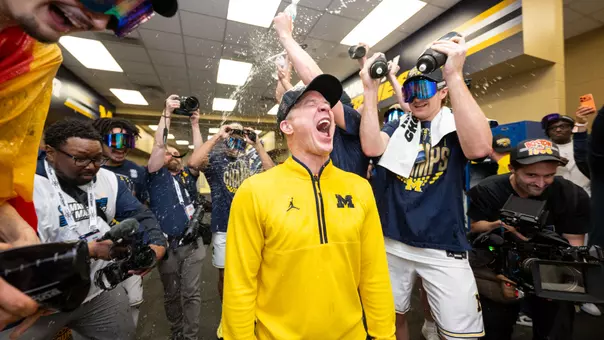
He said the whole experience impacted him in a stop-and-smell-the-roses way, and while he was never the stern taskmaster, he realized he needed to lighten up a bit. And so when his team kept dousing him with water bottles after big wins on the way to the 2018 Final Four, one night he came into the locker room on the attack with a Super Soaker, which ended up being remembered with a bobblehead.

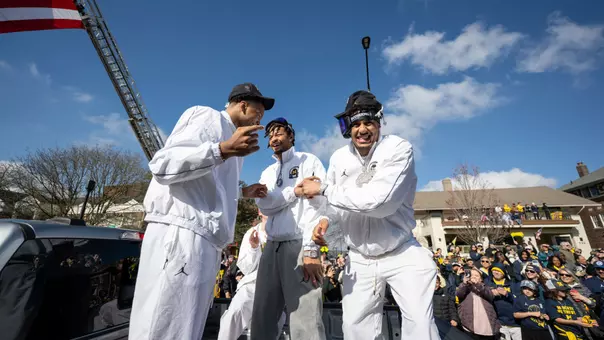
And he was dancing to a rap song with then-freshman guard Jordan Poole on the team bus back to the hotel after winning the West Regional in Los Angeles. Maybe you can't quite picture that, but it happened.
Those Wolverines were unranked in the Associated Press poll in the first week of January but made it to the NCAA championship game. Prior to that game, I asked his players how that turnaround was accomplished, and Robinson said it best, pointing directly to Beilein.
"He's everything, quite frankly," said Robinson. "Everyone's out there making plays, but everything else you have to credit to him. He's always put us in those situations to be successful and encouraged us. But on top of that, he's always pushed us and asked us to go. He does so much for us, and it falls on us to reciprocate that effort."
Beilein, 66, had another life-changer last summer, when he required triple-bypass heart surgery not long after withdrawing himself from consideration for the Detroit Pistons' head coaching opening. He followed doctor's orders, had his wife, Kathleen, take him to rehab religiously, and was still at less than full strength by the time the season rolled around. However, when Big Ten play began, he was his old self once again.
And now, one year later, he's decided he needs a new challenge.
It surprised me as it did most. I couldn't figure out why a man so interested in molding men would leave Michigan for the pros, where the bottom line is quite simply winning. Perhaps he'd tired of losing players to the NBA after one or two years and decided to join them.
But then I thought of Gregg Popovich, who has won five NBA titles with the San Antonio Spurs, and has done so by creating a college-like bond between and with his players, demanding high character as well as high talent.
I'm sure that's the approach Beilein will take in Cleveland, and we have to wish him the very best, even if so many of us wish he'd stayed.
Beilein won everything but the national championship at Michigan, and when I asked him on the eve of the title game last year how important winning one would be to his coaching legacy, he said:
"I honestly say I wouldn't look at it any differently. I really would not. Others may. But I don't think Kathleen and I would look at it any different. ... You hang in there and you just do your absolute best every single day. And some day you're going to say, 'I gave it everything I had, and I'm falling into my grave.' And that's OK, too.
"But you just do everything you can to be the best coach, the best mentor, the best teacher, the best husband, the grandfather, father, every day, and you go do it again. And that's all I want to be."
You do the next right thing.
You thank God daily for your blessings.
You make a difference in so many lives.