Eiler, Roy Discuss Support of Champions Challenge Funding Mental Health Counseling
10/1/2020 11:00:00 AM | General, Features
By Steve Kornacki
ANN ARBOR, Mich. -- There have been so many issues and emotions to sort out for the University of Michigan's 900-plus student-athletes dating back to March 12 -- when the NCAA canceled postseason play for winter sports amid the coronavirus pandemic -- and continued with the Big Ten's postponement of the fall sports schedule earlier this month.
Athletic, academic and personal concerns have been very real and quite constant.
Abigail Eiler, the Wolverines' director of athletic counseling, and her staff of six realized a quick and ongoing spike in the need for their services.
"We've had 2,500 face-to-face, video or phone counseling sessions from the beginning of COVID(-19) to the beginning of August," Eiler said of the five-month period. "That's significantly higher than over that same time period last year -- the end of winter term through the spring-summer term. It's about 30-percent higher."
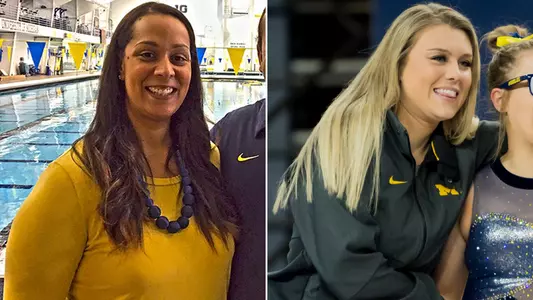
Eiler, a former Wolverine water polo player, replaced long-time director Greg Harden during this hectic and trying time. Harden, a guru to many of the program's greatest student-athletes such as Tom Brady and Desmond Howard, retired in June. Eiler thrived on Harden's staff, and now runs the program.
"The staff is always changing," said Eiler, who also serves as a counselor. "But right now, I have one MSW (Master's In Social Work) intern. I have one MSW fellow. I have three counselors and one coordinator who also acts as a counselor.
"The counselors are not sport-specific. They are assigned based off of student-athlete preference, as well as best fit for whatever their problem is."

She said efforts such as the Champions Fund -- which raises much-needed financial support for mental health counseling as well as nutrition, athletic medicine, strength and conditioning, international travel, leadership development and career preparation -- are critical.
That fundraising campaign benefiting all 31 intercollegiate teams offered by the Wolverines kicked off its Champions Challenge on Sept. 22 with the goal to acquire 4,500 unique donors.
"We supply a range of services -- from those looking to optimize performances to those that are struggling with pretty severe and significant mental health-related concerns and disorders and everything in between," said Eiler. "We deal with things the individuals and the teams are going through. We're responsive to the needs of the ones we're working with.
"Things that we've done over the last several years -- but specifically during COVID and during this uncertain time -- are flexibility and service-related issues that we have to navigate through so that we can be available to our student-athletes 24 hours a day."
Eiler was asked if athletic donor contributions have been central to all they offer.
"Absolutely," she said. "We have an endowed fellowship family, the Ehrenberg family from New York, that has allowed us to reach more student-athletes and reduce the amount of wait time for those seeking care and services. It has afforded us opportunities to create and enhance the education support that we provide, serving both our staff and our coaches."
Eiler said there are numerous student-athlete advocates for athletic counseling services, including recent graduates Samantha Roy (women's gymnastics competitor and student coach) and Sydney Wetterstrom (women's volleyball), who served as student-athlete liaisons for the Student-Athlete Advisory Committee (SAAC).
Roy, who competed on Michigan's Big Ten championship teams in 2017 and 2018 and was Academic All-Big Ten, earned a bachelor's degree with a neuroscience major and hopes to eventually attend medical school or enroll in a physician assistant program.
"Your mental is just as important as your physical side," said Roy, now working in a doctor's office in the Detroit suburb of Clinton Township. "In my journey, I needed to take a step for my mental well-being. Syd and I were the mental health co-chairs for SAAC and now we advocate for mental health and getting people to go and seek help.
"In the beginning, going to counseling was tough for me. I didn't like it at first. But it actually made me stronger. You can still have good and bad days with counseling, but in the long run it has only benefited me."

Maggie O'Hara (left), Roy
Eiler and other mental health counselors attended all team meetings held by head coaches to announce the winter sports conference and national championships cancellations in March, and she will never forget them. She recalled the "sadness" and the "stages of grief and denial" that come with traumatic life events.
"The women's gymnastics team broke two records this year for their season (highest team scoring average, 197.128, and vault, 49.32)," said Eiler, "and were on the way to do big things at the NCAA (Championships as the No. 5-ranked team nationally). In speaking with the teams, that was the time when there were tears in my eyes. They're done.
"For all of them, there was this shock and disbelief in what was happening. The connection, support and compassion that they had for each other was really powerful. And, over the next three days, they went from being extremely happy and upbeat to wanting to do anything they could to change this situation to eventual acceptance. 'This is going to be OK. We don't like this; we're not happy about this. But we're going to be OK.' Their resiliency shines through really quick even though it was a pretty significant loss for all of them."
Roy noted: "We had a chance to win a national championship and were so cohesive as a family. We put everything out on the floor, and then our season was over. We struggled with that mentally. We all cried. You don't really know how to react to going through a global pandemic, not just to a season being over. We were sad, frustrated, angry."
The mental health counseling staff was there for hundreds of them through every twist and turn -- which included the majority of student-athletes returning home to different states and countries.
"We went from a transitioning of dealing with everything that had suddenly happened -- the shock of losing school and sports -- and then we started to see more of a transition to 'How do I stay motivated? How do I stay connected? And how do I continue to navigate through all the uncertainties that have been prolonged,' said Eiler. "Supporting our athletes through all of that has been our focus in the past two-and-a-half to three months.
"We do our best. Student-athletes definitely drive the ship, and we're there to help them along the way. They shifted from crisis management into more supportive therapy. And they were also working toward the treatment goals they had previously identified. There were some barriers to providing care outside of the state of Michigan because of licensure laws, but those became much more heavily weighted in doing check-ins and linking people to any care and services they might need locally for themselves."
Counseling sessions generally last from 45 minutes to one hour.
Eiler and her staff also provide learning sessions such as the webinar presented March 30 that tied into more than the usual transition that graduating student-athletes realize. It was titled "Managing My Mental Health After Collegiate Athletics."
"A significant number participated in that," said Eiler, "and it was not just those graduating, but also those continuing. It was put on by myself and Caroline Mandel (the Michigan athletic department's director of performance nutrition). It was really well received and we got great questions about how to take those next steps."
They also had Zoom sessions during recent months focusing on student unity to discuss the racial-justice issues that have been prominent.
"It's about how to be supportive and education to change policies and practices, not just at our universities but across the country," said Eiler, who also was recently named Michigan's Chief Diversity, Equity and Inclusion (DEI) Officer for the Athletic Department and is one of the Wolverines on the Big Ten's Anti-Hate and Anti-Racism Coalition. "Our student-athletes are really excited about creating a space that is more inclusive and more equitable. They are very interested in furthering education on racial and social issues. They know they have the power and potential to do so. They are charging forward like they do in sports."

Eiler
Fall classes began Aug. 31 in Ann Arbor with a mix of classroom and virtual learning.
"We will continue seeing a percentage of our student-athletes face to face based off of needs and requests," said Eiler. "Then we will also continue with our virtual appointments depending on where someone is and what they prefer and what has been agreed upon with the (counseling) provider."
Counseling virtually as opposed to in person poses "challenges."
"The providers and student-athletes are still able to connect virtually," said Eiler. "It is different, though, and comes with its own challenges. When we are face to face, we are able to read (eye contact) and body language in a way that is different, and sometimes not even possible through virtual sessions. Also, being in the same shared physical space is how we're also all trained.
"So, we took different trainings and read different articles about how we were to ensure driving the best care possible virtually to our student-athletes. And, again, that goes back to their preference. Do they want to be in the same area, working with their provider? So, we want to honor that and still follow the CDC (Centers for Disease Control and Prevention) guidelines."
And while the initial counseling focus was the loss of winter season championship play and the canceling of the majority of spring seasons, it has now moved on to the postponement of fall athletics (football now will play a fall schedule).
"A lot of our fall athletes knew that there was uncertainty about the approaching season," said Eiler. "However, they were still really hopeful they'd still be able to participate in sports. When the fall got postponed to spring, some of them were extremely bummed.
"We had some that have come back with the intention of graduating in December and are now challenged to make decisions on when they can take their degrees and asking, 'What is the next step for me?' So, helping them sort through that has been one of our primary goals along with grappling with the ambiguity of not knowing what's next. There still is a lot of uncertainty."
And that's where counseling helps piece together the "puzzle" for student-athletes.
"This is a great time for people to explore counseling," said Roy. "I was in quarantine for three months but could reach out to friends and counseling on Zoom calls. Now, kids are still going through having their sports seasons canceled or postponed to the spring. I really have to give a shout-out to Abby Eiler because each time I went in there, I was really able to speak my mind and show my emotions where I wasn't being judged.
"If you have a 50-piece puzzle, and you leave out 25 pieces, you can't put the whole puzzle together. Why not give all 50 pieces and make that perfect puzzle? If you're missing the mental, physical or emotional, you are not complete. It's like my dad says, 'If you have those three things, you will have a stable structure.'"
Funding mental health counseling through the Champions Fund helps make such life-strengthening services possible.
"Why not support one another?" asked Roy. "That's the whole thing at Michigan. People ask me about what I take away from Michigan, and I say, 'First of all, there's a pride in the tradition that rides behind the block M.' And what's important about going to Michigan is that you're part of a family. That family never goes away."

The Athletic Department is launching the Champions Challenge, a fundraising campaign that aims to reinforce these critical student-athlete support areas. More than 20 percent of the Michigan Athletics annual operating budget comes from private philanthropic donations.
With rising costs and the significant financial impact of the COVID-19 pandemic, the Champions Challenge campaign comes at a time when the sustainability of these programs are very much at risk. Without the support of our generous donors, Michigan Athletics would not be able to comprehensively support our more than 900 student-athletes.
To learn more about the Champions Challenge, visit MGoBlue.com/challenge.
• Wagner Credits U-M Strength and Conditioning for Successful First Season
• From the Desk of Warde Manuel: Accept the Champions Challenge