Reliving Michigan's Spiritual, Magical, Sensational Ride to the CWS Series Finals
6/12/2020 10:00:00 AM | Baseball, Features
By Steve Kornacki
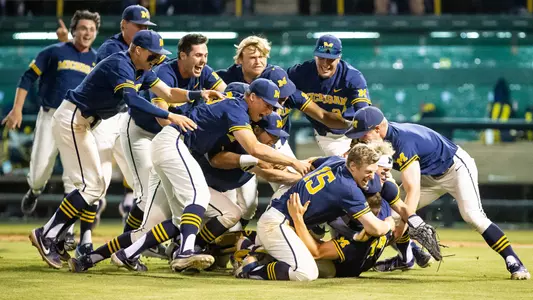
ANN ARBOR, Mich. -- The Wolverines were jumping into the most joyous dogpile of a glorious season on that cool, late-spring night in Los Angeles. Gritty shortstop Jack Blomgren, who had played with a dislocated and broken pinky finger taped to his ring finger, was the last to fly into the humanity.
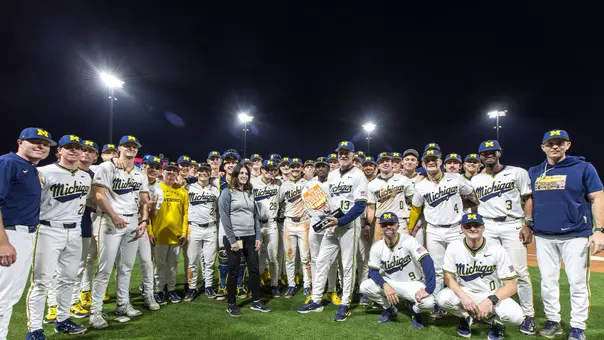
The University of Michigan was going to Omaha, and the caps the team had just received proclaimed that. The Wolverines had taken the deciding game of a best-of-three series in a nail-biter of a victory over UCLA, the No. 1-ranked team in all the land. And so Michigan was headed to the College World Series for the first time since 1984.
I can still hear the whooping and hollering and feel the hugs on the infield from that celebration, and as I stood on the grass at Jackie Robinson Stadium amid players and coaches who were crying and laughing, I thought back to two moments that had foreshadowed all of this.
The first occurred April 28 at Fisher Stadium, when Wolverine catcher Joe Donovan, who was only trying to line a single up the middle to score Jordan Brewer from second, hit a ball well over the left-field wall for a three-run, walk-off homer to defeat Rutgers. Donovan hit the ball well below the sweet spot of his bat, and still it carried out. Head coach Erik Bakich told Donovan that his older brother, Charlie, had been the 10th man on the team during his 10th-inning heroics. Bakich added that he'd been praying in the dugout and could feel the presence of the ultra-talented shortstop who died before he made it to Ann Arbor as a player.
Joe told me about all of this and more in the dugout after his teammates rushed the field to celebrate and doused him with ice water buckets. He said he wore the white bandana around his forehead in every game to remember the white ribbons neighbors tied around trees to remember Charlie, his best friend and hero. And, yes, his brother's "help" was his only explanation for not hitting a ball all that well and having it go so far.
While writing this special story in the press box that evening, I was overcome by a powerful feeling: "This team is going to do something special." I have covered college and pro teams in every major sport for 45 years, and never before had I received such a message.
A few days later, the second foreshadowing moment occurred at Fisher Stadium. I was speaking with Bakich and assistant coach Nick Schnabel about their plans to honor Keith LeClair, their coach at East Carolina, where together they starred on conference championship teams in 1999 and 2000.
LeClair inspired them to become coaches, impacted them even more importantly as people, and provided them Bibles while he began fighting amyotrophic lateral sclerosis (ALS), also known as Lou Gehrig's disease, which he was diagnosed with the year after he coached Bakich and Schnabel, and claimed him July 17, 2006.
Schnabel and Bakich both wear No. 23 to honor LeClair, and had an ALS awareness game that weekend in memory of him.
Bakich said that afternoon: "One of the last things I said to him, when his wife, Lynn, put the phone to his ear, was to reaffirm my commitment to him and the reason why I got into coaching. I told him I loved him and thanked him, and said, 'We will get to Omaha for you.' He never got there as a coach and that was always the unifying theme of our program, getting to Omaha. It was more a lifestyle than it was a destination.
"The effort we gave in trying to get there came through in everything we did. So, I told him that on behalf of all of us coaching, we're going to get there for him. That's how we wanted to continue his inspiration and continue his legacy."
Bakich put a bear hug on me near the mound at UCLA that night and told me things that mean the world to me. I shared that my youngest son, Brad, had flown in from San Francisco for the Super Regional and just informed me that I was going to be a grandfather again. Then I told Bakich about that message I'd received about his team doing "something special" after Donovan's walk-off homer. And as the players and their families began congregating near the team bus before departing that night, I pulled aside Karen and Jim Donovan to share that same story with them and smile about their two sons.
This Team 153 -- the longest-running program at Michigan -- was on a ride that was spiritual, magical and sensational. I got to hop on the bus, both literally and figuratively, and here are the moments that touched me most:
Before departing Ann Arbor, Big Ten Player of the Year Brewer told me: "You're not going to make another brotherhood like this, and now we're going to Omaha. This is going to be talked about for years after. I mean, we're going to call each other at our weddings."
That "brotherhood" carried this team, one of the last four picked as at-large entries, all the way to the last two standing, the CWS championship series with No. 2 Vanderbilt.
June 13

Kornacki poses with the Road to Omaha statue.
It was a warm, beautiful evening in Omaha, Nebraska, and I walked from the downtown Marriott with the team toward TD Ameritrade Park to watch the Detroit Tigers and Kansas City Royals play two days before the College World Series began.
There was a tree-lined, winding sidewalk leading through the stadium parking lot to the ballpark. Fans were grilling burgers and hot dogs, and they took notice of the Wolverines passing through. Many were wearing the colors of the teams we would play, but they still smiled and shouted, "GO BLUE!" They wished the players and coaches well, and commended them on a great season.
There is a spirit you feel at Omaha that you don't get at the Final Four or big bowl games. This is a celebration of the sport as much as anything.
Before entering the stadium, I walked over to the "Road to Omaha" statue of players celebrating and had someone take my photo there to remember just how sweet that road was.
June 15
Practice makes perfect. You hear that all the time, and the "Two-Strike Battle" was the key to the Wolverines taking the first game from Texas Tech.
Jimmy Kerr was down in the count, 0-2, with two out and a pair of runners aboard in the third inning. But he choked up and lined a triple to score two runs before Blake Nelson scored him with a single in what would be a 5-3 victory with Karl Kauffmann shining on the mound.
Bakich has the Wolverines partake in one-hour scrimmages where every at-bat begins with a 0-2 count and Bakich throwing to them from 50-feet away, turning his fastballs into 100 mph darts. Kerr learned how to "battle" from behind in that drill.
The story behind the story is always the best.
June 17
Tommy Henry turned in a masterpiece, beating Florida State, 2-0, with a three-hit shutout. He struck out 10 and didn't allow a walk. Michigan center fielder Jesse Franklin drove the game's second pitch from CJ Van Eyk high and deep for an electrifying solo shot, and the only run Henry would require to win.
One year earlier, Franklin explained after a game why he shunned Pac-12 teams and did not accept a handsome signing bonus from his hometown Seattle Mariners to come to Michigan.
"I always wanted to go to college and that's why going professional wasn't that great of a temptation to me," said Franklin, who aspires to become a lawyer. "I wanted to play in college and really wanted to go to Omaha and experience that."
Now, feet planted firmly in the batter's box and outfield grass in Omaha, Franklin told me: "It's definitely a dream come true. It's still hard to believe that we're here, and that (we're winning). But, after we won at UCLA, the first thing that Karl (Kauffmann) said when he came running up to me was, 'You always said you wanted to go to Omaha! We're going to Omaha!'"
Franklin said other teammates also talked of the dream of Omaha, but I don't recall another Wolverine sharing that inner desire publicly.
He was willing to talk about Omaha when it seemed a million miles away from Ann Arbor.


Before the next game, I sat in the hotel lobby and spoke separately with Blomgren and second baseman Ako Thomas, the middle-of-the-infield players who had been in the middle of everything for this team. They were gritty, played hurt, made plays, got timely hits and got their uniforms dirty -- real dirty.
"We're willing to do anything to get our uniforms dirty," emphasized Thomas.
I was fortunate to get close to both of these guys, and talking with them has always been special. Blomgren (whose nine hits led all CWS players) had begun horsing around with me in the clubhouse after practices, proclaiming how they were going to win the next game. Thomas and I happened to be going down the elevator together after the last of 16 nights we had all spent on the same floor of the Marriott, and our exchange before boarding the bus to the airport was special.
But there was more ball to play now ...
June 21
Kerr became the first Wolverine to hit two homers in one CWS game and equaled the school record of four hits in one game in Omaha in a 15-3 trouncing of Texas Tech, with Kauffmann winning once again.
Michigan was headed to the championship series with Vanderbilt and was the talk of college baseball, with Kerr being the player everyone was talking about most. He had gone from a dismal junior season to leading his team in homers (17) and RBI (64) over this season. He credited offseason work with strength and conditioning coach Jason Cole, and became so good that the Detroit Tigers drafted him.
But as good of a story as he was all alone, he was even better where a family's tale could be told.

Three generations of Kerrs at the College World Series (from left): John, Jimmy and Derek
John Kerr helped pitch the Wolverines to the 1962 NCAA baseball championship. His son, Derek, was a catcher on Michigan's last two College World Series teams in 1983 and 1984. Jimmy, the grandson and son, was the slugging first baseman and captain of this Omaha entry. They are believed to be the only three-generation CWS family.
I cherish the friendship developed with the Kerrs over Jimmy's playing career, and I'll never forget bumping into Derek and his wife, Carolyn, the next morning while we had breakfast at the hotel.
They were answering congratulatory texts about their son when Derek looked up, absolutely beaming, and said, "This is unbelievable. Let's never wake up."
There were two days off before the start of the championship series, and on one of those nights Bakich invited me and other staff members to the team dinner at the best steakhouse in Omaha. We all ate way too much and told stories, shared our lives and grinned the way you grin when things are going this good with people you love.
June 24
Before Henry faced the Commodores in the best-of-three series opener, we had a long talk at the hotel after he had finished a podcast with Kauffmann and Jeff Criswell, the other dynamite starter on the team who was now working out of the bullpen.
Henry talked about the photo he'd seen of his 90-year-old "Grandma Couzens" in a California nursing home cheering him on during the win over Florida State, and he shed some tears of joy.
He later addressed pitching and failing for the Yarmouth-Dennis Red Sox in the ultra-competitive Cape Cod Baseball League after his freshman year, when he was 3-1 with a 3.19 ERA but didn't earn a start for the Wolverines.
It was a topic prompted when Henry was asked what makes him tick.
"I think it's a combination of doubt and adversity," said Henry. "I was really struggling and having some long nights (in Massachusetts). You look in the mirror and ask, 'How much do I love this?' I thought of the young kid who dreamed this from when he was 2 years old and would stand out in his driveway and throw the tennis ball against the bricks for hours on end."
He paused and his eyes welled up again.
"I'm getting emotional right now," Henry said. "But I think of those things that are hard to put into words. It's the experience of that, when from such a young age you want to be so good at this game and have success.
"And it's hard. It's a game of failure, but you just stick to it because you love it so much."
Wow.
I was blown away. His love of the game, his teammates and family is both powerful and moving.
Then he went out and beat Vanderbilt.
Henry allowed three earned runs over 8.1 innings and struck out eight against a team with seven MLB Draft picks. Michigan won, 7-4, as Kerr hit a two-run homer on, you guessed it, a 0-2 count.
John Kerr and Dick Honig, the shortstop on that '62 national championship team, spoke to the Wolverines before this game.
"It gave me chills when they walked into the room," said Henry. "It was awesome. We look up to those guys, and those are the shoulders that we stand on. They laid the foundation for Michigan baseball. They've had the success, and to just get a little insight from guys who have done it, who have the rings, was awesome. For them to lend their time was special for all of us."
Jimmy shook his head and smiled when asked about Grandpa.
"That was the most I've ever heard my grandpa speak," said Jimmy, "and it was great. I loved every second of it. To hear him talk about his team was special."

Henry
Henry (12-5) now shared the school single-season wins record with teammate Kauffmann and Rich Stoll (1982 and 1983), and had a 1.56 ERA after 17.1 innings that produced 18 strikeouts with only one walk on 10 hits in the CWS.
"Another gutsy performance by Tommy Henry," said Bakich. "Just the thing about his last three outings, for him to finish his Michigan career tonight, the way he pitched and to know that he's emptied the tank for three straight years and poured his heart and soul into our program, and we wouldn't be here without him, and to pitch with the flu and pneumonia in Los Angeles (against UCLA), to do what he did against Florida State (a shutout), to pitch into the ninth inning tonight, just an incredible performance."
When Henry came out, having thrown 110 pitches, Kerr pounded his glove so loudly that Henry could hear it. Then he was greeted outside the dugout by two rows of appreciative teammates and Maize and Blue fans, chanting, "TOMMY! TOMMY! TOMMY!"
"I don't know what the words are for something like that," said Henry. "I mean, to hear our families, and everyone with a Block M on their chests here, who made the trip to Omaha to come supports us, and cheering for us, throughout the entire game was special.
"That's something I'll remember forever."
During the run to the championship series, Bakich was named National Collegiate Baseball Writers Association National Coach of the year. He led the Wolverines to a 50-22 record when it was all over, taking them closer to a national championship than they had been in 57 years.
I asked every starter and the top two pitchers why Bakich was the best college baseball coach in the country.
Henry said, "One night I had to go back to the stadium to pick up something I'd forgotten, and Coach's truck was still there. He was there that late, alone, getting ready to get us ready the next day. I saw him the next day (smiling) and said, 'Coach, go home to your family!' But he's a great family man, too."
Third baseman Nelson, from Normandy Park, Washington, noted: "Coach emphasizes that we're all family, but he doesn't just say it. He does it. If you aren't going home for a holiday, he sends you to his house or the house of one of the coaches. I've spent the last two Thanksgivings with the Bakich family. It means so much. We really are family."
During the winter, Erik and his wonderful wife, Jiffy, invited the entire team and everyone connected to their home on Ann Arbor's far west side. The food was unbelievable and we all had such a great time getting caught up.
Having a coaching staff that shares his vision of family and team as one makes it all work. Chris Fetter, the pitching coach, is one part older brother and one part genius on everything connected to the craft. He has the players' undivided attention and trust, and my getting to know his parents at the team hotel made it very clear where his people skills come from.
June 26
Michigan lost for the second consecutive night, and had to wait in and around their dugout for a long championship trophy presentation to the Commodores. Everyone was crying, some hard and some softly. They'd given so much, come so far, and come up one win short.
Wolverine first base coach Michael Brdar, a volunteer and former Michigan shortstop who did so much for so many players, sat in the dugout, eyes red. I'd watched countless players approach him and hug him long and hard. Then I sat next to Brdar, who has gone onto work for the San Francisco Giants organization, and told him that the impact he'd had on them all was so evident from the love they showed him. We had a good talk and at the end of it, we were smiling.
The Wolverines were hugging one another on the grass in front of their dugout at TD Ameritrade Park. Then something pretty stirring happened. The thousands of Michigan fans who had come to back their team at the College World Series packed into a few sections behind the dugout and began chanting:
"It's GREAT to be a MICHIGAN WOLVERINE!"

Michigan fans gather to show their appreciation for Team 153 after Game 3 against Vanderbilt.
Their heroes in cleats with dirt-stained white pants and sweat-soaked blue jerseys and caps, stopped in their tracks. The players turned to wave and acknowledge that touching gesture, and it became a love fest for a team that was so easy to love.
Michigan won't be putting the gold NCAA championship trophy in the case back home at Fisher Stadium, but it did put the program back on the national map while stirring the imaginations of its fans and many in the Midwest who came to follow the first Big Ten team to reach the title game since 1966.
I thought of something designated hitter Jordan Nwogu said at the beginning of our trip, when we boarded a charter flight in the Hawaiian shirts Bakich prefers: "After beating UCLA at their home, Coach Bakich told us, 'You can beat anybody, win anything.'"
Michigan ended up going 3-3 against No. 1 UCLA (2-1) and No. 2 Vanderbilt (1-2), with Henry beating both of those powerhouse MLB factory teams.
I'll always remember not only the passion Tommy brought to the mound, but the example he set for his teammates. On that last night, with the Wolverines trailing in a game they would lose, 8-2, Henry did something he always did when not starting. He led the players not in the game out of the dugout to sprint to the outfield wall between innings. Henry was the first to the wall, and the first back to the dugout.
The captain, along with Kerr and reliever Benjamin Keizer, was a leader to the end. He could've curled up in a dugout corner and gazed into the night, said nothing. But instead, Henry did something for himself and his teammates. He always talked about "playing for the eight letters on our chest" and said he might just sleep in his jersey that night. He didn't want to take it off for the final time.
And that is what I will remember most about Henry and Team 153. They continually spoke about winning to play another game together, and they meant it. Really, there is nothing more beautiful in sports than that.