Bearing Witness: Michigan Student-Athletes Carry Lesson of USC Shoah Foundation Beyond Athletics
8/21/2026 10:00:00 AM | Field Hockey, General, Women's Cross Country, Women's Gymnastics, Women's Track & Field
As Sophie Parenti walked through Auschwitz-Birkenau, she began counting her steps.
The University of Michigan women's gymnast was trying to make sense of what happened on the ground beneath her feet. She also wanted to find a way to honor the people whose lives were taken there.
So, in her mind, each step became one person.
Over roughly five hours, Parenti estimated she took about 10,000.
"And that's just 10,000 people," she said.
It was a simple exercise, but one that helped her begin to understand a scale that otherwise felt impossible to comprehend. Standing at the former concentration and extermination camp turned history into something immediate and deeply personal.
"You get there and you feel the weight," Parenti said. "We step off the bus, and you feel the weight of that place immediately."
She left still trying to process everything she had seen and felt. But she also left with a question.
"What can I do with this now?"
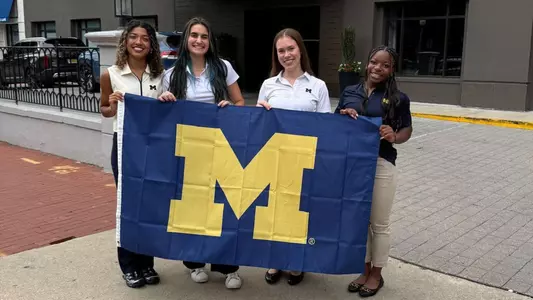
That question followed Parenti and her fellow Wolverines throughout Michigan's first time participating in the USC Shoah Foundation Student-Athlete Global Leadership Program. The experience brought four Michigan student-athletes together with student-athletes from USC and UCLA for time in Washington, D.C., and Krakow, Poland.
For Parenti, women's gymnastics teammate Jahzara Ranger and track and field and cross country student-athlete Penelopea Gordon, the experience became about much more than learning the history of the Holocaust and antisemitism.

Through museums, workshops, conversations, historical sites and personal testimony, they found themselves thinking about their own identities, listening to perspectives different from their own and reconsidering what leadership can look like beyond competition.
Brian Townsend, director of Michigan Athletics' Leadership Development Program, accompanied the Wolverines on their journey. He hoped the experience would help the student-athletes develop a global perspective while recognizing the responsibility that can come with being a leader.
Townsend said he wanted the participants to become "agents of change in the face of hate" and return to Michigan willing to share what they had witnessed.
"We don't need them to save the world," Townsend said. "We just need them to be a role model when they see hate being displayed in their sphere and in their communities."
Building Trust Before Confronting History
The experience began in Washington, D.C., where participants attended workshops, heard from speakers and visited museums. The group also visited the United States Holocaust Memorial Museum and heard testimony from Holocaust survivor Irene Weiss.
Before some of those conversations could happen, though, the student-athletes first had to become comfortable having them with one another.
One of their earliest exercises asked participants to consider different parts of their identities, including race, gender, sexuality, physical appearance and religion. They reflected on which parts of themselves made them feel empowered and which made them feel vulnerable.
For Ranger, something changed within the group almost immediately.
"We were able to be vulnerable with each other, and we were in a space where we could just trust each other," Ranger said. "We all really got connected that way, even though we didn't know each other five minutes prior."
Parenti felt it, too. And as that trust grew, she said, so did the depth of their conversations.
Townsend watched the same thing happen. He was struck by the willingness of student-athletes from all three universities to participate in conversations that could be uncomfortable, even when they did not have all the answers.
For Townsend, that willingness was part of the lesson.
"I won't say tough conversations, I'll say courageous conversations," Townsend said. "Because you have to be courageous to talk about these atrocities."

From Learning to Witnessing
What the student-athletes learned in Washington took on a different meaning when the group traveled to Poland.
In Krakow, participants explored Jewish history through walking tours, visited a synagogue and spent time at the Jewish Community Center of Krakow.
Then came Auschwitz-Birkenau.
Ranger remembers being struck by the reality that she could walk into a place where so many others had been taken and then simply walk back out.
"You get to walk through it. You get to go in and leave," Ranger said. "We became witnesses, whether we wanted to or not."
For her, being a witness meant carrying something away from the experience.
"We bore witness, and we can say it is real and it happened," she said. "We have something to fight for. We have people to stand up for."
Gordon also left Auschwitz with thoughts that continued to unfold after the visit itself.
She had expected the emotions to come immediately. Instead, much of what she felt surfaced later, once she had time to sit with what she had seen. As she walked through the site, she found herself wondering about the people who had once been there and the small pieces of humanity they might have held onto in unimaginable circumstances.
The group's earlier conversation with Weiss stayed with the student-athletes as well.
For Gordon, hearing a Holocaust survivor tell her own story reinforced why that history must continue to be remembered. Ranger and Parenti were similarly struck by Weiss' willingness to revisit painful memories so another generation could hear them firsthand.
By the time the Wolverines left Poland, the idea of being a witness had taken on a different meaning.
Parenti described becoming what the group called a "second witness," someone who carries awareness forward, shares the truth and is willing to stand up for what is right.
"I used to not really have that confidence," she said of entering difficult conversations. "But now it's like, you know what? No, I have to stand on what I believe."

Leadership Beyond Competition
Back in Ann Arbor, those lessons did not simply stay behind in Washington, D.C., or Poland.
For Gordon, the experience changed how she thinks about leadership. It became less about having all the answers and more about being willing to listen.
She describes a leader as "someone who wants to learn more about others, to advocate for them" and someone capable of seeing perspectives beyond their own.
It also made her think differently about the platform she already has as a Michigan student-athlete.
"I feel like we need to be better as young student-athletes to use our platforms to advocate for injustices and be social leaders," Gordon said.
Her hope for future Wolverines who participate in the program is straightforward. She wants them to understand "that they have a voice and it's important to use it."
Parenti came home thinking about her role as a student-athlete differently, too.
There is always another competition, another academic goal or another decision about what comes next. Those things matter. But the experience reminded her that they are only part of who she is.
"This really gave us something to fight for outside of all of that," Parenti said. "We're student-athletes, but we're also just people that are navigating society and trying to find ways to make a difference."
Making that difference does not have to start with something enormous.
"Nothing I do has to be huge or on this grand scale," Parenti said. "But every day, I can do something that will make a difference and that will make my community better."
Townsend could see that growth happening during the trip.
As the days passed, he watched the student-athletes become more comfortable contributing to difficult conversations, asking questions and offering their own perspectives.
That growth is part of why he believes an experience like this belongs within athletics.
"Any athlete that's competing at the University of Michigan has a platform," Townsend said. "At the end of the day, the athlete is inside the person."
Carrying It Forward
Returning to Ann Arbor did not give the Wolverines a neat answer for what they should do next.
Instead, it left them with choices.
Parenti began thinking about leadership as something that goes beyond helping her teammates become better athletes or gymnasts. It also means helping the people around her become willing to stand up for something outside of sports.
Townsend hopes the student-athletes continue to reject hatred in their own lives, influence others to do the same and seek out communities where differences are valued.
For Gordon, the lesson is rooted in something simple: pay attention to what is happening around you and be willing to act when something is wrong.
The experience left her feeling connected to something larger than athletics and more aware of what it means to stand by while someone else faces injustice.
"If you're a bystander, then you're not doing enough," Gordon said. "You need to stand up and advocate for things you see that are wrong right in front of you."
For Parenti, that responsibility still leads back to the steps she counted at Auschwitz-Birkenau.
She arrived trying to understand a piece of history that was difficult to comprehend. She left knowing she would continue processing it long after the trip ended.
And with one question still in mind: "What do I do with this now?"
For Parenti and the other Wolverines who returned to Michigan, answering it is part of what comes next.