University of Michigan Football Head Coaches Biographies
3/14/2005 12:00:00 AM | Football
University of Michigan Football
Head Coaches Biographies
(Through 2004 Season)
Mike Murphy and Frank Crawford
1891 (4-5-0 overall)
In 1891, Murphy and Crawford became the first official football coaches in the history of the University. Prior to their appointment, the Michigan football program operated for 11 seasons without a coach. An experienced and popular trainer for the Detroit Athletic Club, Murphy was named the actual head coach of the 1891 team. However, midway through the season, Crawford was established as co-coach, doing most of the coaching while Murphy settled into the more appropriate role as the squad's trainer. A graduate student from Yale, Crawford learned football while attending school in the East. Crawford's efforts in contacting other institutions about the possibilities of competing on the gridiron led to the first advance schedule in Michigan history. Prior to this, the school's games were somewhat sudden and occurred with little or no planning.
After his stint at Michigan, Crawford went on to coach the University of Nebraska to a 9-4-1 overall record in 1893 and 1894, and led the University of Texas to a perfect 5-0 record in 1895.
Frank E. Barbour
1892-93 (14-8-0 overall)
Michigan's second head coach was an 1892 graduate of Yale University, the national champions during the 1891 season. During his two seasons at the helm, he led Michigan on a then-ambitious 12 and 10 game schedule. Ward's teams scored over 60 points four times and shutout the opponent on eight occasions, including five times during the 1893 season.
William L. McCauley
1894-95 (17-2-1 overall)
Attending the University as a medical student, McCauley was named Michigan's third head coach prior to the 1894 season. In contrast to today's modern football players, McCauley's first club weighed an average of 170 pounds. In his two seasons at the helm, the Wolverines only lost two contests, falling to eastern powers Cornell and Harvard. Michigan's 12-4 victory over Cornell in 1894 marked the first time in collegiate football history that a western school defeated an established power from the east.
Before coming to Ann Arbor to continue his medical studies, McCauley graduated from Princeton in 1894 and played tackle on the Tigers' championship football team. Before his departure in November of 1896, McCauley assisted William Ward in coaching the 1896 team.
William D. Ward
1896 (9-1 Overall)
Ward led Michigan into its first season in conference play, and the Wolverines emerged with a successful 2-1 record in the league. Like his predecessor, Ward had also graduated from Princeton and came out to Michigan after receiving his diploma in 1895. During the season, Ward's team only allowed 11 points and dropped only a 7-6 game to Chicago in the season finale in the Chicago Coliseum.
Gustave H. Ferbert
1897-99 (24-3-1 overall)
Due to a move by the student-alumni advisory board (of which he was a member) to have only former students as coaches of the football team, Ferbert replaced William Ward in 1897. Ferbert was an 1897 Michigan graduate and would lead the team to its first Big Ten title in 1898.
Langdon "Biff" Lea
1900 (7-2-1 overall)
A Princeton graduate, Lea coached a successful season at Michigan in 1900, and then returned to assist his alma mater. Lea established a set of strict rules for his team at Michigan, which he posted on the wall of the gymnasium before tryouts. One such stipulation was, "The word 'Can't' is not in the football vocabulary. Any man feeling that way about any part of the game in detail is not wanted on the field and will please stay away. Only those wanted who say 'I will' with teeth together and who never stop fighting. Otherwise they go off the field."
Lea was also head coach at Princeton from 1938-42. He later went to Maine and served as head of the AFCA in 1947.
Fielding H. Yost
1901-23, 1925-'26 (165-29-10 overall)
In his 25 years as head coach of the Wolverines, Yost's accomplishments rank among the most legendary in collegiate football history. Beginning with his inaugural club of 1901, Yost led the Michigan football program on an unprecedented victory run over a five-year period. Known as the "Point-a-Minute" teams, those Yost-led squads played 56 consecutive games without a loss from 1901-05, including winning streaks of 29 and 26 games, which remain today as the longest in school history. In those five seasons, the Wolverines outscored their opponents 2,821 to 42 -- an average Michigan victory of 50-1. In his first season of 1901, Yost led the Wolverines to a perfect 10-0 record, a Big Ten Championship, a 49-0 victory over Stanford in the first Rose Bowl game and the school's first national championship. The Wolverines went on to win the national title again in 1902, 1903 and 1904. Under Yost, the Maize and Blue won 10 Big Ten championships and 20 of his players earned All-America recognition.
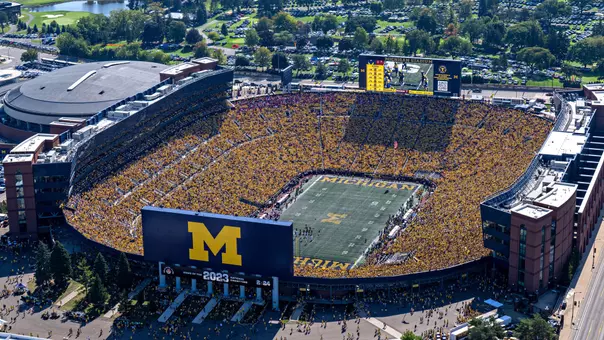
Along with his accomplishments as the head football coach, Yost served as Michigan's Director of Athletics from 1921-41. For his leadership of the athletic department, Yost is viewed by many as the consummate pioneer and visionary of the field. As athletic director, Yost continued Michigan's tradition of accepting only the highest personal, academic and athletic standards, while spreading that ideal to the facilities that support Michigan's athletic pursuits. Yost conceived and engineered today's modern athletic campus in Ann Arbor. Among the projects constructed under Yost's direction were Michigan Stadium, the university's 18-hole golf course, the nation's first Intramural Sports Building and the nation's first multi-purpose field house, now known as Yost Ice Arena.
Yost received a law degree from the University of West Virginia, yet also attended school at Ohio Northern University and Lafayette. He began his coaching career at Ohio Wesleyan University and led them to the school's only victory over Ohio State. After leaving Ohio Wesleyan, Yost held brief coaching positions at the University of Kansas and the University of Nebraska. In 1900, he continued his move to the west coast and took over as the head coach at Stanford University, where he remained for a year before Stanford enacted a rule allowing only graduates to coach its football teams.
George Little
1924 (6-2-0 overall)
After serving primarily as Yost's top assistant for two seasons, Little was named head coach for the 1924 season. In his three years at Michigan, the Wolverine football program suffered only two losses. In the 1924 campaign, Little's defensive-minded clubs shut-out their opponents in five of the six victories. Upon his arrival in Ann Arbor, he helped restore Michigan's prominence on the gridiron after three straight finishes in the Big Ten's lower tier.
Little left Michigan following his lone season as head coach to accept the Athletic Director position at the University of Wisconsin. At the time of his appointment, Little was the youngest A.D. in the Big Ten Conference. He later served as Director of Athletics at Rutgers and as the Executive Secretary of the National Football Foundation and Hall of Fame.
Little graduated from Ohio Wesleyan University in 1912 and began his successful coaching career at the University of Cincinnati in 1914-15. He then moved to Miami University in Oxford, Ohio, where he guided the Redskins to their first conference title in 1916. Little served in World War I in 1917-18 before returning to Miami in 1920-22.
Elton E. "Tad" Wieman
1927-28 (9-6-1 overall)
Considered one of the top offensive line coaches in the nation, Wieman succeeded Fielding H. Yost as Michigan's head man in 1927. In Wieman's first four games, the Wolverines won by an amazing 89-0 margin. Upon being appointed head coach, Wieman incorporated many of his own techniques into a system he fundamentally held over from the Yost years.
Known for his quiet, yet strong demeanor, Wieman came to Ann Arbor from Los Angeles to join the Michigan football team in 1916. He starred at a variety of positions, particularly tackle and fullback, and received all-conference recognition at each position. In addition to his accolades on the field, Wieman also earned Phi Beta Kappa honors for his achievement in the classroom.
Harry G. Kipke
1929-37 (46-26-4 overall)
In a four-year span between 1930 and 1933, Kipke's teams experienced unparalleled success by winning four Big Ten and two national titles (1932 and 1933). During this stretch, the Wolverines compiled an astounding 34-1-3 record. Kipke stands as one of only three Michigan coaches ever to direct teams to four consecutive conference championships along with Fielding Yost and Bo Schembechler.
In his playing days, Kipke distinguished himself as one of the nation's greatest kickers and was named an All-American halfback by the Walter Camp Foundation. He holds the honor of being Michigan's first nine-time letterman, participating in football, basketball and baseball.
Following his graduation in 1925, Kipke became assistant football and head baseball coach at the University of Missouri, but returned to Ann Arbor the next fall to fill similar positions at Michigan. In 1928 he was named the head coach at Michigan State College (currently Michigan State University) where he remained for one season. Kipke's Spartans lost a tough 3-0 contest to Michigan in his only season in East Lansing. Kipke took over the Wolverine program in 1929 after a 3-4-1 season at Michigan State.
Herbert O. "Fritz" Crisler
1938-47 (71-16-3 overall)
In the 10 seasons Crisler was coach, Michigan's fate on the football field was in good hands. Crisler's teams consistently excelled in conference play, finishing lower than second only twice. His style of coaching was offensive-oriented, using innovative formations to pile up yardage. In 1943, the Wolverines won their first Big Ten title in 10 years with an 8-1 record. His .805 winning percentage ranks him second in school history behind only Fielding Yost (minimum 50 games coached). He climaxed his career by directing Michigan to a 49-0 rout of Southern California in the 1948 Rose Bowl. At the culmination of the 1947 season, members of the Associated Press voted the Wolverines as the mythical national champions and Crisler the National Coach of the Year.
Crisler graduated as an honor student from the University of Chicago where he played football under legendary coach Amos Alonzo Stagg. He is one of two men in Chicago history ever to earn nine letters in three sports (football, basketball, baseball).
Upon receiving his diploma in 1922, Crisler became an assistant coach to Stagg, remaining there eight years. In 1930 Crisler was named the athletic director and head football coach at the University of Minnesota, where he remained for two seasons before accepting the head coaching position at Princeton University. In his six years at Princeton, the Tigers compiled a 35-9-1 record.
Perhaps Crisler's greatest contribution to the history of Wolverine football was the implementation of the Michigan winged helmet in 1938. Initially designed to aid quarterbacks in distinguishing receivers, the winged design has become a longstanding symbol of the University.
Bennie G. Oosterbaan
1948-58 (63-33-4 overall)
One of the greatest athletes ever to wear a Michigan uniform, Oosterbaan dedicated a great part of his life to the Michigan football program. After taking over as head coach in 1948, he guided the Wolverines to a 9-0 mark, the Big Ten title and the national championship. For his efforts in that first season, Ooster-baan was named Nation-al Coach of the Year. Oosterbaan utilized the traditional single-wing and T-formations on offense to capture the Big Ten title three times. His intelligent approach to the defensive side of the ball enabled the Wolverines to lead the league in total defense in five of his 11 seasons as head coach.
During his playing days, Oosterbaan became the first player in school history to earn All-America honors three times. He won nine varsity letters at Michigan in football, basketball and baseball -- one of the few student-athletes ever to achieve this honor. Following his graduation in 1928, he turned down contracts from professional baseball and football organizations in order to join the Michigan coaching staff. Under Fritz Crisler, Oosterbaan tutored the Michigan backfield, ends, and eventually was promoted to first assistant.
Chalmers W. "Bump" Elliott
1959-68 (51-42-2 overall)
Named Michigan's 13th head coach in 1959, Elliott holds the rare distinction of both coaching and playing for Big Ten and Rose Bowl championship teams during his football career as a Wolverine. He directed the 1964 Michigan team to a 9-1 record and a Rose Bowl victory over Oregon State, 34-7. During Elliott's 10 seasons as head coach, Michigan produced five All-American performers: Bob Timberlake 1964; Bill Yearby 1964-65; Jack Clancy 1966; Rick Volk 1966; and Ron Johnson 1968.
As an All-American player at Michigan, coach Fritz Crisler called Elliott the greatest right halfback he had ever seen. In the Wolverines' national championship season of 1947, Elliott was selected as the Big Ten Most Valuable Player. He began his coaching career at Oregon State in 1948, remaining there until he was named the offensive backfield coach at Iowa in 1952. While at Iowa, he helped the Hawkeyes to the Big Ten and Rose Bowl titles in 1956. Elliott returned to Ann Arbor in 1957 to coach the Maize and Blue backfield under coach Bennie Oosterbaan.
Glenn E. "Bo" Schembechler
1969-89 (194-48-5 overall)
As the winningest head coach in Michigan football history, Schembechler's teams won or tied for an impressive 13 Big Ten championships during his 21-year tenure. Under Schembechler's guidance, Michigan's 96-10-3 regular season record through the decade of the 1970s was the nation's best. He guided 17 teams to post-season bowl games (10 Rose Bowls) and another 17 to top 10 finishes in the final wire service polls (AP and/or UPI). In his 27 years of coaching, Schembechler's teams never had a losing season. Upon stepping down after the 1989 season, Bo retired as the winningest active coach in the nation (234-65-8) and fifth on the all-time list, only behind coaching legends Paul 'Bear' Bryant, Amos Alonzo Stagg, Glen 'Pop' Warner, and Woody Hayes. In addition to his coaching responsibilities, Schembechler served as Michigan's Director of Athletics between 1988-90.
After earning his diploma from Miami University (Ohio) in 1951, Schembechler received his master's degree from Ohio State in 1952 while serving as a graduate assistant coach. He continued his coaching career with brief stints as an assistant at Presbyterian College (1954), Bowling Green (1955) and North-western (1958) before spending five seasons as an assistant at Ohio State. In 1963, Schembechler was named head coach at Miami of Ohio, a position he held until taking over the Michigan program prior to the 1969 campaign.
Gary O. Moeller
1990-94 (44-13-3 overall)
Taking over for the legendary Bo Schembechler in 1990, Moeller guided the Wolverines to four bowl victories in his five years, including a 1993 Rose Bowl triumph over Pac-10 champion Washington. Moeller's list of accolades include directing teams to three Big Ten championships, two outright Big Ten titles, five bowl appearances (1991 Gator, 1992 and 1993 Rose, 1994 Hall of Fame, and 1994 Holiday), and five straight finishes in the nation's top 20. Moeller's Wolverines set a Big Ten record by winning 19 consecutive conference games from 1990-92. By winning the Big Ten title in his first season as head coach, he joined Fielding Yost, Bennie Oosterbaan and Bo Schembechler as the only coaches to accomplish this feat in school history.
After graduating from Ohio State in 1963, Moeller began his coaching career at Bellefontaine High School in Ohio. He joined Schembechler's staff at Miami (Ohio) for the 1967 and 1968 seasons and made the move to Michigan with Bo in 1969. Moeller served as the defensive ends coach until being promoted to defensive coordinator in 1973. His Wolverine defensive units of 1974 and 1976 led the nation in scoring defense.
In 1976 Moeller took over as head coach at the University of Illinois, a position he would hold for three years before returning to Ann Arbor in 1980 as the Wolverines' quarterback coach. Moeller resumed duties as defensive coordinator from 1982-87. As his units did twice in the mid-1970s, the 1985 Michigan "D" led the nation in scoring defense. Before being named Michigan's head coach in 1990, Moeller served as the team's offensive coordinator for three seasons (1987-89).
Lloyd Carr
1995-present (95-29 overall)
Lloyd Carr compiled a 9-3 record and guided Michigan to its 42nd Big Ten title with a 7-1 conference mark in 2004. Carr completed his 10th year as Michigan's head coach in 2004 and his 25th overall season with the Wolverine program. The fourth-winningest active Division I-A coach with a .766 winning percentage, Carr has a 95-29 career record and an impressive 63-17 Big Ten Conference mark. He has guided the program to five Big Ten titles during his 10 years (1997-98-2000-03-04) and has led the Wolverines to nine consecutive Jan. 1 bowl games. Carr was named the 1997 national coach of the year after guiding the program to a perfect 12-0 record and the Associated Press national championship. He led the Wolverines to back-to-back Big Ten Conference titles (1997-98) a share of the 2000 championship and back-to-back titles in 2003-04. His teams have finished in the top 20 nationally each of his 10 years. Carr, previously a Michigan assistant coach for 15 years, began his college coaching career as a defensive backs coach at Eastern Michigan (1976-77) be-fore joining Gary Moeller's staff at Illinois in the same role (1978-79). Carr came to Michigan in 1980 as Bo Schembechler's secondary coach. Carr served as defensive coordinator (1987-94) and was assistant head coach (1990-94).