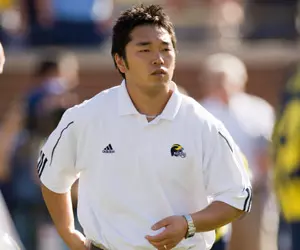
Foreign Exchange: The Kentaro Tamura Story
7/24/2009 12:00:00 AM | Football
Listen to this feature on iTunes
Kentaro Tamura graduated from Nihon University in Japan with a degree in economics in 2000 and spoke almost no English. Two years later, he had lived in Mississippi, Illinois and West Virginia and found himself working for one of the most respected strength and conditioning coaches in the country. Tamura's journey from a traditional Japanese family to Mike Barwis' den in Morgantown is full of surprises.
Kentaro visited the United States only once as a child and he remembers next to nothing about the family's trip to Los Angeles. He grew up in the city of Hadano in Kanagawa Prefecture, a part of the greater Tokyo area, a 60-minute drive from the capital. His father worked for an electric company and his mother was an elder care professional, raising Kentaro and his two younger sisters.
He played soccer as a youth, playing through high school and eventually attending the largest school in the country, Nihon University.
Kentaro doesn't mince his words; he chose Nihon because it had a soccer team. He didn't hate school, but he wanted very badly to continue playing soccer, which he did while studying for a degree in economics. Economics wasn't in his blood, but Kentaro was a practical person and he realized that graduating with a degree in economics was his best chance at landing a job. Upon graduation, Kentaro hit the job market looking for a position with a trading company or business agency, but the positions seemed boring and all he could think about was athletics. Kentaro made the decision to pursue a career in sports, specifically as a trainer, and with no certification program in Japan, the best place to do so was the United States.
Kentaro packed his bags and moved from the suburbs of Japan to Hattiesburg, Miss.
"I had two options," says Kentaro. "Go to Minnesota or go to Mississippi. I prefer warm weather."
Before he could jump into an athletic training program, Kentaro had to learn English. Tuition was the right price at the University of Southern Mississippi, so he jumped head first into a six-month intensive language course to learn English. Kentaro was a fish out of water in Hattiesburg, learning a new language in a new country in a very unique setting. He struggled with southern dialects and battled some minor discrimination as an Asian student on a predominantly black and white campus, but a small group of international students and a young Californian named Hiroko made his transition a little easier.
There were changes that took some time to adapt to, like food. In Mississippi, Kentaro says he had to drive two hours to find white rice. There were Japanese restaurants in Hattiesburg, but he didn't have money to splurge on eating out. Mississippi was also tough because he was living in a two-bedroom apartment with three other people, which, though just 80 dollars a month, meant that he shared one room with two other guys, while a third paid more to keep a room to himself.
After six long months in Hattiesburg, Kentaro was ready to move on and enroll in an athletic training program.
"My English wasn't good, but it was better than before," says Kentaro.
Once again, he moved to where the price was right: Macomb, Illinois. Kentaro enrolled at the University of Western Illinois and began a program in athletic training. Hiroko moved back to California, making the transition a little more difficult for Kentaro. The language barrier forced him to work three times as hard as most of his classmates. Kentaro would carry his well-thumbed English to Japanese dictionary at all times and in class he would struggle to write down 20 or 30 percent of the material. Sometimes he would sit in class and have no idea what was going on. Then, he would return to his room and study the textbook all day and into the night so that he could truly learn the material. At this point failure was not an option. Kentaro was borrowing more and more money from his family to pay for tuition, rent, books, food and the occasional night out and because he was an international student, he was unable to get a job to supplement his loans.
His grades were good, but Kentaro began to fall out of love with athletic training. He got bored. He got tired of taping ankles and getting ice and picking up water bottles that athletes had thrown on the ground. He was more interested in developing his athletes, rather than maintaining them. With more confidence in his English and more knowledge of the professional landscape, Kentaro began researching fields in exercise science, more specifically strength and conditioning. West Virginia showed up on the radar, once again because of its low tuition. Kentaro also learned that he would be eligible for a master's program at West Virginia if he completed a few core courses at Western Illinois and took one chemistry class at WVU. What also appealed to Kentaro was the fact that West Virginia's exercise physiology program was under the school of medicine, which would make a big difference on a resume back in Japan.
There was some hesitation. Kentaro viewed strength and conditioning as a field for big, muscular guys. He's fit, but Kentaro is no beefcake. He worried that his smaller frame would make it difficult to work with big athletes, specifically football players. He worried that explaining technique and demonstrating proper form would not be enough to earn him respect. He also had no experience with weight lifting or formal conditioning programs despite being a collegiate athlete. The Nihon soccer team lacked an athletic trainer or any formal strength and conditioning staff. His English was also still rudimentary and he didn't know what to expect in Morgantown.
Despite these hesitations, Kentaro moved to West Virginia to pursue this opportunity, knowing that he couldn't give up on his dream. Making the move with him was Hiroko. Soon after, they married.
Kentaro arrived at West Virginia in 2002 and soon learned from a classmate about internships in strength and conditioning with a man named Mike Barwis.
"My life just changed because of him," says Kentaro.
Barwis remembers the young man from Japan very clearly.
"Everywhere he went, he used to carry a notebook and a little dictionary," says Barwis. "He used to follow me and take notes in Japanese on a pad and then translate those later. It was wild. Here I was speaking in English and he's writing things down in Japanese. He could have been writing 'Mike Barwis is an idiot' for all I know."
Kentaro is more succinct about Barwis.
"He was crazy," says Kentaro. "Definitely unique."
Kentaro interned, then secured a graduate assistant position and then was hired on full time as an assistant strength coach in 2007. With a young child and another on the way, his immediate future seemed set until the Rich Rodriguez hiring at Michigan.
It could not have been easy, making the decision to pick up and move yet again, especially with a new job and a young family, but Kentaro believes in loyalty and he believes in Mike Barwis.
"As an Asian student, it is hard to get into a strength and conditioning program, but Mike Barwis gave me an opportunity," says Kentaro. "I don't think there is anyone else in the United States that is like him. I owe him. It is loyalty. He's the only guy I would work for."
The move to Ann Arbor turned out to be a happy one for the Tamuras. The city's diverse population allowed Hiroko, Kentaro and their children opportunities to interact with bustling Japanese cultures in the area, speeding their acclimation to Michigan. Apart from working with world-class athletes, Kentaro's family reaped the benefits of Ann Arbor's kid-friendly environment and welcomed little Kazushi to the family in 2008, shortly after their arrival.
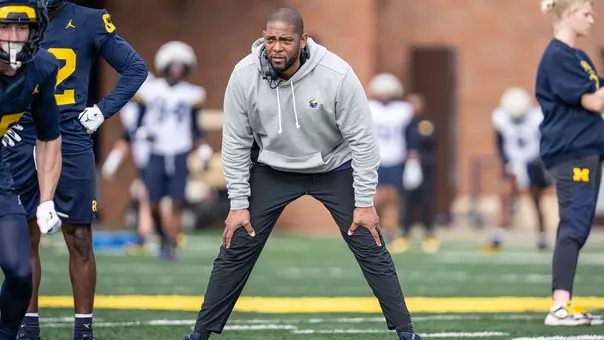
Kentaro has impressed Barwis and the Michigan football players during his time in Ann Arbor. Barwis praises Kentaro as a tremendously hard worker, very disciplined, very structured, very organized, and very knowledgeable.
"The kids love him," says Barwis.
Kentaro is enjoying his stay and his plans for the future are ambitious. He would like to take his experiences from the United States and bring them to Japan, starting a business where he can train amateur and professional athletes to help them reach their own dreams. For now, Kentaro is happy helping make Michigan better. He jokes with players on the field and in the weight room and their smiles hint at how much they like him. As for his English, Kentaro's speech and comprehension are impressive for someone speaking the language just nine years. Kentaro is self-deprecating to the end when asked which English words he still struggles with.
"Everything," he smiles.