
More Mental Than Physical for Michigan Coxswains
4/15/2016 12:00:00 AM | Rowing
April 15, 2016

By Brad Rudner
Don't tell Francesca Derteano that she isn't athletic. She might yell at you. As a junior coxswain on the University of Michigan rowing team, she does it nearly every day.
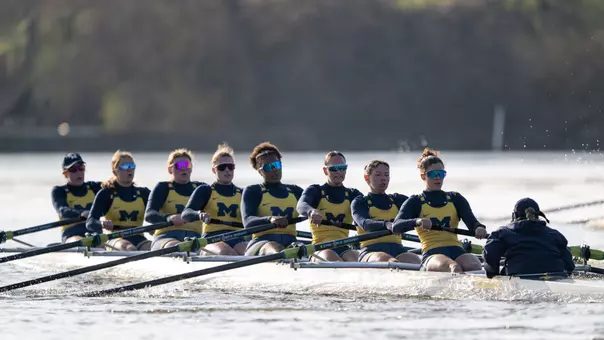
Instead of working their arms and legs as their counterparts do, Derteano and the other coxswains are trained to use their vocal cords and brains, steering the boat through whatever body of water they find themselves in and shouting commands -- sometimes pointedly, always loudly -- along the way.
But as Derteano has learned, it's not how loudly you say something, it's how you say something.
"Honestly, I've never had a rower say, 'You hurt my feelings when you said that in the boat,'" she said. "We don't yell. We motivate."
The training regiments for rowers and coxswains are different in that coxswains aren't required to do any sort of physical training. They don't have to lift weights, they don't have to run, and they don't have to erg (a rowing ergometer, or the physical act of rowing on an indoor machine).
Coxswains are typically much smaller in size than rowers -- Derteano estimates she's 50 pounds lighter and five-to-eight inches shorter than the average rower -- but they do have to maintain a minimum weight (110 lbs.). It's not exactly a physically demanding job, but she has found ways to push her body to its limits.
Two weeks ago, one day after coxing the 1V8 crew at Ohio State, Derteano and fellow coxswain Hailey Kruger raced back to Ann Arbor to run in the Ann Arbor Marathon. Derteano had been training for the event since October and finished in less than four hours.

Derteano ran the Ann Arbor Marathon along with coxswain Kruger and said of her team's support: "They motivated me without saying anything.
"I wanted to show them (teammates) that I appreciated their hard work," she said. "They motivated me without saying anything."
"At one point, Fran hit a wall, maybe 20 miles in," explained junior Kaitlin Wright. "Afterward, she said something like, 'Now I understand what you guys feel like when you're rowing.' It was cool to hear that. We were all very proud of both of them."
From Wright's perspective, coxswains are like mini-coaches because they're able to see things from a different angle. They're looked to for advice, mid-race improvements and when the going gets tough, motivation.
If you're sitting opposite a coxswain, as Wright has, you must take every element seriously. You also must have a short memory, especially when it comes to those, shall we say, harsher motivational ploys.
Being a coxswain requires a sharper mental edge. Derteano says the top two priorities for coxswains are the safety of the crew ("We have to control what happens in our boat and be aware of the boats around us.") and steering.


Derteano served as coxswain of the second varsity eight last spring. At the 2015 Big Ten Rowing Championships, the Michigan 2V8 won an individual boat title with an outstanding race in the final, holding off Ohio State for the win.


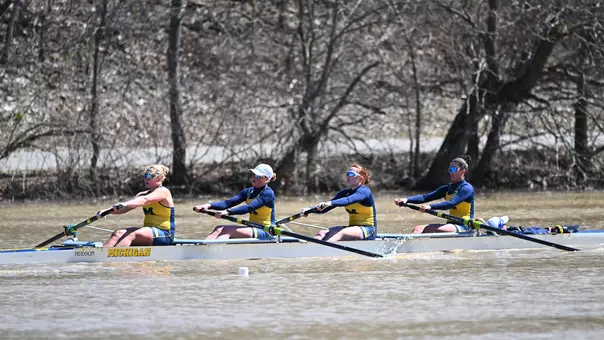
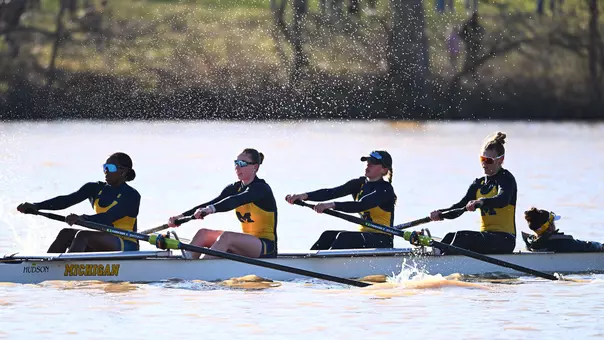
Left: Junior coxswain Derteano has to multi-task, steering the boat, while motivating the first varsity eight crew to perform at its best.
Right: Coxswains will head to the course early to scout, looking for bends and turns on the water, but also checking for weather-related elements that could affect racing conditions.
Before races, coxswains will head to the course early to scout, looking for bends and turns on the water, but also checking for weather-related elements that could affect racing conditions, especially wind speed.
Keeping the rhythm of the boat, both in practice and in racing, is also incredibly important.
"We have to be thinking all the time," she said. "The tricky part about being a coxswain is when you're trying to get a concept across and you just want to say, 'No, it's so simple! This is all you have to do!' and they don't get it. So you have to think of different ways to communicate on the move. Sometimes the way we perceive things isn't the way they perceive things. You want to try get the whole crew on the same page."
In high school, Derteano rowed, coxed and sculled (the act of rowing with two oars) on the advice of her cousin. But once she realized that she was no longer physically growing, becoming a coxswain was the only logistical choice, especially if she wanted to be on a college rowing team.
The honor of sitting at the head of the boat, as Derteano does on a daily basis, is part coaches decision, part vote. On training trips, the coaching staff will hand out coxswain evaluations to the rowers on the team. They'd ask a hypothetical question like, "If Big Tens were tomorrow, who would you put in the 1V8 and 2V8?"
In how many other sports do you find that? It would be like asking a baseball team who they'd want to pitch that day or an offensive line choosing a quarterback.
"We're the ones racing with them," Wright said. "We're the ones who have to figure out who's going to fit that boat the best. Obviously the coaches' opinions play a big role, but it's good for the team to have that kind of voice."
Derteano, Wright and the rest of the Wolverines, currently ranked 10th, have four meets left in their season, beginning at the Clemson Invitational this weekend (Sat-Sun, April 16-17) in South Carolina. After that, they'll return to Belleville Lake for races against Louisville and Michigan State on April 30 before gearing up for Big Tens (May 14-15 in Indianapolis, Indiana) and NCAAs (May 27-29 in Gold River, California).
If you find yourself at one of those events, keep your eyes and ears fixed on the front of the boat. Being a coxswain is a tougher job than you think.
Players Mentioned