Bruder Shares Bond with Mother Nature
5/9/2016 12:00:00 AM | Baseball
May 9, 2016

By Brad Rudner
For graduating student-athletes in spring sports, the chances of being able to walk at spring commencement are slim. There's almost always games to be played.
On April 29, just as the University of Michigan baseball team hit the field against in-state rival Michigan State, the doors to the third annual Student-Athlete Graduation Ceremony had just opened a short distance away at Crisler Center. Because they'd miss the celebration, the graduating class was to be honored in a pre-game ceremony.
As the seniors gathered between the mound and home plate to collect their senior gift and a handshake from athletic director Warde Manuel, starting centerfielder Cody Bruder was the only person absent.
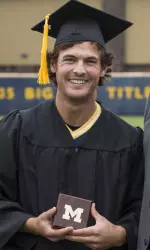
Suddenly, a loud cheer emanated from the far corner of the dugout and out popped Bruder with a full cap and gown draped over his uniform.
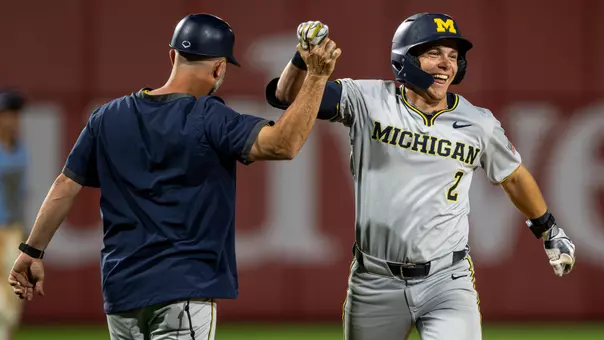
As the whole team laughed and cheered, Bruder couldn't help but smile from ear-to-ear. This was the only chance he'd have all weekend to wear it, and he relished every second. The hard work, determination and sacrifice had all paid off. He had made it.
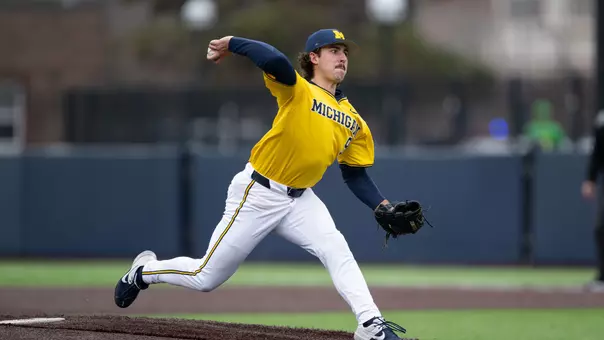
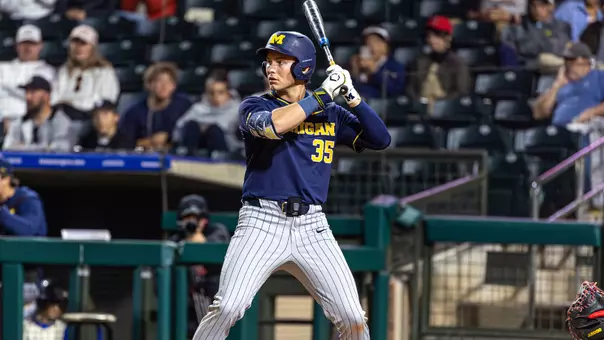
By the time you read this, Bruder will have already received his undergraduate degree in evolutionary anthropology with a focus on zoology and an accompanying minor in the environment. He's also having a magnificent season for the nationally ranked Wolverines, hitting .371 with 38 RBI as of May 2, both the second-highest marks on the team. But despite the accolades on the field, Bruder knows his studies will take him farther in life than baseball ever could.
Remember "Captain Planet," the titular hero from the once-popular 1990s animated show? That's Cody Bruder, minus the magical powers, goofy outfit and mullet.
To Bruder, protecting Mother Nature is his calling. As he describes it, the conversation about conservation starts and ends with us.
"As humans, our ecological footprint is way too big," he explains. "We use too many resources, produce too much waste and greenhouse gases, eat too much meat. We need to conserve the wildlife and their habitats. We're encroaching way too much on them right now.
"Instead of stepping back and seeing what we're actually doing to other people or wildlife that we share this planet with, we just go about our lives and try to get as much done in a single day as we can. That's what it comes down to."
Steps from his childhood home in Corona, California, stood trees ripe with oranges, lemons and avocados. When the fruit basket at home ran low, he'd pick the best ones and bring them back to his mother, Raleen, and older sister, Kelsey, the two women who raised him. Occasionally, he'd spot lizards and toads scurrying about the ground beneath the trees. Those came home, too, despite some objections.
For him and his friends, that was the playground. But as he grew older, those trees slowly started to disappear, and with it, the wildlife.
His junior year of high school, he took an earth science class and began to learn about environmental change, global warming and population control. It all hit a little too close to home.
"I just said, 'I have to do something about this,'" he said.
He's certainly prepared to do that. In his two years on campus, Bruder has learned field research from professor John Mitani, one of the world's leading experts on chimpanzees, and has studied the behavioral patterns of campus squirrels with Dr. Ben Dantzer. He's also helped turn a section of Mason Hall into an organic produce co-op.
You could call him a hippie. People have been doing it since middle school when he wore pink headbands and tie-dyed shirts. Bruder just laughs it off.
He's not your prototypical student-athlete, but that's just what his teammates love about him.


"I don't know anyone else like Cody," said sophomore Oliver Jaskie, one of Bruder's housemates. "For starters, the first time I met him, he showed up in short-shorts and a deep V-neck T-shirt. When we were introducing ourselves to the team, he stood straight up and said he likes playing Pokèmon and Yu-Gi-Oh! He's definitely very comfortable with himself, but I think that's what makes him unique. He's got a lot of good qualities about him."
But he also was a pretty good ballplayer, which isn't a surprise given his family heritage. Softball was the sport of choice, as his grandmother, mother and sister all played professionally or coached (or both); Kelsey was the recipient of the Honda Sports Award while at the University of Florida (2008-11). Wherever she went for travel tournaments, Cody would go, too. He couldn't escape it.
Athletically speaking, hitting a baseball was about the only thing he could do well, so he toed the family line. By the time he reached the end of his playing days at Santiago High School, few four-year colleges showed interest. As puzzling as it sounds for a player with a strong game and a stronger family name -- Kelsey was one of the best softball players in the country at the time -- nobody wanted him.
The best choice, at the time, was Orange Coast College, a junior college in Costa Mesa with a reputation for churning out Division I ballplayers. Since there are no athletic scholarships given, making the team meant surviving three cuts throughout the fall.
When Bruder first arrived, he figured it would be easy. He'd be the starting shortstop, maybe do some pitching. But after that first workout, he was simply trying to keep his spot.
Despite an 18-credit academic schedule, Bruder wasn't going to allow himself to be cut. When he wasn't at class or doing homework, he was at the field for upwards of five hours every day working on his game.
That fall, not only did he survive the cuts, but he successfully transitioned to the outfield and, with the help of the coaches, completely rebuilt his swing. When the season opened, he was the team's starting leftfielder and leadoff hitter. That year, he hit .336 with 28 RBI. The next year was even better, as Bruder hit .359 with 22 extra-base hits and 31 RBI. His play drew the eye of Michigan assistant Nick Schnabel and the rest is history.
With his collegiate playing days nearing an end, Bruder is looking ahead to the future. He could get drafted and continue playing with a minor league club, but long-term, expect him to end up back in California or Hawaii working for the U.S. Fish and Wildlife Service. For the environmental decay that he himself was responsible for, this is a way to reverse it.
"Everyone has their thing, right?" Bruder said. "Mine is a little more intriguing because it comes with cute, fuzzy animals."