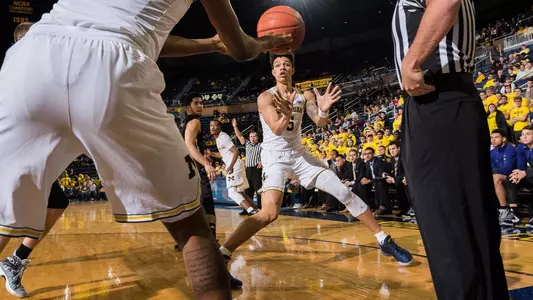
Kornacki: How Wilson Went from Suspect to NBA Draft Prospect
6/21/2017 12:24:00 PM | Men's Basketball, Features
ANN ARBOR, Mich. -- The future went from cloudy to so bright that D.J. Wilson went from suspect to prospect.
Wilson, the University of Michigan men's basketball forward who can shoot from behind the arc and wreak havoc down low, was a very unlikely NBA Draft pick entering last season. He'd averaged 2.7 points and less than one rebound per game the year before, meriting just six minutes of playing time in the average game.
However, Wilson averaged 11.0 points and led the Wolverines with 5.3 rebounds and 1.5 blocks per game last season. He upped that to 15.6 points in seven postseason games, and helped lead Michigan to the Big Ten Tournament championship and NCAA Sweet 16.
Wilson came so far in his third college season that he opted to forgo his final season of eligibility, and many mock drafts have him going late in the first round when NBA teams begin selecting Thursday (June 22).
So, what in the name of Rudy Tomjanovich happened?
We mention Rudy T, who went from Ann Arbor to NBA greatness as a player and coach, because the program's most improved player award is named for him. Wilson won that as well as the Loy Vaught Rebounding Award.
Wilson, a 6-foot-10, 240-pound emerging dynamo, was not only developed on the court by Michigan coach John Beilein and his assistants. Strength and conditioning coach Jon Sanderson, himself a former college player, played an important role in unlocking the physical abilities Wilson now possesses.
Sanderson noticed the valgus or "knock-kneed" condition, and set about training and teaching Wilson how to overcome that and launch off the court to his full capabilities. Sanderson said that process began when, as Sanderson does with all incoming players, Wilson was evaluated for any "weaknesses" that merited attention.
"D.J., as long and lanky as he was," began Sanderson, "in our initial evaluations we saw some valgus tendencies. The knees collapsed inward and were knock-kneed. At the root of it is under-developed hip strength. It's extremely common with basketball players, and so we have a formula to correct it.
"You have to re-educate the knees to stay out or stay neutral and to give the hips greater strength. Sometimes you have to mobilize the abductors or the groin because that can pull the knees inward. In D.J.'s case, it was more about neuromuscular re-education. So, we trained his knees to go out or stay neutral and increased his strength. It was a series of exercises, of activation, and it never ends. You are constantly re-training the knee on where to go or where not to go."

That required countless hours of dedication and hard work at the team's training facilities at the William Davidson Player Development Center.
"It was exercise, drills and a whole protocol that we put together for D.J.," added Sanderson. "You train the heck out of him and focus on some of the isometric properties of training, and you de-emphasize mobility and stretching because you want him tighter and more stable. That was extremely effective in his development.
"He's a work in progress and you can still see some of the tendencies. But they have drastically improved. His vertical jump has improved by eight inches and the two are tied directly."
It was a matter of applying physics.
"If you're jumping with your knees inward," said Sanderson, "think about how much force you are going to apply. You're in a very awkward position to maximize force production, which propels you into the air. Jumping is about physics. For every action, there's an equal and opposite reaction. The more force we can apply down into the ground, the ground will reciprocate and propel us vertically into the air. Anyone with valgus tendencies will lose energy and not maximize the force they can produce and not jump as high as possible.
"That eight-inch improvement was about improving his efficiency with how he was jumping, and not just the strength and power. It's about the mechanical makeup. When you jump, you want it to be like a rubber band about to explode. If you're hyper-mobile, it's like having a rubber band that's stretched out and doesn't have those elastic properties that will let you explode."
When you watched Wilson "explode" en route to the basket for a thunderous dunk, he was an elastic rubber band man putting his full athletic capabilities into motion.
"It made a big difference for me," said Wilson. "When we played Villanova in my freshman year, when I went down with that (left knee) injury, it was my jumping. My technique was all wrong. So, once I got healthy, I got back in the weight room and we worked a lot on core strength and leg strength. Now, that's not a problem for me.
"Coach Sanderson, I give him a lot of credit."
Improved physical capabilities are one thing, but applying them was another important ingredient to turning the corner.
Beilein challenged Wilson early in the season:
"You can't have five guys that you're dialing up. It just can't happen, and so he's got to create off his own, and we will dial him up. He's an athletic forward, and he's got to find opportunities. He's got to get in there (down low).
"He can really shoot, but he has to understand that if we're going to win, and if he wants to play at another level, he's got to mix it up inside. And he's very accepting of that coaching."
That proved to be a prophetic observation for both the championship team and Wilson.
"Coach Beilein gave me the opportunity," he said, "and it was my job to come in and make the most of it. I think in the summer I did a great job -- especially on the defensive end -- of showing that I'm here, and then I could elevate my game on the offensive end.
"He gave me an opportunity and I ran away with it. My confidence really began to build in the Big Ten Tournament from the Illinois game (opener). I was doing it back-to-back-to-back and on a consistent basis. That meant a lot to me."
And so he's off to the NBA. Wilson injured a quad muscle while working out for the San Antonio Spurs, and that prevented him from doing much at the NBA Combine in Chicago. Still, his stock didn't seem to drop because of that.
Playing at the highest level was something he thought the Wolverines could help him reach and played a big role in his college selection process.
Wilson, from Sacramento, California, had the unique recruiting final four of Michigan, Gonzaga, Cal-Berkeley and Harvard. He committed to the Wolverines at Beilein's house on his visit in large part because he believed the program, which had five draft picks (four first-rounders) in 2013 and 2014, would prepare him for the big step he's about to take.
"I was in awe of their player development," said Wilson, "and how well Michigan developed both their guards and their bigs, getting them ready for the next level. And that was something I wanted to do, and this was somewhere I wanted to play at. So, that was a big selling point."
And, by the May 24 deadline to either stay or remove your name from the draft pool, Wilson decided he was sold on the timing being right to go pro. His roommate and good friend, Moritz Wagner, who also had a breakout season, opted to stay at Michigan.
"It's never going to be easy," Wilson said in a statement he made last month. "But if I have learned anything at Michigan, perseverance pays off. It has truly been a blessing to have had the opportunity to attend Michigan, and I will forever be grateful to Coach Beilein and his staff for taking the chance on me."
Chances are, his future is quite bright.