Cardiac Awareness Game: Reid Recalls Why She's a Fortunate Mom
9/7/2018 10:42:00 AM | Field Hockey, Features
By Steve Kornacki
ANN ARBOR, Mich. -- Courtney Reid is a proud mother of three and loves attending the school and athletic events in their lives. But where Reid, a University of Michigan field hockey All-American in 2000, has a different view of such moments is connected to what happened on Feb. 3, 2013.
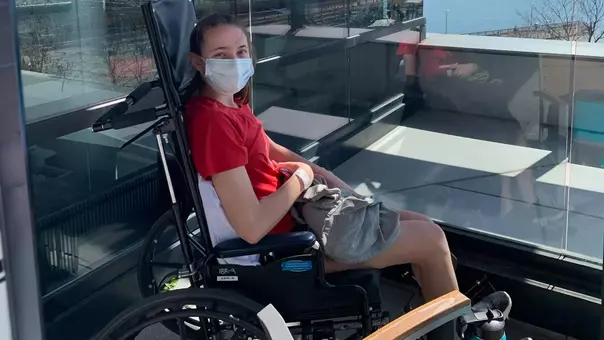
She nearly died that day, suffering a cardiac arrest as she slumped over in the car parked in the driveway of a home in Whitmore Lake.
Daughters Brooke, 12, and Alexis, 7, and son Chase, 10, would've been growing up without her had she not survived.
"That was the biggest thing when I woke up and recovered," Reid said of her hospitalization over five years ago. "My kids almost didn't have a mom.
"I still, to this day, when they do things, like a little Christmas sing-along at the school, and I'll stand there and think, 'Omigosh! I almost wasn't at this.' They'll have a Mother's Day tea, and I'll think that they almost didn't have a mother to have Mother's Day with. I start thinking about the effect it would've had on my kids and I get emotional."
Her appreciation of life -- both the big and little things that go into it – is heightened from her harrowing experience.
Reid is convinced she survived because the police car that arrived well before the ambulance had an AED (automated external defibrillator) in the back seat.
"If the police didn't have the AED," Reid said this week, "I don't think I'd be here. Every second counts."
So, she began promoting fundraisers to purchase AEDs for police squad cars, raised money with a GoFundMe account, and has consistently gone to bat for the cause over the last five years.
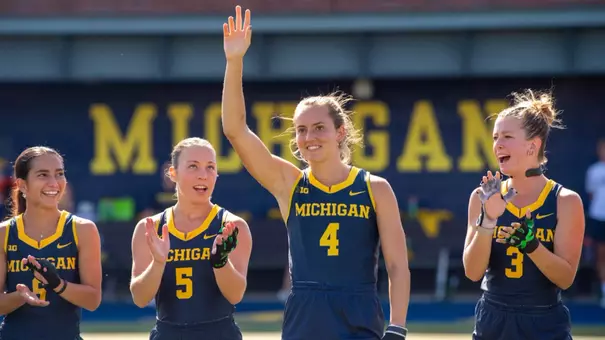
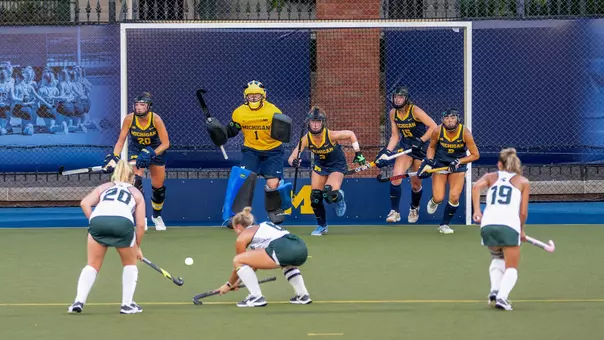
The Wolverine field hockey team is featuring Reid in connection with its Cardiac Awareness Game at noon Sunday (Sept. 9) with Monmouth at Phyllis Ocker Field.
Marcia Pankratz, Michigan's long-time field hockey coach, was impacted by what Reid experienced five years ago.
"She really does care about everyone who's played for her," Reid said of Pankratz. "So, she wants to support this because of what hit one of her ex-players. She was in the ICU with me every morning at 4:30 when I was there with my family. She really takes care of her players, past and present. She's so very thoughtful and generous, and a great woman."
Reid first experienced the signs of heart problems while playing in an ice hockey tournament with Pankratz in Las Vegas the weekend before her cardiac arrest. She returned home feeling not quite right.
"There were signs," said Reid, now a speech therapist living in Saline, "but I just didn't know them at the time."
Reid said she can't actually "recall" the events leading up to the cardiac arrest but has been told of them by Pankratz; her then-husband, Nick Alexander, a former Wolverine baseball pitcher; and others.
"I don't know if I lost my memory because of my event or what," said Reid.

An All-American as a senior in 2000, Reid helped U-M to the NCAA title game as a junior.
On that Feb. 3, she was gathering ski equipment for a family trip to Mt. Brighton, awaiting Nick to arrive and help her load the gear. Nick drove up and noticed "I was barely standing up" and asked if she was alright.
"My back's killing me," she told him. "All of a sudden, it just hurts. And I have tingling and numbness down into my hands."
Nick drove her to the University of Michigan Hospital emergency room, took the kids home, called a babysitter, and returned to the hospital. She was examined and discharged, and they drove to the babysitter's house in their neighborhood.
When Nick, who had been driving, asked if she wanted to go into the house to pick up the kids, she turned to him and said, "I don't feel good."
That's the last thing she remembers first-hand.
"I slumped over," said Reid, "and he ran into the house to call 911."
Nick ran back to her along with another man and they performed CPR on her.
"The Hamburg Township Police were first to arrive on the scene," she said, "and they had the AED. They administered it and brought me back, and the ambulance came. The ambulance arrived over 10 minutes after they got there.
"So, I definitely credit the Hamburg Police Department with saving my life. And the only reason they had the AED was because about three years earlier, they had a little fun festival and there was a country singer who walked off stage and went into cardiac arrest. He was revived when the ambulance arrived, but it got somebody thinking: 'We don't have any AEDs in our police cars.'"
Reid said the singer, whose name she can't recall, returned for a benefit concert to raise money for AEDs.
"Fast forward to three years later," she said, "and one of those AEDs saved my life. So, I decided to pay it forward and do something because I wouldn't be here if they didn't have one."
She called local city and county police departments to see if they had AEDs. They didn't, and so she volunteered to raise funds for their purchases. She was amazed at how quickly donations came in for the cause.
Reid said the main purpose of the Cardiac Awareness Game is broader than simply the need for AEDs. There will be a station to learn "hands-on CPR," AEDs for fans to familiarize themselves with operating one, speakers, and a video presentation from Wolverine softball assistant coach Jennifer Brundage, whom Reid said was involved in using an AED in an emergency revival.
Children will be able to participate in a fitness challenge, and the common signs and facts connected to cardiac distress and heart disease will be detailed on a videoboard. Michigan Medicine and MHealthy are among groups that will be participating.
Reid will receive an honorary pass back to start the game. She was a midfielder from 1997-2000, also earning Big Ten Tournament MVP as a senior. But Reid's favorite memory and accomplishment "is the run we took to the national championship game my junior year" after failing to win a conference championship but staging "a miracle run" in Boston. The Wolverines lost that title game to Maryland, but Reid enjoyed seeing a team that wasn't expected to go that far exceed expectations, adding that playing the games in her home state of Massachusetts added to the special quality of the experience.
She's had a defibrillator inserted that will monitor her heart while providing the potential for electric shock to restore heart rhythm, and she remains physically active. "My health's been fine since the event.
"When I talk to people to educate them on this," said Reid, "I tell them, 'This can happen to anyone. If something doesn't feel right, you really have to get it checked out.' Had I known what the symptoms were for women, I would've known they were signs of something being wrong with my heart."
Having that AED available for the police to revive her made what she's convinced was a life-saving difference. The experience taught her the importance of heart health education and paying forward, while also serving as a constant reminder of just how special it is to celebrate Mother's Day with her children.