When Every Step is a Gift: McMahon Preps for Boston Marathon Run
3/26/2026 6:30:00 PM | Field Hockey
By Maggie Meredith
In Boston, the Marathon means streets filled with crowds cheering on their friends, family and strangers. It means a celebration bigger than St. Patrick's Day, the entire city pausing to celebrate one of its proudest traditions. In Boston, Marathon Monday means a citywide holiday. But to University of Michigan field hockey goaltender Caylie McMahon, this year, it means so much more.
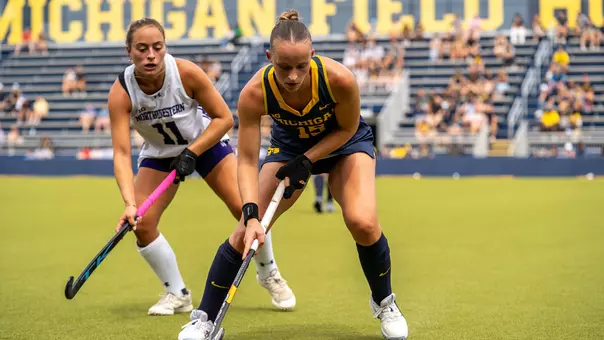
Growing up in Boston, the marathon was always a part of the culture -- something that represented strength and brought the city together. It was a part of life. However, it was never a personal goal for McMahon. Running at all, let alone 26.2 miles, was an idea so unappealing and foreign to her, even as an athlete. On the field, her world revolved around quick reactions, short bursts of energy and explosive movement -- not endurance. The marathon was something that she sat by and observed, not something she imagined for herself.
Then her goals changed.
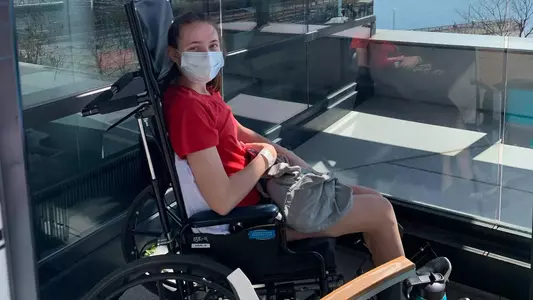
Five years ago, on March 12, 2021, McMahon underwent spinal surgery to remove a tumor that had been discovered after years of unexplained back and leg pain. When she woke up, she discovered that she was paralyzed from her belly button down. Within a week, McMahon moved from Boston Children's Hospital to Spaulding Rehabilitation Hospital, where her new dream was born.
Her rehabilitation at Spaulding was grueling; it was dubbed "nerve boot camp." She underwent hours of physical and occupational therapy every day, being forced to relearn things that come as second nature to everyone else -- from sitting up in bed to tying her shoes and standing at the sink, and ultimately standing up and walking again. When she began therapy, her brain did not recognize her legs as part of her body. Therapists used mirror therapy to help retrain those connections, slowly but surely teaching her mind and muscles to work together again. Progress came through small victories: feeling returning to one foot, then the other; learning to balance; taking one step, then another.
With physical struggle, there will always come a mental counterpart. Doctors tried to manage her expectations. Most patients aim to leave rehab safely -- often assisted by a wheelchair or walker. But when asked about her goals, McMahon gave a very different answer.
No, no. I'm going to run out of these doors.


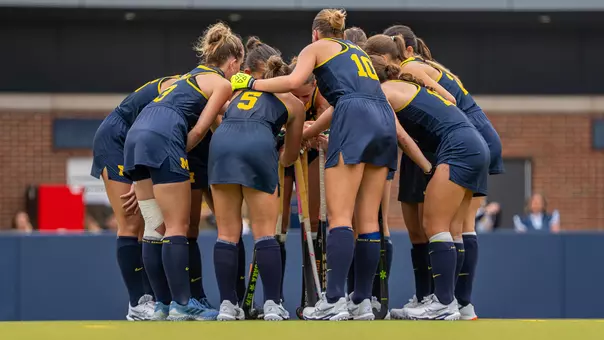
The staff at Spaulding tried to explain that it is not really how rehabilitation works. But she did not care. She was determined to prove them wrong. Her mindset and an extraordinary support system carried her through. She found solace and inspiration in her former club field hockey coach, Chelsey Bettencourt, who had suffered a rare spinal stroke years earlier and also made her remarkable recovery at Spaulding. Bettencourt became both a mentor and a symbol of what was possible. Best friend and longtime Michigan field hockey teammate Lindsey Stagg was another constant source of encouragement, checking in from the moment surgery ended and never letting doubt creep in. Together, the idea of McMahon running the Boston Marathon was hatched.
Against all odds, McMahon improved quickly while working at Spaulding. She graduated from a wheelchair to a walker, then to a cane, and although she did not run out of Spaulding, soon enough, she was able to walk out on her own accord. Outpatient therapy followed, and by the time she arrived at Michigan, not only was she walking again, she was back on the field competing as a Division I athlete. But even now, the effects of her injury remain. She still does not have feeling from just above the knee to the ankle in her left leg, and a recent health complication caused temporary numbness in both feet. Running with this limited sensation requires constant awareness and adjustment, working to shorten her stride, retrain her gait and adapt to what she can and cannot feel every day. The process is challenging, but every step feels like a gift.
Out of that gratitude came her new goal: to run the Boston Marathon. Every year, Spaulding Rehabilitation Hospital organizes a small but highly competitive group of runners called Race for Rehab that runs the marathon and works to raise money to support the hospital's programs. Now, years after leaving Spaulding, McMahon -- along with Stagg -- have started their journey to run. Their fundraising goal is a steep $30,000, but for McMahon, the purpose makes it easy. So, the training began.
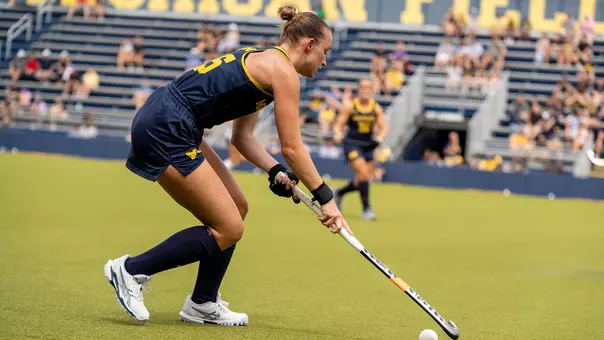
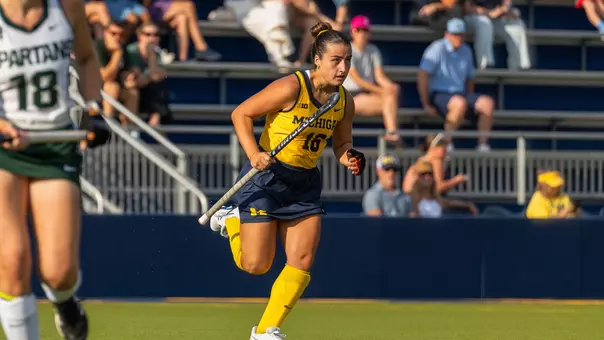
Training for a marathon has been night and day compared to training for field hockey, even at such an elite level. Each week brings four days of running, two days of lifting, and long miles on Saturdays. The training has become a new and exciting part of her routine in her final semester, a way of transitioning out of college athletics and into her new life postgrad. She still craves a goal, something to work toward, and running the Boston Marathon is just that -- a way to compete with herself in a new way while staying connected to the resources and community she loves. At the start of her Michigan career, her goal was to walk; now, it is to run.
Five years ago, McMahon was relearning how to stand. Now she is preparing to complete a ritual ingrained in her hometown with her best friend, who supported her through it all. That finish line will mean the end of the 26.2 miles on April 20, but it will also mean a finish line to the marathon of her recovery. Crossing it will be much more than an athletic achievement -- it will be undeniable proof of resilience, friendship and perseverance.
These last five years have changed the way McMahon sees life. What was routine is now extraordinary, as she wakes up every day grateful to move, to walk and to chase new challenges. The identity she once tied to being an athlete has grown into a new perspective, appreciating each day amid the adversity, patience and hard-earned strength. Doctors once told her she might never walk again. She never believed them.
This spring, she will prove it -- one mile at a time.