Coaching Third: Honoring the Impactful Man Who Inspired Two U-M Coaches
5/6/2019 1:31:00 PM | Baseball, Features
The Michigan baseball program will hold its ALS Awareness Game on Tuesday (May 7) when the Wolverines host Michigan State in a 6 p.m. non-conference game at the Wilpon Complex, home of Ray Fisher Stadium.
By Steve Kornacki
ANN ARBOR, Mich. -- There are very deep and meaningful reasons why two baseball coaches at the University of Michigan both wear No. 23.
Head coach Erik Bakich and assistant coach Nick Schnabel do so to honor Keith LeClair, their own coach at East Carolina, where together they starred on conference championship teams in 1999 and 2000. However, they gained so much more than pennants and games in the standings in their days with LeClair.
He inspired them to become coaches, impacted them even more importantly as people, and provided them Bibles while he began fighting amyotrophic lateral sclerosis (ALS), also known as Lou Gehrig's disease. He was diagnosed with ALS the year after he coached Bakich and Schnabel, and the disease claimed him July 17, 2006.
And so a man who dedicated himself to baseball and then God died from a disease named for one of the game's greatest sluggers. LeClair asked that those wishing to donate in his memory do so to the Jim "Catfish" Hunter ALS Foundation, which helps fund the North Carolina Chapter of The ALS Association that now also bears the name of that Baseball Hall of Fame pitcher. That chapter helps support the ALS Clinic at Vidant Medical Center in Greenville, where LeClair lived and received treatment.
The "Ten Finger Prayer," which featured some of LeClair's favorite scriptures dealing with strength and trust through trials, was copied and pasted to the back of the royal purple and gold covers of those Bibles, honoring both East Carolina's school colors and purple's biblical meaning. He gave them to his former players while fighting ALS.

LeClair (East Carolina University photo)
"He was a Christian man, and we prayed before games," said Bakich. "But he didn't talk about his faith as much until then. He really found strength through his faith while battling the disease. Instead of inspiring baseball players, he used his daily devotionals to make an impact on so many with emails that applied to everybody."
The Bible always is front and center on Bakich's office desk.
"It's pretty cool because I just gave that Bible that Coach LeClair gave to me to my son, Cal," said Schnabel. "He's nine and he's got that Bible now. He was asking for one, and this was a good time to give him mine and talk about it with him."
Cal and Bakich's young sons, Beau and Colt, can often be found in the clubhouse, batting cages and on the field after Wolverine games at the Wilpon Complex, home of Ray Fisher Stadium, where the legacy of Coach LeClair will be honored Tuesday (May 7) with an ALS Awareness Game with archrival Michigan State.
When East Carolina coach Clifford Godwin, who played with both Wolverine coaches in college, called to get them involved in Mustache March, Bakich and many members of the baseball staff and team grew mustaches to raise awareness and funds to fight ALS.
"We raised over $10,000 between ourselves, East Carolina and Memphis," said Bakich, adding that the awareness game was a natural next step.
Finding out that LeClair had ALS shook Bakich and Schnabel just as it did everyone connected to the Pirates.
"I'll never forget it," said Schnabel. "I was in a hotel in Oneonta, New York, playing (minor league ball) for the (Montreal) Expos, and I got a call from Bryant Ward, one of my good friends and teammates. He said, 'I've got some bad news.' I couldn't believe it."
The man who had pushed them to the brink physically was going to lose the use of every muscle in his body, and that was hard to fathom, hard to accept.
Schnabel has a photo of the Pirates taken after the whole team finished running LeClair's obstacle course on a hot day, and he pointed out Bakich on the far left flexing a well-defined bicep muscle and himself in the center, leaning in and smiling while perched on the back of a teammate. It's framed in the corner of his office along with a message from LeClair:
"These guys had to snake the football stadium, run around Minges Coliseum, enter the practice soccer field and crawl under barbed wire filled with mud, carry wooden pallets over their head fifty yards, flip tractor tires another 50 yards, and pull a hundred-pound weight to the finish line, not to mention some crazy stuff in between.
"... Seeing that picture hung on the middle of my wall for years to come, I truly believe it was on that day when those young men turned into champions on the field and, more importantly, developed a belief that they could achieve extraordinary things when they gave an effort above what they thought was possible."

Schnabel said LeClair had that photo close to him until his dying day.
"That was his favorite photo," said Schnabel. "When he was in his wheelchair and couldn't move, he had that photo in front of his (laptop) computer because he had that Eyegaze machine he would talk through. That photo was right there so he could always see it. That's how much he liked that photo."
Bakich and Schnabel attended his memorial service three days after his death along with countless others at both Oakmont Baptist Church and Clark-LeClair Stadium, the baseball facility to which his name was added in 2005.
"We all got a chance to speak," said Bakich, "and I read one of the emails he had sent me. It depicted his humor. He was a disciplinarian who worked us hard but had a very humorous side, and I got to see that through our wrestling matches on the bus and then these emails. The crowd loved it and laughed because they could hear him saying all that stuff, just razzing me."
Schnabel said, "It was very emotional, but it was as much a celebration of his life as anything. Still, it was very sad. But we knew he was in a better place."
What made LeClair special?
"He had the unique ability to maximize what he got out of each individual on the team," said Bakich. "You hear the saying, 'I'd run through a wall for that coach.' He was that coach. We had incredible team chemistry and we jelled. He took kids from not only North Carolina and the Eastern seaboard, but California junior college players and everyone in between, and molded them together into one really tight circle."
Schnabel said, "What he did best was he knew how to handle different personalities, different people from different backgrounds. I mean, he was an absolute rock star as a coach back then. Talk about a hot name and commodity, he turned down a couple SEC jobs to stay at East Carolina. But he never talked about his wins or things like that. He talked about the relationships he had with everyone he coached and coached with."
Third baseman-left fielder Bakich (San Jose City College) and second baseman Schnabel (Ohlone College in Fremont) were recruited by LeClair through their California junior college coaches, and both accepted his recruiting pitch despite never meeting LeClair or visiting the campus.
Bakich said, "We just said, 'We're in.' We didn't know what it was. We had offers from bigger schools, but there was something about the opportunity at ECU that we could detect in his voice. It just seemed like we were going to be part of something very special, and we were.
"If I hadn't taken a chance on East Carolina and a coach I'd never seen, I wouldn't be at Michigan now. I might not be coaching. I wouldn't have my wife, Jiffy, and kids (they also have a daughter, Tempie) and gotten onto this path. So, I feel very fortunate and blessed and so thankful for the people God's put in my life, and he was certainly one of those people. He had as big of an impact on my life as anyone."
They found their vocations through LeClair.
"I knew after spending some time with him that this was what I wanted to do," said Schnabel. "I wanted to have an impact on young men like he had on me. If I can have half the impact on others that he had on me, it's a win."
Bakich echoed those sentiments.
"I didn't even know what hard work was until I got there," said Bakich. "I had no idea what mental toughness was until I got there. He pushed our limits and our boundaries physically and mentally. That was one of the unifying themes of our team. He trained and worked us so hard that we felt like we had outworked every other team in the country and drew a lot of confidence from that.
"He challenged us and helped us grow in ways as people but still took a sincere interest in our lives. He embodied all the characteristics you admire in leadership figures and was a great husband and father. So, I switched my major from business management to exercise science and decided I wanted to coach. I wanted to have the same type of impact he had on all of us."
Schnabel added, "Coach LeClair had two young children, J.D. and Audrey, at the time he coached us, and we saw how he treated his family and others. He was a good role model and could be quiet off the field. But he was the ultimate competitor around it. He taught us that you get what you earn."

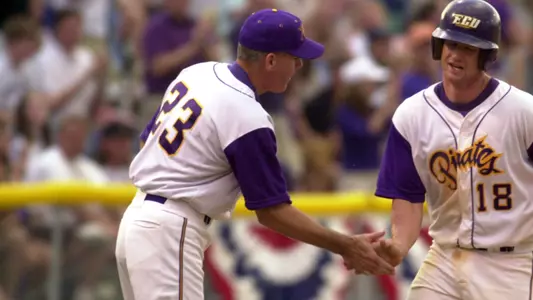
After helping ECU to two league titles, Bakich (above) and Schnabel (below) followed LeClair into the coaching field.

"Coaching Third: The Keith LeClair Story" was written by Bethany Bradsher in 2010. LeClair's wife, Lynn, wrote in the foreword:
"Coaching third, in baseball terms, was the literal position where you would find Keith LeClair when his team was at bat. The third base coach's box was where he felt most comfortable. He was giving signs and sending runners home. He was in the game!
"... 'Coaching third' also represents the realignment of priorities as Keith faced the greatest challenge of his life: Christ first, family second and coaching third."
Schnabel has a bound copy of the devotionals LeClair wrote while dealing with ALS. It's a gift from Schnabel's mother, Linda, who wrote in it that her prayers for "Godly men" to influence him was answered by LeClair and his assistant coaches.
LeClair posted a devotional on Nov. 2, 2004 that quoted the scripture he had on the windowsill of his bathroom, Proverbs 3:5-6: "Trust the Lord with all your heart and lean not only on your own understanding but in all your ways acknowledge Him and He will make your path straight."
He wrote below those two verses: "Lord, this is your day and I trust you with everything that comes my way."
LeClair accidentally knocked the tracheotomy tube out of his neck shortly after his nurse visited him that day, and he knew it would be nine minutes before she returned. He wrote that he had turned gray and was "literally on my last breath" when the nurse returned to place the tube and get him breathing normally once again. He wrote that he repeated that inspirational scripture over and over, trusting it through his fear.
He also wrote this to his friends after recalling the experience: "Who are you trusting today?"
LeClair seemed more concerned with others rather than himself during his five years of surviving ALS, and Schnabel said it was "unbelievable" how he handled such a difficult fate in such "remarkable" fashion.
"It was never about him," said Schabel. "He was concerned about his family and others."
Schnabel made Greenville his offseason home during four minor league seasons and was a volunteer coach at ECU in 2004, when he also spent considerable time with LeClair and his family.

Bakich (left) and Schnabel
Their coach led them in baseball and faith, but they also had loads of fun with LeClair. Bakich said the coach would "bust his chops" about his healthy eating extremes, and Bakich would get him into a headlock on the team bus. Then LeClair would get him in a headlock as they horsed around wrestling.
"I'll never forget that," said Bakich, chuckling at the memory. "But even when he was very sick, he would still bust my chops about being a juco player and eating healthy."
Bakich wears No. 23 now for LeClair, as does Schnabel.
"Both Nick and I wear it," said Bakich, "and there are six or seven of us off of one team who are wearing it now as college coaches.
"One of the last things I said to him, when his wife, Lynn, put the phone to his ear, was to reaffirm my commitment to him and the reason why I got into coaching. I told him I loved him and thanked him and said, 'We will get to Omaha for you.' He never got there as a coach, and that was always the unifying theme of our program, getting to Omaha. It was more a lifestyle than it was a destination."
Omaha, Nebraska, is the long-time site of the NCAA College World Series.
"The effort we gave in trying to get there came through in everything we did," continued Bakich. "So, I told him that on behalf of all of us coaching, we're going to get there for him. That's how we wanted to continue his inspiration and continue his legacy.
"It's an honor and a privilege to wear the No. 23. I wear it with a great deal of pride because it represents something so important to so many people. I hope we all get there -- Cliff Godwin and East Carolina and Bryant Ward (the hitting coach) at UCLA, and Nick and I. And I hope we all get there the same time. Nothing would be better than seeing the four of us there."
Bakich has no doubt that if and when that happens, the coach they all love will be there with them, too. He always is.