Scholar Stories: Harrison Adapting to New Normal on Field, Classroom
9/18/2019 10:40:00 AM | Men's Soccer, Features
Continuing the series that began in 2016-17, each Wednesday MGoBlue.com will highlight a Michigan student-athlete and their academic pursuits. These are our Scholar-Athlete Stories, presented by Prairie Farms.
By Brad Rudner
For 22 long months, Joel Harrison wondered if he'd ever play soccer again.
He was a senior in high school and was playing at a recruiting showcase in Florida with the Vancouver Whitecaps Academy. The coaches from Michigan were scheduled to see him in-person for the first time. Problem was, they arrived a few minutes too late. Harrison picked up an injury five minutes into the match.
They never saw him play with their own eyes, yet they recruited him anyway. Harrison was diagnosed with a sports hernia, a painful soft tissue injury in the groin area.
"It was at that point when I went off the deep end a little bit," he said. "I had to stop playing because it got so bad. They (doctors) knew I had pain in certain areas, but there was no specific diagnosis. Up until I came to Michigan, I had an idea in my head that I was close to getting back. That kept going for months."
Harrison didn't play at all as a freshman, and watched his teammates -- many of whom saw the field in key roles -- help Michigan win its first Big Ten championship in program history.
He rehabbed and visited several specialists, but nobody could pinpoint what was causing his pain. By the end of that season, Harrison underwent double hernia surgery.
When he returned to campus for preseason camp in August, he still wasn't sure the procedure worked. The surgeons did what they set out to do, but Harrison didn't know if it would ease his pain.
Then one day, he went in to see Bill Shinavier, the team's long-time athletic trainer, and could barely contain his excitement. The pain was nearly gone. Harrison finally felt like himself again.
After barely touching a soccer ball for the better part of two years, Harrison eased back into training toward the end of September 2018. It took three weeks to get match fit. Then, on Oct. 3, 2018, during a match at Oakland, Harrison's name got called.
"The grass, it was not a great field. All I could think about is getting injured again," Harrison said. "We were up 2-0 and I was warming up. Coach (Chaka Daley) called me over from the sideline. At that point, all the butterflies and nervousness came back. I've thought about getting on the field for two years, and now here I am."
"Looking back, it feels a lot like a dream. I don't think I was fully present. My head was in the clouds. Then just as I was lining up to go in, Oakland scores to make it 2-1. Tommy (McMenemy) looked at Chaka and made a mention, 'Should Joel still go in?' Chaka said yes. I think that was big for me, just seeing the coaches, after never seeing me play in a game and watching me struggle through this, still have confidence in me."
Harrison played for nine minutes, and Michigan held on for a 2-1 win. After the win, Harrison led the team in singing "The Victors" in the locker room.
It was a moment he'll never forget.
After making his collegiate debut and playing his first match in 22 months, Joel Harrison led us in The Victors! #GoBlue pic.twitter.com/ZiDgJKLgEw
— Michigan Men's Soccer (@umichsoccer) October 4, 2018
Harrison saw bits and pieces of playing time the rest of the season, playing in nine matches. After some injuries hit the Michigan defense prior to the NCAA Tournament, Harrison stepped in and played 71 minutes in the team's opening round bout with Princeton.
Three days later, he got the start -- the first of his career -- at Notre Dame in the second round. He played all 110 minutes and helped the defense get the shutout, but the Fighting Irish won, 11-10 on penalty kicks. Though there was disappointment in not advancing, Harrison walked off the field with a small bit of personal satisfaction.
"In my head, that was the end of my recovery process," he said. "Before that, I hadn't proven to myself that I was back. I hadn't played how I remembered. But after that game, even though the year was done, I could look in the mirror and know that I'm back."
Off the field, Harrison hasn't missed a beat since day one in Ann Arbor, having compiled a near-perfect grade-point average as a computer science engineering major. One of the things that drew him to engineering was the way it forces you to solve problems. For Harrison, that meant facing challenges inside a computer.
He took a computer programming course as a first-year student, which meant learning how to code. Now in his third year, Harrison wants to take what he's learned and apply it to building intelligent programs and algorithms -- or artificial intelligence.
"Not the physical robot, but rather the mind of a robot," he explained. "It's trying to give computers the ability to solve real issues."
Harrison also is using what he's learned to give back. This fall, he is one of 12 engineers from various Midwestern universities and across different engineering disciplines (biomed, mechanical, industrial, computer science) whose goal it is to build a mechanical arm for a high school principal who is unable to afford one. They are in the process of raising funding and are nearly ready to move forward with prototypes. They hope to complete the project by the end of the calendar year.
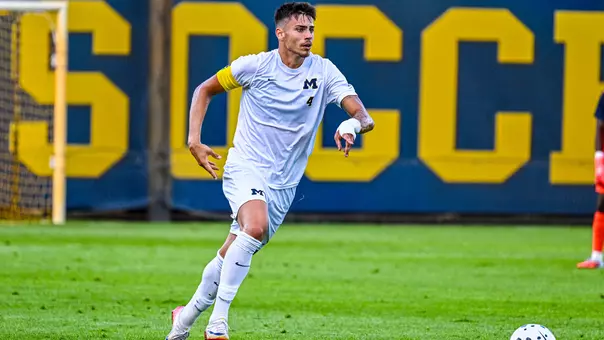
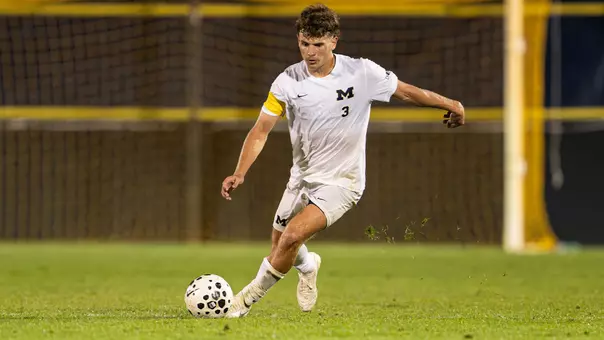
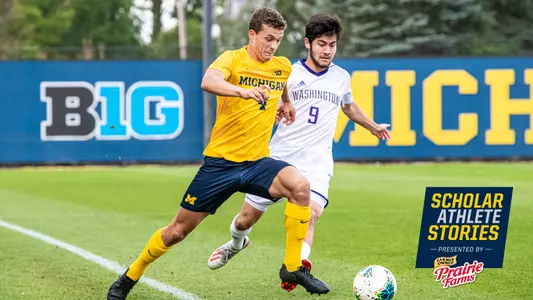
In the meantime, Harrison is adapting to his new normal: a place in the squad's starting XI, and new responsibilities that come with being appointed one of the team's three captains (along with classmates Umar Farouk Osman and Marc Ybarra). The Wolverines are 3-2-1 through six matches, with Harrison logging four starts on the back line.
He still sees Shinavier every day to rehab and fight off the effects of the injury. It'll probably be like that the rest of his career.
"I think there's always going to be some caution," he said. "But I've always been taught when you cross the white line, you're there for battle. My head is completely focused from minute zero until the final whistle. There's nothing to smile about until you win."
• Scholar-Athlete Stories Home