150 Years of College Football: Choosing the Best of the Leaders and Best
9/27/2019 12:56:00 PM | Football, Features
By Steve Kornacki
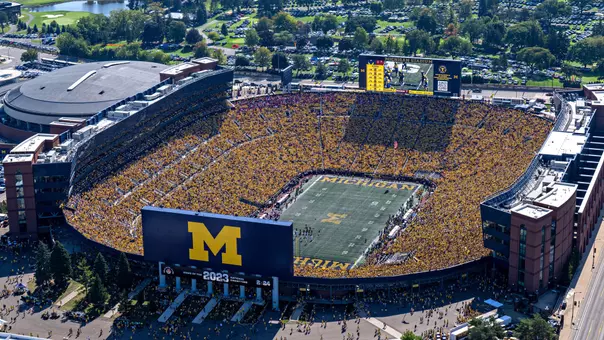
ANN ARBOR, Mich. -- From Yost to Crisler to Schembechler to Carr. From Harmon to Howard to Woodson. The University of Michigan's long, storied football history has everlasting bright lights illuminating the accomplishments of its Hall of Fame coaches, Heisman Trophy winners and everyone who's contributed to 11 national championships, a conference-record 42 Big Ten championships, and 955 victories that exceed every other school's total.
The Wolverines will honor their past Saturday (Sept. 28) against Rutgers while celebrating the 150th season of college football. Michigan has participated in 140 of them, more than all but five other schools. The visiting Scarlet Knights played Princeton in the very first game in 1869, and Harvard, Yale and Pennsylvania are the only other places where this game has been played longer than in Ann Arbor.
It's a time to reflect on the best of the "Leaders and Best" on the gridiron. Here are my top 10 moments in Michigan football lore in chronological order:
Michigan Wins First Bowl Game, Culminating Truly Perfect Season
Jan. 2, 1902, Pasadena, California
The Wolverines beat Stanford, 49-0, in what was not only the first Rose Bowl but the first bowl game, period. It was the exclamation point on the most dominant season any team from anywhere has had over the last century and a half. Michigan finished 11-0, outscored opponents, 550-0, and the "Point-a-Minute" teams of coach Fielding Harris Yost had their beginning.
Yost wasn't beaten in 56 consecutive games in his first five seasons, outscoring opponents, 2,821 to 42. Running back Willie Heston became the school's first two-time All-American, scoring 72 career touchdowns and rushing for 170 yards in that initial Rose Bowl. However, it was 5-foot-8 fullback Neil Snow, with 107 yards and five touchdowns, who was the MVP in that first bowl game in Pasadena.
Yost had coached Stanford to a 7-2-1 record in 1900, but its board then enacted a rule barring any non-alumnus from holding a coaching position. Michigan offered him a $2,300 salary, only $200 less than a full professor, and Yost had found a home. By the time the smoke had cleared after the 1926 season, Yost had a record of 165-29-10 and had become the driving force behind Michigan Stadium being built in what was once the Miller family farm.
That first Rose Bowl was so lopsided and undramatic that for the next 13 years Tournament of Roses officials ran chariot races, ostrich races and other events instead of football. However, football returned on New Year's Day 1916, and the bowl went on to become "The Granddaddy of Them All."
"The Benny to Bennie Show" Avenges Grange, Illinois
Oct. 24, 1925, Champaign, Illinois
The legendary Red Grange, the game's first true superstar and drawing card, had run wild on the Wolverines in 1924. He scored four touchdowns in the first quarter and finished by accounting for 402 yards and five touchdowns in a 39-14 drubbing by the Fighting Illini in Champaign.

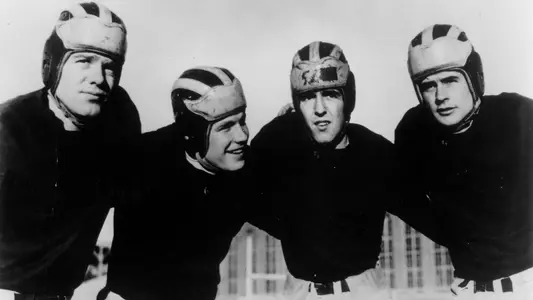
From left: Bennie Oosterbaan, Fielding Yost, Benny Friedman
Yost, after a one-year hiatus as coach while continuing as Michigan's athletic director, returned in 1925, and his passing combination of quarterback Benny Friedman to end Bennie Oosterbaan revolutionized the game.
But this rematch, again in Champaign, was a slugfest on a wet field. Oosterbaan, in the era of two-way players, intercepted a pass that led to a Friedman field goal from the 25-yard line for the only scoring in a 3-0 Wolverine triumph before a record 67,000 fans at Memorial Stadium.
Friedman set up the score with a long pass to George Babcock, who handed off to Bruce Gregory.
Grange was held to 56 yards on 25 carries as Michigan got its revenge. Grange had a rare start at quarterback and was one of three passers intercepted by a ball-hawking Wolverine defense spearheaded by Bo Molenda.
Harmon's One-Man Show
Nov. 23, 1940, Columbus Ohio
When it's said that a player "did it all" in a game, it's almost never true, especially in the current era of platoon football with nobody playing offense and defense on every down as Tom Harmon did.
Harmon dominated Ohio State in every phase of the game. He ran for three touchdowns, passed for two touchdowns, kicked four extra points, intercepted three passes, and averaged 50 yards on three punts.
But as amazing as all of that was, what happened when the 40-0 win at the Horseshoe was over provided the most memorable moment of all. Buckeye fans gave Harmon a standing ovation, and that hadn't happened in Columbus before. It hasn't happened since.
Harmon, known as "Old 98" for his iconic jersey number, won Michigan's first Heisman Trophy and had a Hollywood flair. He would marry a movie actress, Elyse Knox, and they would have a son, Mark, who would quarterback UCLA before moving on to a highly successful film career.
Columbia Pictures made "Harmon of Michigan" before World War II broke out, and Harmon enlisted in the U.S. Army Air Corps. He was a bomber pilot whose plane went down, but Harmon survived to become a fighter pilot who was shot down by the Japanese over China and again survived.
He played for the Los Angeles Rams before becoming a noted television and radio sports broadcaster, and he died in 1990, one year before Michigan won its next Heisman.

Fritz Crisler (left) and Tom Harmon
"Mad Magicians" Win Crisler's Finale, National Title
Jan. 1, 1948, Pasadena, California
Fritz Crisler was an innovator who brought two-platoon football to the game and won games at a great pace. He finished 71-16-3 in 10 seasons as the head coach for an .803 winning percentage second only to Yost's .833 among Michigan coaches with at least three seasons.
However, Crisler didn't win a national championship until his team trounced No. 8 Southern Cal, 49-0, in the Rose Bowl to finish No. 1 in an unprecedented Associated Press poll. It marked the first time a vote was taken after bowl games, and Michigan overtook Notre Dame.
Crisler addressed his team on overconfidence in practices leading up to the game after the Wolverines were made 15-point favorites, and they more than tripled that total while rolling up 491 yards total offense and setting nine Rose Bowl records.
It also was a fitting way for the "Mad Magicians" backfield -- so named by sports writers for the sleight-of-hand ball-handling they perfected to keep defenses guessing as to who would end up with the pigskin -- to finish a season in which they led the NCAA with 412.7 yards per game. Quarterback Bob Chappuis finished second in Heisman Trophy voting, and two-way halfback Bump Elliott, who later coached his alma mater to a 1965 Rose Bowl win, was the Big Ten MVP.
Johnson Runs and Runs and Runs
Nov. 16, 1968, Ann Arbor, Michigan
Ron Johnson ran to glory and frequently to the end zone, making history with 347 yards rushing and five touchdowns against Wisconsin.
The senior captain from Detroit established a Big Ten single-game rushing yardage record, and Johnson also tied the conference record of five rushing touchdowns set by legendary Illinois halfback Red Grange against the Wolverines in 1924.
Johnson, crediting his blockers for huge holes to run through, scored on runs of 35, 67, 1, 60 and 49 yards on a slick grass field in a game played in a chilling rain.
Michigan coach Bump Elliott told reporters afterward: "I've never seen a one-man performance like that. It was so explosive."
Johnson averaged 11.2 yards per carry -- which remains a school single-game record -- against the grabbing-for-air Badgers.
The yardage total has been surpassed by Big Ten runners three times in the last five decades, but it remains the Michigan record. Only Tshimanga Biakabutuka, with 313 yards on 37 carries against Ohio State in 1995, has come close.
In the 124–year history of the Big Ten, Johnson is the only player to ever run for 250 or more yards in one game and average over 10 yards per carry, and he did so twice.

From left: Ron Johnson, John Wangler, Anthony Carter, Bo Schembechler, Barry Pierson
Wolverines Upset No. 1 Buckeyes to Jump-Start Schembechler Era
Nov. 22, 1969, Ann Arbor, Michigan
Ohio State had won every game that season by at least 27 points and had 22 consecutive victories. A Sports Illustrated article suggested the Buckeyes should play the NFL powerhouse Minnesota Vikings for a challenge.
However, the No. 12 Wolverines had built great momentum in Bo Schembechler's first season, winning four consecutive Big Ten games by a combined score of 178-22. They also had some salt in the wounds of a 50-14 loss the previous year in Columbus to wash out. OSU coach Woody Hayes went for two points after the last touchdown, and Michigan captain Jim Mandich promised those 1968 seniors, who were in tears after that defeat, that the Wolverines would bring a payback for them next year.
Michigan, a 17-point underdog, literally knocked down the locker room door en route to the tunnel and the field, and the Wolverines scored 17 unanswered points in a 24-12 upset. Cornerback Barry Pierson intercepted three passes and had a 60-yard punt return while playing the game of his life. He was the star of stars in this one.
Schembechler and Mandich, the All-America tight end, were carried off the field on the shoulders of Michigan players, and an amazing era had been launched. Schembechler won the first of 13 Big Ten titles in 21 seasons, and he went on to set the Michigan record with 194 coaching victories.
Wangler to Carter: The Indiana Miracle
Oct. 27, 1979, Ann Arbor, Michigan
The Wolverines and Hoosiers were knotted at 21-all with six seconds remaining to play and the ball on the Indiana 45-yard line. Bo Schembechler put his left arm around John Wangler on the sideline and barked out the play: "54 Pass Post!"
Wangler jogged to the huddle, called the play, and Anthony Carter, the ultra-confident freshman running the post route, said, "Throw me the ball. I'm going to be open." Wangler replied, "I am. Don't worry about it."
All these years later, Wangler laughed about carrying out the play-fake handoff to Butch Woolfolk in the play even though it made no sense for the Hoosiers to anticipate defending a run.
Wangler fired a tight spiral down the middle of the field that Carter caught in front of two defenders at the 20-yard line. Neither Hoosier could corral him, and a defensive back made a diving attempt at an ankle tackle inside the five-yard line that failed, and there was no stopping "A.C." from reaching the end zone.
Carter held the ball high and Woolfolk hugged him as teammates and fans engulfed them, creating a dogpile after the 27-21 win. Radio play-by-play man Bob Ufer's wildly enthusiastic call, Wangler said, has made the play seem even bigger than it was and added to its lore.
It's arguably the most dramatic play in Michigan history, and Carter never stopped running wild after catches, becoming a three-time All-American.
Howard Does the Heisman Pose
Nov. 23, 1991, Ann Arbor, Michigan
Desmond Howard caught 62 passes for 985 yards and a Big Ten-record 19 touchdowns as a junior, and he had 23 touchdowns in all, tying San Diego State tailback Marshall Faulk for the NCAA lead.
Howard secured a win over Notre Dame by diving all out in the end zone for a 25-yard touchdown catch on a fourth-down pass from Elvis Grbac that landed him on the cover of Sports Illustrated. And as memorable as that one was, he topped it with his 93-yard punt return touchdown in a 31-3 dismantling of Ohio State.
The blocks were all there and so was Howard's speed. He caught the ball, sprinted from an area near the left hash mark through the holes, and blew by anyone who came close. As he crossed the goal line, announcer Keith Jackson roared to his ABC-TV audience: "HELL-OOO HEISMAN!"
As if on cue, Howard slowed to a stop in the end zone and struck the Heisman Trophy pose with his left arm before teammate Dwayne Ware, who escorted him on the play, hugged him. Then it was a dogpile as the crowd roared.
Three weeks later, Howard collected the Heisman at the Downtown Athletic Club of New York with a landslide victory.

Desmond Howard (left) and Charles Woodson
Woodson Does It All to Cap Undefeated Regular Season
Nov. 22, 1997, Ann Arbor, Michigan
Charles Woodson caught a 37-yard pass from Brian Griese to set up one touchdown and intercepted a pass from Ohio State quarterback Stanley Jackson to thwart a Buckeye comeback attempt.
But it was the 78-yard punt return touchdown during the 20-14 victory that combined a memorable play in a hugely significant game as well as any moment the Wolverines have had. Woodson got superb blocking, broke the one tackle required and slithered through the OSU defenders to the same south end zone where Howard had taken his punt back six years prior.
Woodson intended to duplicate Howard's Heisman pose, but teammates piled atop him before he could get in position.
That was the signature play and moment in a game that ended with Woodson strutting off the field with a long-stemmed rose clenched in his teeth. Woodson proclaimed in a lasting sound bite: "They do the talkin'. I do the walkin', baby."
OSU receiver David Boston had predicted big things for himself and his team that day, and he even physically got into it with Woodson on one play. But Woodson got to have the last word. He became the only primarily defensive player to win the Heisman in a close race with Tennessee quarterback Peyton Manning, who finished second and ironically visited Michigan as a high school recruit.
Griese Leads Wolverines to Rose Bowl Triumph, National Championship
Jan. 1, 1998, Pasadena, California
It might be that Charles Woodson's dramatic end zone interception of Washington State quarterback Ryan Leaf was the key moment in a 21-16 victory that kept the Wolverines undefeated and No. 1 in the final Associated Press poll. Woodson assured that the Cougars didn't take an early two-touchdown lead that could've been tough to overcome.

Brian Griese
But in terms of the most emotional moment, it came after Brian Griese had completed 18-of-30 passes for 251 yards and three touchdowns (two to Tai Streets).
Keith Jackson looked at his broadcast partner, Bob Griese, the Purdue and Miami Dolphins quarterback who is in both the pro and college football hall of fames, and, with the Wolverines celebrating their victory and season on the field below, said, "The MVP -- I'm standing beside his proud Daddy. ... Go ahead and cry."
"Daddy's" eyes welled up with tears that instant, and afterward, in the hallway beneath the historic stadium, he came face-to-face with his triumphant son.
"We didn't have to say a word," said Brian. "We just hugged each other, and it was a special moment. That was the moment that -- we'd been through a lot, losing my mom (to cancer) -- it's still there. It's right there. It's right under the skin."
"Miracle Moments in Michigan Wolverines Football History" (Skyhorse Publishing, New York, N.Y., 2018) was referenced in this compilation, and more in-depth stories on the Top 10 Moments are available in the book co-authored by the father-son team of Derek Kornacki and Steve Kornacki.