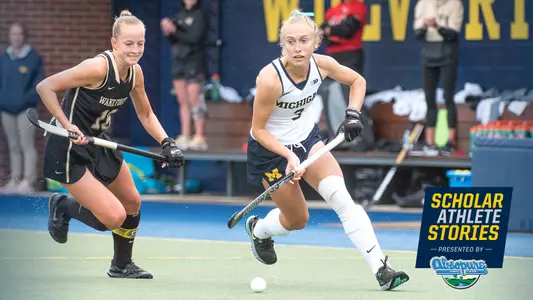
Scholar Stories: Ann Arbor Native Gompper Plugged in, Giving Back to Community
12/2/2020 11:00:00 AM | Field Hockey, Features
Continuing the series that began in 2016-17, each Wednesday MGoBlue.com will highlight a Michigan student-athlete and their academic pursuits. These are our Scholar-Athlete Stories, presented by Absopure.
By Brad Rudner
Being an Ann Arbor native, Maya Gompper is plugged into her community. So much so, in fact, that a large portion of her time outside of school and sports is dedicated to making that community better.
"As student-athletes, we have a platform and resources given to us that make it easy to help others," Gompper said. "I think it's important to use that position to better others, to help others who aren't as fortunate. There's always something you can do."
Clearly, Gompper has the passion, but as is the case with many University of Michigan student-athletes, using it becomes a question of time. Most days are filled with class and practice, in some order, along with everything that comes with them: homework and studying, ankle-tapings and ice baths.
When you can't find the time, you make it. Right?
"I don't know," Gompper said, laughing. "Those things are worth it, not just for me but for who I'm engaging with. If I can support someone else or take something off someone else's plate, then it's absolutely worth my time. It doesn't feel like a task at all."
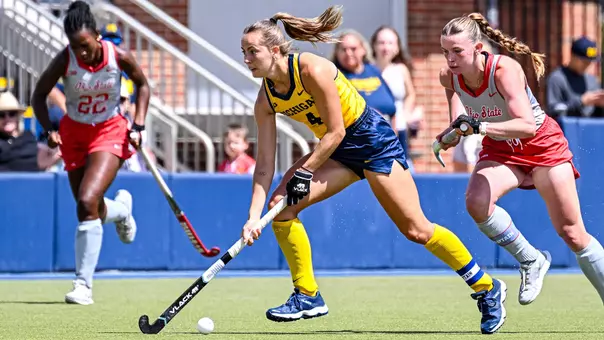
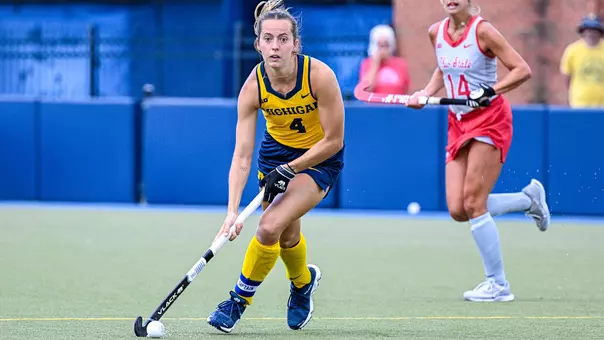
Gompper started playing field hockey in the third grade. She is no stranger to Ocker Field, first serving as a ball kid and later attending camps, more for fun than anything else.
Despite having the University of Michigan in her back yard, the thought of playing in college never entered her mind, at least not initially. It wasn't until her freshman and sophomore years of high school at Pioneer that she began to change her mind.
"I didn't think it was somewhere I was capable of going," Gompper said pointedly. "It was [U-M assistant coach] Ryan [Langford] who first approached me, said that the staff was interested and that I should keep them on my radar. I took a visit that fall, met the team, toured the facilities, and at the end of that visit, [head coach] Marcia [Pankratz] offered me."
"I thought about it for maybe a week and a half. When I'd look at other places, I always found myself comparing the town to Ann Arbor. It wasn't the same. At a certain point, I didn't know why I was waiting any longer. I talked to my mom and she said, 'You know where you're going.' That was it. It became a no-brainer."

As a freshman in 2017, Gompper did not play much -- just six games -- but was able to learn from a group of seniors who led the Wolverines to the Final Four, the program's first in 14 years. Her role expanded in the last two years; she has played in 41 games as a reserve, including six starts.
The role of a reserve is two-fold: to bring the energy and to make sure that there is no drop-off in play. Not everyone can start, but off-the-bench types like Gompper are crucial to a team's success.
"To go from a starter [in high school] playing all the time to not playing as much as you want, it can be difficult," she said. "But our team has done a great job creating a community where everyone feels valued. Everyone feels appreciated and is important, and every role is important."
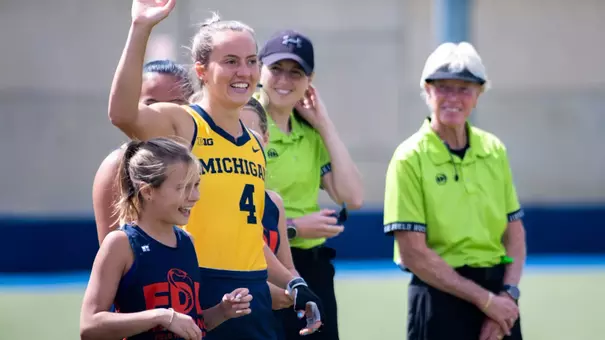
There's that word again -- community. The field hockey team adopted Lily, a teammate from Team IMPACT. The two parties have only seen each other a few times, all before COVID-19 shut everything down. Since then, it has been virtual hangouts over Zoom, even some movie nights.
Through SAAC, the team is also involved in a pen pal program with the Ann Arbor Public Schools. Last year, they wrote letters to elementary schools in the area. Again, due to COVID-19, everything about it is now virtual.
On a more personal level, Gompper serves as a volunteer coach with the Pinnacle Field Hockey Club, the same team that gave her a start all those years ago. She also volunteers one hour a week with Athletes for Community Transformation (ACT), a student-led organization partially founded by field hockey alumnus Ainsley McCallister (2010-14) of which which Gompper's teammate, Kragen Metz, is now president.
When it came to her studies, Gompper had planned on being pre-med, but ditched it quickly. She wanted to be a pediatrician, but could not help but feel she was forcing herself into medicine. Was it the medicine she liked or was it the children?
It turns out it was the latter. Gommper pivoted to elementary education with an eye on becoming a school teacher following her graduation in the spring. She does her student teaching in neighboring Ypsilanti, working in a first-grade classroom comprised mostly of students of color.
One of the things her studies have taught her concerns the disparities and systemic problems that effect communities. It is something she is keenly aware of in her classroom.
"So much of teaching is not just content. Obviously you teach that, but it's how you teach it and how you teach the kids to see themselves in the world," she said. "Any class you're teaching, you're teaching them how to interact with each other and how to see themselves confidently. As educators, you spend almost all day, nearly every day, with these kids. You're a huge influence in their lives."
Right now, because of COVID-19, Gompper is not physically present in the room where the teaching is happening. Doing everything virtually is extremely challenging, especially considering her audience is a bunch of 7-year-olds.
"First off, you want them to have experiences with each other, but because you aren't physically present, that's hard to do over the computer," Gompper said. "If you have a writing assignment, you aren't there to actually physically help them. Plus, different kids have different resources. We're trying to provide opportunities that are enriching but equitable. Kids are so resilient. They're working hard, engaging and still learning."
That same mindset could be said for the field hockey team as a whole. Like other fall sports, the Wolverines saw their season delayed to the spring while other conferences, mainly the ACC -- a powerhouse in field hockey -- played on. The NCAA trimmed its postseason tournament field from 18 to 12, making qualification that much more challenging.
Such decisions had the potential to negatively impact a team, but Gompper said the opposite happened.
"At the end of the spring when things got cut off, we had developed a culture we were really happy with," she said. "Coming back, it took us a minute to find the reason to train hard in the face of all the uncertainty, but once we decided not to let that uncertainty become a factor, we were right back to where we were in the spring."
"There's something to be said about the way our team pushes through adversity. Marcia has done a good job creating situations for us to work through. Although COVID-19 has changed things, it's not affecting us that much anymore. Whatever difficulties come this winter and spring, we'll work through them."
In the end, for Gompper, choosing to stay home was the best decision she's ever made.
"I think that being here is being part of a legacy, upholding what a Michigan student-athlete looks like," she said. "Everyone does that in different ways. I try to engage with that by working hard in the classroom, community and on the field. It's understanding you're a part of a bigger picture. I'm always grateful for the opportunities that being at Michigan has provided and will continue to provide. I'm very lucky to be a part of this."