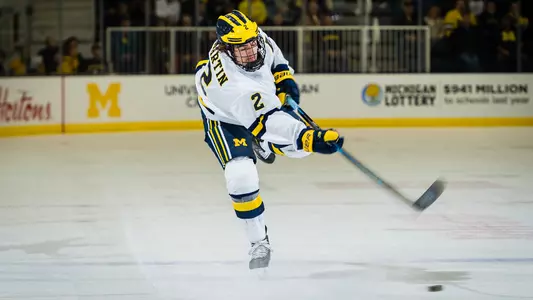
Martin on Penalty-Kill Success in Win Over Spartans: 'It's an opportunity'
3/7/2020 10:00:00 AM | Ice Hockey, Features
By Steve Kornacki
ANN ARBOR, Mich. -- Special teams told the tale in this one.
The Wolverines were 3-0 winners Friday night (March 6) in the opening game of the Big Ten quarterfinals with Michigan State at Yost Ice Arena. How the archrivals responded to being short-handed pretty much determined the outcome in the first showdown of a best-of-three series.
Goal-scoring leader Jake Slaker (No. 13) and Nick Pastujov (No. 9) made good on two of five University of Michigan power-play opportunities. Pastujov's, with 7.7 seconds remaining in the second period, was a back-breaker, giving the Wolverines a three-goal lead just 2.4 seconds into the man-advantage.
Strauss Mann, who notched his fifth shutout of the season to tie for No. 2 nationally in that department, made seven of 25 saves on power plays. Mann is tied for third in the NCAA with a .938 save percentage and tied for seventh with a 1.91 goals-against average.
Combine Mann with a smart, tenacious defense, and it's the recipe for success in any situation. Michigan killed a season-high five penalties, and now ranks 16th nationally in penalty killing with 88 kills in 105 "opportunities" for a success rate of 83.81 percent.
The Wolverines set the tone the first time MSU had the man-advantage. The four Michigan defenders kept the puck along the boards, where nothing could happen offensively for the Spartans, and deftly cleared the puck several times.
"We talk a lot about the 'one go, all go' mentality," said senior defenseman Luke Martin. "If one guy's stepping up and adding pressure, two, three and four have to step up, too. We did a really good job there and were on the same page all night.
"Once it got on the yellow (strip painted along the bottom of the boards), we kept it there, and then got it out."
It didn't even seem like MSU had the extra skater on the ice.
And when the Wolverines had three penalty kills in the second period, it was as if the life had been sucked out of the Spartans.
"I think we did that tonight," said Martin.
Mann said of the penalty kills: "I think it was the difference in the game. If they score two of those, it's a whole different game. We were able to keep them at bay, and then you can really turn momentum when you get a goal on the other side.
"Sometimes, penalties can be the worst thing because they give the other team opportunities. But at the same time, if you can kill them off, it can be a huge momentum swinger."

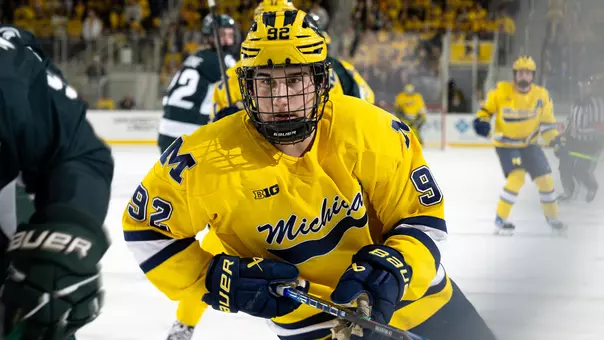
Martin heads up the penalty kill, or "PK" as it's known, with smarts, tenacity and toughness. He blocked three shots Friday and his 83 on the season rank second nationally.
"He's our rock back there," Wolverine assistant coach Kris Mayotte said of Martin. "Him and Strauss and (defenseman Griffin) Luce are as consistent as they come in those areas. They're willing to do whatever it takes for the team, and Luke is a guy our team relies on a lot, especially on our kill, and he's the quarterback back there. He reads everything very well, and makes sure guys are in the right spots.
"We were dialed in and executed a game plan, and we were successful. We had some big blocks, and even when we had some breakdowns, guys stepped up and made the right reads, and covered, and sacrificed their bodies with big blocks. Luke will block a shot, get the puck out or do whatever it takes."
Michigan head coach Mel Pearson said of Martin: "He just gets in the way. He's not afraid. He's a tough kid."
Mann added, "Luke's great, and the blocked shots are huge. When you've got guys in front of you willing to put their bodies on the line, my job's easy. I've got all the pads on and I'm fitted for the job. These guys are wearing a couple of elbow guards and a foot-wide chest pad, and putting their bodies on the line.
"That can be the difference in the game, and also credit the 'D' tonight for clearing out a lot of rebounds. Making the first save is the biggest thing, but if they're there to smack it out of harm's way, then it makes my job easier."
Pastujov also blocked three shots in addition to his pivotal goal, and freshman defenseman Cam York blocked a pair as Michigan had a 15-11 edge.
"And that thing hurts," Pearson noted of the pucks being fired. "Put on some equipment and I'll shoot one off your shin pads. I don't shoot it very hard. But let me know how it feels. It's not a fun thing, but you have to do that this time of year."
The decision Pearson made to give Mayotte the PK and goalie coaching duties, while associate head coach Bill Muckalt focused on power play situations, has paid dividends in all cases.
"He's done a great job," Pearson said of Mayotte. "We looked back during the hiring process and knew we had to improve our penalty kill and we needed to improve our power play, and we've improved in both areas. Billy Muckalt has done a good job, and the special teams have improved.
"The players begin to take ownership, and between the coach and the player they've got a great relationship."
Mayotte said, "I think it's been cohesiveness and a consistent message throughout the year, right?"
Muckalt was a Hobey Baker Award finalist as a senior and a two-time national champion for Coach Red Berenson's Wolverines before playing five seasons in the NHL and becoming a successful coach.
Mayotte was a standout goalie at Union College before playing professionally, and had the same coaching duties at Providence College, where he became associate head coach and was part of a 2015 NCAA championship team.
"He has one of the best hockey minds I've ever met," Mann said of Mayotte. "He's a really good mentor for me and our whole team. He pays a lot of attention to detail, and that's how I work. With what he preaches to the team, we can be prepared for any situation that comes our way.
"Penalty kill is huge, and we feel comfortable even if there is only four guys out there. Everyone knows their role and trusts each other. We've built that throughout the year, and he's the brain behind it for sure."
Martin added on Mayotte: "He is very, very detailed. He gives us a great book on their team on Thursdays before the games. We go out and practice it, and then he's very committed to adjusting in games, and making those observations which are huge. A team can change their entire look, and Mayo will take in the information and give us a plan to those changes.
"And he's always very encouraging. He's taken the mindset to the next step, like this is an opportunity for us. It's not a penalty we have to kill, it's an opportunity."
It's an "opportunity" to deflate opponents while creating a belief that a siege survived is a mind game won.
Mayotte said his new approach took time, but his players now show confidence in it.
"Early on in the kill, we were implementing some new things," said Mayotte, "and trying to get them to kill in a certain way. Early on, there was a hesitation. They were doing what they thought they should be doing instead of just playing. But the more you do it, the more it feels natural."
Martin said: "Some of the rotations and pressure points (changed). We knew it was going to be different and everybody did a good job of handling it and adjusting. It's paying off now. That's a huge strength of our team. We have the trust back there, and every PK is an opportunity."
What happens when there's a breakdown on the PK often determines the success rate.
"Early in the year, if there was a breakdown it would cost us," said Mayotte. "Now, there's a breakdown -- and we try to limit those as much as possible -- but guys know how to recover and help each other. They are more playing hockey than being robots.
"I stole this term from somebody: 'Hockey sense rules out all rules.' When you see a play to be made, these guys are good hockey players, I want them to go make it. When things break down, instincts take over, and we want them to use it."
Martin said: "It's about learning where each other are on the ice, and we talk about not making the same mistake twice. If we make one, we learn from that, and we've all done a great job with that. We've figured out where one another are on the ice and support each other. We're going to make mistakes -- it's a game of mistakes -- but it's about being able to recover from those and limiting the damage."
Damage control. That's what the PK boils down to, and it's something the Wolverines are doing with great success.