Wolverines Using Unique Approaches to Fall Practices Without Games
8/21/2020 11:00:00 AM | General, Men's Soccer, Women's Soccer, Volleyball, Features
• Watch: Daley Talks Pandemic, No Fall Season, Next Steps
• Watch: Klein Discusses Reaction to Postpoement, Navigating Uncertainty
• Watch: Rosen on Pandemic, Uncertainty, Moving Ahead
By Steve Kornacki
ANN ARBOR, Mich. -- Many Wolverines are adapting to a unique challenge. They are practicing fall season sports without a schedule of games dangling in front of them as motivation for their hard work.
When the Big Ten Conference announced Aug. 11 that fall sports were postponed because of the coronavirus pandemic -- with possible rescheduling later in the school year -- it brought about the need for adjustments.
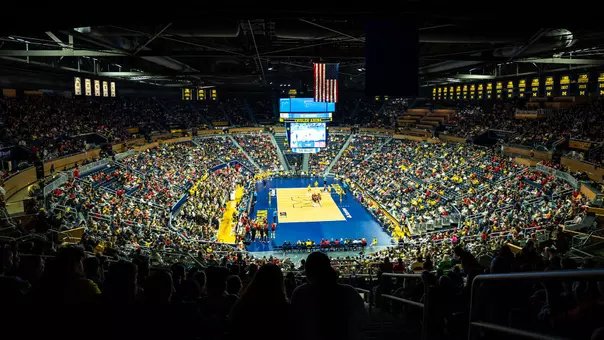
University of Michigan volleyball head coach Mark Rosen moved scrimmages from legendary Cliff Keen Arena to the large "rubbery" pad off the grass in the middle of the nearby outdoor track lanes.
Gov. Gretchen Whitmer has limited groups to gathering inside with 10 or fewer people, and after the coaching staff is subtracted, that would leave room for only six players -- enough for one team but six short of what would be required for a second team to play in an intrasquad setup.
"We didn't feel it would be productive in the fall unless we could get the whole team together at once," said Rosen. "Some of that is also tied into the team dynamic of wanting them all in one place and with each other, talking about the things we need to do for our team to play well.
"So, we decided to move outdoors at what used to be Ferry Field. They have a pad where they do all the high jumping and pole vaulting. It's flat and just like a rubbery track surface. We built two courts out there with nets and equipment we have from our summer camps."
Women's soccer head coach Jennifer Klein has seen her seniors focus on molding the freshmen, and set up team bonding time with events such as a movie night in the Big House.
Men's soccer head coach Chaka Daley is taking it one day and one week at a time, "reading" the changing needs of his squad.
"There's no blueprint to do this because none of us have ever experienced this before," said Daley. "But we do know that we don't want to push too much, too soon. We're really reading the mood of the group for how much we push. We're not coming close to the (allotted) 20 hours (of weekly practice time) right now, but definitely using some meaningful time that is great for us and great for the kids.
"We're together again to create some bubble or normalcy for the time being."
Klein noted, "We're plugging away. There has been some somberness, but the team has been tremendous about staying positive, optimistic, resilient and working together. We've told them it's all about adapting and finding ways to thrive in the new parameters that you're given, and they've done such a great job."
Rosen added: "We're telling our team, 'Control what you can control.' They've all been so resilient. I'm so proud of them. It's so great to be together again. You know, you can't really build culture on a Zoom call."

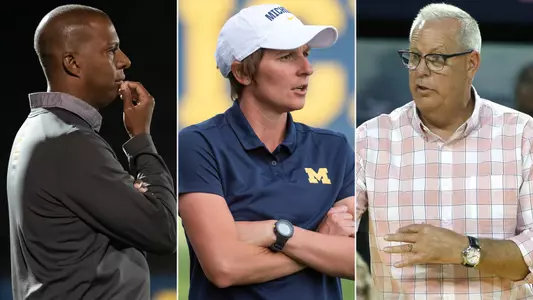
Klein (right)
They're all typically gearing up for season openers in late August, but this year they are focusing on long-term gains.
"One of our biggest challenges right now is defining what this time is for us," said Klein. "Our fall is typically our performance time and our time of competition. We're looking at it as a time to make up for the time we lost in the spring, with putting the focus back on development of the individual and team. We've dedicated this time to conditioning to get back the strength we've lost, to improve our speed and agility and endurance. That way, when we can compete, we'll be in a good position to do so.
"But it's great just putting the team back in an environment where they can enjoy being together again. It's your escape from everything going on right now, playing the game you love and just enjoying it all."
Baby steps are required during the return. None of the three coaches are currently using the 20 hours per week, playing it smart by gearing up at a safe pace. Rosen, now going three days a week while offering individual work and strength and conditioning other days, doesn't expect to practice five days a week at full speed before October.
"There's a resocialization process that we went through with athletic medicine and our athletic department medical staff," Daley said. "And we're going through a physical acclimatization period right now. So, we're putting the building blocks on after not being together for five months.
"They haven't competed in a long time, and so we're putting them through the challenges of a lot of technical work and building from week to week, to where we can eventually have them competing in a way that's not too dissimilar to games."
Providing competitive situations for student-athletes longing to go against conference and other foes is important, the coaches agreed.
"If we're cleared at a point into the fall," said Daley, "and everything looks positive from a health standpoint, our objective will be to manufacture a competitive fall season for their own well-being, hopefully getting six to eight (intra-squad) games. The guys don't know this yet, but we'll do them on Saturday mornings or occasionally at night so they can get that feeling of playing under the lights. I think that will excite them and keep them hungry and motivated for whatever is to come.
"It'll be important just for them to get some of that competitive edge out, and also from a tactical standpoint, will be very, very helpful for us as a teaching tool. To keep every fall team improving, we have to manufacture what they enjoy doing most, and that's to compete on a stage in games with meaning.
"We can use the videos after taping the games to highlight what we want to educate the group on. We've basically flipped it, and made this our offseason. We only had a month of that before we were shut down in the spring (on March 12)."
Klein said, "When we asked them what they wanted to do, they said, 'Compete.' They love to compete. They find ways to make everything a competition. They love to work on finishing (shooting after breaking in on the goalie). And we're hoping to be cleared to scrimmage at some time during the fall term."

Daley
Practices for the men's soccer team began Aug. 11 with a morning workout that concluded only hours before the bad news came.
"We met with the guys that afternoon," said Daley. "We met at the (soccer) stadium in the main grandstand and talked to them. We told them that we were hopefully optimistic (for spring games) and we're going to use the fall to improve. 'There are brighter days ahead. But that's not going to change the opportunity to train. Let's take advantage of it, enjoy it, and get better day to day.'
"I had been purposely transparent about the possibilities (for anything happening) back to March. On the last time we met back then, when we said goodbye as a team on Zoom, I told them, 'Hey, it's tragic. Appreciate what you have because you never know what's going to happen.' You figured there might be some kind of normalcy, but once the dominoes began to fall, they realize we're now doing the best thing."
Road trips and tournaments provide great team bonding potential, but coaches have been required to get creative to create that experience this fall.
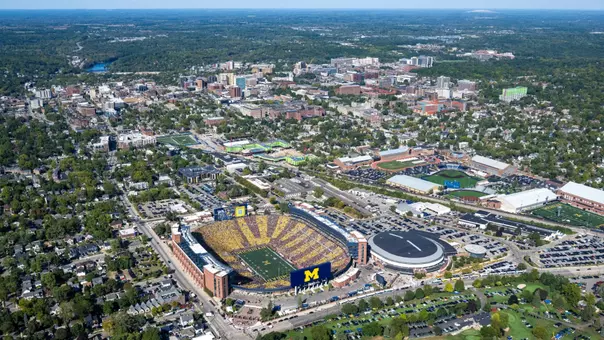
"We looked for a team activity that allowed us to social distance," said Klein. "And so we're going to the Big House for a movie night. 'Miracle' (about the 1980 U.S. Olympic hockey team) beat out 'Black Panther' by one vote."
Rosen said the coaching staff will "explore" team social activities, and particularly wants to make his four freshmen feel at home as quickly as possible.
Daley did trivia and movie nights, and also had John Beilein, Michigan's winningest men's basketball coach, on a Zoom call to discuss team culture.
"That was a real treat for our guys," said Daley.
Seniors, who may or may not get to play during this school year, are the focus.
"Our seniors are the first group from Michigan to go to the NCAA Tournament three times," said Daley, "and they're primed to compete again. Potentially, there is no NCAA Tournament in the 2020-21 cycle, and that's still to be determined. With a lot of things still hanging in the balance -- like what eligibility is going to look like and whether the NCAA considers playing in the spring with a national tournament."
Klein said her 10 seniors -- who last year led Michigan to the NCAA Tournament for the first time since 2016 and made its first appearance in the Big Ten Tournament final since 2005 -- have dedicated this time to nurturing the seven freshmen.
"The freshmen usually get two weeks to practice and then have to jump on a moving bus," Klein said. "But we can get them up to speed and integrated fully. The senior class really wanted to take this time to be mentors for the freshmen. They really want to leave a legacy with the freshmen so they can carry on what we've built over the last two years. The senior class is a very special group."

Rosen
Rosen said volleyball practices begin just as they always have with individual drill work. Only now, half the team goes to the Intramural Building while half stays at Keen. Then they reunite on the never-before-seen outdoor courts.
"It's been good," said Rosen. "People are calling or shooting me emails, saying how 'innovative' we are and 'excited' they are to have these outdoor courts. I think it looks better than it is. It looks cool and different. But playing indoors and outdoors are two very different skill sets. We're used to playing in an environment where the air doesn't move and there's no sun. If the winds blowing at all, our ball only weighs 12 ounces. And when you look up at the sun, it really blinds you."
Rosen said most of his players do not have sunglasses suited for athletic competition.
"But being outdoors is better than nothing, for sure," said Rosen. "We're able to play as a team. And the surface we're playing on is awesome, it's ideal. It's good on their legs and they jump well on it. It's about as good of a surface other than wood that you can play on."
Rosen has taken the Wolverines to the NCAA Tournament in 18 of 20 seasons, and is the program's winningest coach with 429 victories and a .618 winning percentage while playing in a Big Ten that is readily accepted as the nation's best volleyball conference.
His teams in recent years have approached Keen for practices and games to the eye-catching sight of two story-high photos of top players in full uniform, the schedule also there in big, bold letters. This year, that wall is just a brick wall, no schedule in sight.
"Right now," said Rosen, "I think the motivation comes from just being happy to be back in our sport after five or six months of being away from it. We identify how lucky we are to be able to play again, and are thankful to come together as a team and have our sport back in our lives.
"So, they're pretty motivated right now and excited. But that will wane, and we'll hopefully not let it wane. People don't get into sports so they can practice. They get into sports so they can compete, and they practice so they can compete well. So, we try to have competitive opportunities in every practice. You need to develop that skill (competitiveness), too, and it's also fun. And they know every day: 'We're going to play today, have game time.'"
He envisions, in the months ahead, creating a regular gameday experience with warmups and intrasquad games. They'll play outdoors unless the indoor gathering number increases, "and hope it doesn't rain while we get good weather."
Rosen added, "I think that will give them that little adrenaline rush, excitement and playing for something."
Which is what this all comes down to -- playing for something, playing other schools and striving for a championship season. But for now, they have to make the best of playing only one another, for one another -- making improvements for another day.