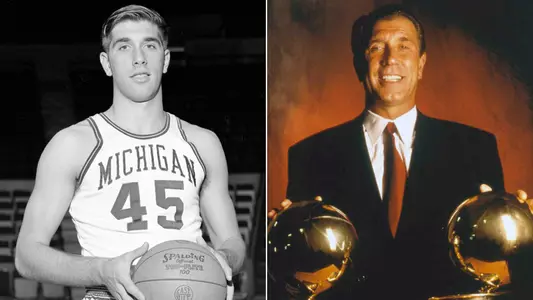
How Hall of Famer Tomjanovich Became NBA Playing, Coaching Success After Michigan
8/27/2020 12:00:00 PM | Men's Basketball, Features
By Steve Kornacki
ANN ARBOR, Mich. -- There was a chance Rudy Tomjanovich, the pride of Hamtramck, Mich., was going home to play professional basketball after his All-America career at the University of Michigan. Instead, he found a new home in Texas. Tomjanovich spent one-third of a century playing for and then coaching the Houston Rockets.
The Detroit Pistons owned the No. 1 overall pick in the 1970 NBA Draft, and selected St. Bonaventure center Bob Lanier. The San Diego Rockets (who moved to Houston one year later), with the next selection, took Tomjanovich. I asked the five-time NBA All-Star how close he came to joining the Pistons.
"I don't think it was close, but I don't know for sure," said Tomjanovich. "But here's what happened in that situation. Pro basketball was a different situation then with the ABA (American Basketball Association) pushing for a merger, and the feeling was that salaries would go down if that happened."
The ABA drove up salaries as a rival league, and paid big money to lure away top college stars such as Julius Erving, Moses Malone, George Gervin (from Detroit and Eastern Michigan), David Thompson, Rick Barry and Dan Issel -- each of whom preceded Tomjanovich with Naismith Memorial Basketball Hall of Fame inductions.
Rudy T. will join them when he is enshrined May 13-15, 2021, in Uncasville, Conn., due to the COVID-19 pandemic. Tomjanovich, and the rest of the 2020 Hall of Fame class, was originally scheduled to be honored Saturday (Aug. 29) in Springfield, Mass.
The established NBA did not want to get burned in losing high first-round picks, and so Tomjanovich said teams looked to sign players even before drafting them in order to assure they did not lose them or get into bargaining wars.
"A New York agent talked to me and put the fear of a merger into me," said Tomjanovich, 71, now retired and living in Austin, Texas. "He asked, 'What would you consider a good contract?' I said, 'One hundred thousand dollars (a year).' I had seen that (Michigan's) Cazzie (Russell) had received something like that (as the No. 1 overall pick in 1966 by the New York Knicks). The agent said, 'I think I can get that for you. However, you have to sign a contract before the draft with an NBA team.'
"So, I signed and was already in the can before the draft. There were four or five of us that were delivered that way. I thought I was going in the first round, and probably high in the first round, but there might have been guys drafted ahead of me had I not signed with the NBA."
Now, the first four NBA picks in that draft held 50 years ago are in the Hall of Fame: Lanier, Tomjanovich, Pete Maravich and Dave Cowens.
Tomjanovich could not figure out why he was not starting for San Diego as a rookie, but got a break when the Rockets visited Detroit's Cobo Arena to play the red-hot Pistons, and he came off the bench to become his team's second-leading scorer in a 112-101 victory.
"Bob Lanier falls on our starting power forward, who wrenches his back and is out for a month," said Tomjanovich. "I came off the bench and got a career high in points (19) and rebounds (10), and I thought that would be the beginning. I came off the bench and got us going with some offensive rebounds in the next game, and then, all of a sudden, I don't play."
Coach Alex Hannum asked Rudy to take a walk with him during the next road trip, and had this to say to him: "Some guys are going to have to learn by watching, and some guys are going to learn by playing. You are going to have to learn by watching."
Tomjanovich said: "I'm thinking, 'This doesn't make sense. I think I'm better than most of our players, and all of a sudden I'm not going to play?'"
Hannum had won two NBA and one ABA championship and also is in the Naismith Hall of Fame, but he missed the mark on Tomjanovich, who averaged 5.3 points coming off the bench as a rookie. Tomjanovich was livid when presented a gag award at the team banquet following the season.
"I was presented with a mustache in a plastic case," he recalled. "Somebody thought it was funny and said, 'Rudy's contribution for the year was having the worst NBA mustache we have seen.' So, I walk out of that thing and I'm kicking that damned moustache down the street.
"Smoke was coming out of my ears and I said, 'This isn't going to happen again.' The next day -- now remember, NBA teams didn't even have facilities to work out in back then -- I found a gym to practice as hard as I could."

Tex Winter replaced Hannum when the team moved to Houston, and Tomjanovich blossomed, averaging 15.0 points. Two seasons later, he averaged 24.5 points, finishing sixth in the NBA. He played with one great center at the beginning of his career, Elvin Hayes, and went out with another great center, Moses Malone, while reaching the NBA Finals before losing in six games to the Boston Celtics in 1981, his final season.
Being drafted by the Rockets turned out to be a fabulous break for Rudy T., after all. He spent more than three decades with the organization as a player (11 seasons), assistant coach (nine seasons) and head coach (12 seasons).
Tomjanovich led Houston to both of its NBA championships in 1994 and 1995, and that, along with coaching the 2000 Olympic gold medal team for the U.S., eventually punched his ticket for Springfield.
"Being in the Hall of Fame is beyond my greatest dreams," said Tomjanovich. "The Hall of Fame, though, is about coaching. I believe I'm going in as a coach."
He paused and said, "God! That's almost laughable. That here I am -- I'm not an authoritative person. That's no part of who I am, and how in the hell do you get to become a coach and have success in a very tough business where the players make 10 and 20 times more than what the coach makes? But I look at how it happened, and it's just amazing. It's about believing in other people. I couldn't do it by myself. The guy that ended up being my assistant, Carroll Dawson, really helped me."
Dawson, who later became Houston's general manager, and Tomjanovich worked as assistants under Don Chaney. When Chaney was fired during the 1991-92 season, Tomjanovich not only expected the more-experienced Dawson to become the head coach, he wanted his mentor to get the post. However, Dawson declined for health issues. Tomjanovich was not sure he was ready for the job, but Dawson convinced him that he had to take it.
Dawson told him, "I'll give you everything I have in my knowledge. Everything I know, you will know. Let's do this thing." Together, they led a team that won two NBA titles.
"I couldn't have done it without Carroll," said Tomjanovich. "He was like having your big brother in a foxhole. So, I was blessed."
His marquee player on the title teams was center Hakeem Olajuwon, the 1994 NBA MVP and NBA Finals MVP in 1995 -- when they swept Shaquille O'Neal and the Orlando Magic.
"We inherited a player as great as Hakeem Olajuwon," said Tomjanovich, "and I knew him as well as anybody as far as a player. We had watched him at the University of Houston and then with the Rockets. We knew that he had to be the ticket, the main guy, and we had to find ways to make it very efficient to go to him. But teams are so smart and aren't just going to let you do that.
"They found ways to take him away, and that was the key, making them pay for taking the ball away from Hakeem. That was when we devised our spacing pattern. What we did different was instead of just cutting players through, because teams would still double-team him, was find enough spacing. And as soon as the double-team happened, Hakeem would go right to the basket."

Olajuwon and Rudy T.
Two defenders would stay with Olajuwon, and the Rockets usually found a three-on-two advantage on the perimeter.
"Hakeem would then pass the ball out and we started acquiring great shooters to get that big pay off," said Tomjanovich. "His passing was his secret to becoming a champion. I mean, he could score, rebound and block shots. But when we got great was when he could trust the other guys around him."
It was that offensive adjustment drilled into Olajuwon, belief in his players and ability to connect with them as a former star player that set up Rudy T. for success. Superstars Charles Barkley, Scottie Pippen and Clyde Drexler each asked to be traded to Houston because they wanted to play for Tomjanovich and with Olajuwon.
"When we interviewed free-agent players, we wanted to get to know them," said Rudy T. "But we wanted them to get to know us, too. I believe in having a very close relationship, and all the things we did were to show them we were very player-centered, and that they would have access to me."
Robert Horry, the clutch-shooting forward on both championship teams, also played for coaches Phil Jackson (a record 11 NBA titles) and Gregg Popovich (five NBA championships).
Horry wrote in the Players' Tribune: "They are both great in their own right, but based on personal experience, 'T' was the greatest NBA coach. I know he doesn't have nearly as many championships, but sometimes we give one person too much credit for titles." He loved that Tomjanovich realized he could not see what players were seeing on the court.
When discussing plays in huddles, Tomjanovich said he would often ask: "What do you think will work?" If the player-suggested play worked, he would call it again, showing even more trust.
"Nobody has all the answers," said Tomjanovich. "I knew what I liked, but didn't pretend to be the expert. It's a great feeling when you come up with something that works for your team, and it fits your team. There's no other feeling like it.
"My philosophy is that the plays don't go from year to year. Finding plays that your players can be the best at is what I tried to study in the game. It was finding ways to get them in the right areas, and then make the right calls to communicate with them so it's not confusing. I gave them a lot of stuff."

And Winter, who brought the triangle offense Michael Jordan termed "a huge part" of the Chicago Bulls' championship success, coached Tomjanovich early in his playing career, too.
"Tex accelerated my growth as an NBA player," said Tomjanovich. "I learned what things to stay away from in clogging up offenses and spacing. He's a big, big factor not only in me as a player, but as a coach, too. He gave us terminology so we could talk in front of other teams and they wouldn't understand what we were talking about. He had the triangle back then (in Houston), absolutely. It was called the triple-post offense at that time, but it was the same stuff Chicago ran."
Complete knowledge and clear communication were Tomjanovich strengths. So was his ability to innovate. Tomjanovich expanded Houston's videotape department and became one of the first coaches to stress intense film study.
"Oh, absolutely," said Tomjanovich. "You know, I had every job that you can have in a basketball organization. I was an advance scout, spying on other teams, drawing up their plays. And I would come back from the road and show the videotape as well, breaking that down, and walking the team through those plays. That was a great, great education for me.
"Pat Riley (of the Los Angeles Lakers) and Chuck Daly (of the Pistons) were coaching then, and watching Daly as a scout was just fantastic. He ran a new play every time down, and you would get 20 different plays. But I was different. If we had success with a play, I'd say, 'Run it again.' Sometimes, if we got a good shot and it just didn't go down, I would run the play again as a motivator for players. If you triggered a successful play for the Rockets, you deserved another shot at it."
His final major accomplishment was coaching the United States to gold in the 2000 Sydney Olympics, surviving a scare from Lithuania in the semifinals and holding off France in the championship game.
"It was a great honor and privilege to get that assignment," said Tomjanovich. "I thought I was a candidate to make the Olympic team in 1968. But now, I could get no greater assignment, that our people wanted me to coach our team against all the other countries.
"But the pressure of being an NBA team. I can't tell you the pressure you feel in not wanting to be the first pro team that loses in the Olympics. I know the players were feeling that pressure, too. And the other countries were getting a lot better at that point. We're losing by one to Lithuania (late in the game)."
Ramunas Siskauskas was fouled on a three-point shot with 43.4 seconds remaining and the opportunity to put his team up by three points.
Tomjanovich recalled: "That guy shoots the three free throws, and I'm thinking that in the future, at my funeral, somebody doing a eulogy says, 'He was a good father. He was a great friend. He was a hard worker, but that dummy lost in the Olympics!' Luckily, the guy makes only one of three, and we make some hustle plays and get the ball in the basket and get through that game (with an 85-83 win). But, man, that was a scare.
"After that close scare, after we beat France, I just had a sigh of relief. It didn't hit me, and I turned and saw Gene Keady, a tough son of a gun, I love that guy, and he had a tear in his eye. All I could feel was relief."
Tomjanovich coached four more seasons in the NBA.
Rudy T. was 503-397 in 11 seasons in Houston, but resigned after missing the final 17 games in 2002-03 while battling bladder cancer. He stayed with painful treatments to become cancer free, and later opted to sign on as coach of the Kobe Bryant Lakers in 2004-05.
When discussing entering the Hall of Fame along with Bryant and others, Tomjanovich said, "How blessed I was to have that opportunity (to coach Bryant). The only negative is Kobe not being alive to go in for his family to see the wonderful tribute that the Hall is going to make for him. He was such a big factor in the way basketball was played and such a great achiever of amazing things. I consider him a gift in the short opportunity that I had to coach in L.A."
Tomjanovich said they spoke often during that season, adding that he "would ask Kobe where he liked the ball" in order to better devise ways to get him the ball in those spots in the first season after dominant center O'Neal left for the Miami Heat. It always came down to the chess-match element of the game for Rudy T.
Popovich said Tomjanovich has had hall of fame "credentials for quite a while," adding that it was a "mystery" as to why his inclusion took so long.
"That was the silver lining in the years that I didn't get in," said Tomjanovich. "So many people spoke up for me that I didn't ask them to do that, and that was quite a compliment. So, even though the Hall wasn't happening all those years, I had a wonderful feeling of support from so many coaches."

Tomjanovich and Bryant
The kid who could rebound with the best of them and drain deep bank shot after deep bank shot is going into the Hall of Fame as a coach.
However, more than anything, Rudolph Tomjanovich Jr., enters basketball's Valhalla as a survivor. He grew up in the tough neighborhoods of Hamtramck, Mich., and Detroit, battled through the initial cancer diagnosis and two returns of the cancer for clean bills of health. Then there was the horrific attack and injury that required physical and mental toughness.
Tomjanovich said he was running to protect a Houston teammate involved in an altercation with powerful Lakers forward Kermit Washington on Dec. 9, 1977. Washington whirled and sucker-punched Tomjanovich with a blow that shattered his face.
ABC News wrote: "Tomjanovich, who crumpled to the floor, almost died that night of injuries that were akin to being thrown from a car going 50 miles per hour. His skull was dislocated and spinal fluid was leaking from his brain. He recalled being able to taste the fluid in his mouth."
The life-threatening injuries sidelined him for five months. But he came back, and did so with a flourish with an All-Star Game selection the very next season.
The incident, recovery and eventual forgiveness and friendship were covered in Tomjanovich's 1997 autobiography, "A Rocket at Heart: My Life and My Team" and a 2003 book by John Feinstein: "The Punch: One Night, Two Lives, and the Fight That Changed Basketball Forever."
"I went through a range of emotions," said Tomjanovich. "It was such a shock and I had been so high on where that team was going. I had 19 points at the half of that game in Los Angeles, which was really something at that place.
"And then a fracas broke out with (Kevin) Kunnert and Kermit. I ran down the court but happened to take the wrong route. He thought I was attacking him, and I had no intentions of fighting. I was just concerned about a teammate. It was an unbelievable bad break, and a mistake by him to do that. But it changed basketball. That's when you started seeing stricter rules on those kinds of things.
"What happened was, I had to forgive him to save me. I couldn't dwell on anger and resentment toward him. Resentment is like drinking poison and expecting somebody else to get the effects. I had to let that go and move on. Years later, John Feinstein wanted to do a book. I said I was honored because he's a really good writer, but I said, 'Kermit's not going to want to do this.' He said, 'No, Kermit wants to do this.' I was still reluctant, but John was such a good guy, and I thought he would do a good job.
"After the book comes out, I was working for the Rockets and the phone rings, and it's Kermit, and he thanks me for doing the book because he wanted an opportunity to show how his life's gone, and it hasn't gone great. But it was my bad luck to get hit by the strongest guy in the league."
Washington was fined $10,000 and suspended for 60 days by the NBA, but Tomjanovich missed more than twice that amount of playing time and was lucky to be alive, doctors said.
Nearly 25 years later, Washington, working with young prospects, sent Tomjanovich a player who worked hard in training camp going against Rockets rookie center Yao Ming, even though that player was not a candidate to make Houston's roster.
"And Kermit called every once in a while to stay in touch," said Rudy T., adding that it was an incredible experience to combine with Washington considering their past history.
What a road he traveled after departing Michigan 50 years ago. He played with two Hall of Fame centers (Hayes and Malone), and then coached two Hall of Fame centers (Olajuwon and Ming). He made All-Star teams, coached two championship teams and a gold medal team. He survived a cowardly punch that shattered his face, but not his will to succeed. He's survived cancer three times and praises God for that.
Tomjanovich, "The Shoemaker's Son" of Croatian descent, blazed quite a trail to Springfield, one lined with determination at every turn. Rudy T. could play and coach basketball like one tough son of a gun.
• Part 1: Tomjanovich, 'The Shoemaker's Son,' Changed Shot at Michigan on Way to Hall of Fame