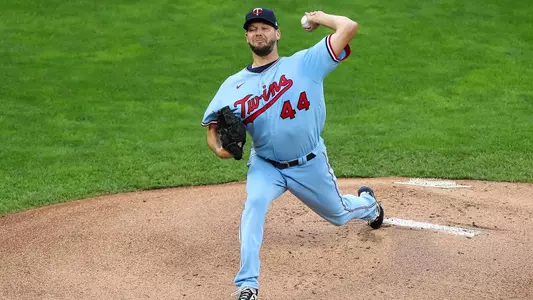
Hill, MLB's Oldest Pitcher, Hoping to Return to World Series and Win with Twins
8/28/2020 10:00:00 AM | Baseball, Features
By Steve Kornacki
Rich Hill is pitching with an eye on returning to the World Series, where he was once masterful for the Los Angeles Dodgers.
He posted a 1.80 earned-run average with 19 strikeouts and eight hits allowed in 15 innings over three starts. However, the Dodgers lost a heartbreaking, seven-game series to the Houston Astros in 2017, and the Boston Red Sox took care of Los Angeles in five games the next year.
Hill went from being a journeyman to a tough man to beat with the Dodgers, who also made the former University of Michigan pitcher a very rich man. He signed a three-year, $48 million deal with Los Angeles just 16 months after making $2,000 per month pitching for an independent league team called the Long Island Ducks.
However, the Dodgers chose not to offer close to the one-year deal the Minnesota Twins put together this season with Hill coming off primary revision surgery to repair the ulnar collateral ligament in his left pitching arm. He reportedly signed a $3 million deal with $9.5 million in possible incentives.
Hill is enjoying his new team and believes it enables him to chase an old dream.
"This is a really lively group," said Hill, whose next start is scheduled for Sunday afternoon (Aug. 30) in Detroit against the Tigers. "It's a group of guys that want to play the game of baseball and want to win. And that was our main reason for signing here. Because of the 101 wins last year, the youth that this team has also with a mixture of veteran leadership, (there's an) opportunity not only to get to the playoffs but win a World Series. It's extremely real.
"We're here to win a World Series. We're not here just to get to the playoffs and be happy about that. I guess until you get to that point, and it didn't happen to me until recently, and I look at it in a very hard way. If you didn't win the World Series, I feel like, yeah, it is a failed season. You can say that there's a lot of development and good things that are coming. But the main goal is to win the World Series.
"And that is what this clubhouse has -- guys having that focus -- and as we head into this stretch in September, it's going to be even more of a stretch than it was in August. So, I'm really excited to see what these guys are going to be bringing to the table. The excitement is starting to build, and guys are getting more and more comfortable around one another. So, this September is going to be a lot of fun."
Hill is the oldest pitcher in baseball at 40, and is showing there is still plenty of productivity left in him. He allowed one run over five innings with five strikeouts Tuesday night (Aug. 26) to come out with a 2-1 lead over Cleveland Indians All-Star Shane Bieber. It was Hill's second start since returning from the injured list with shoulder soreness, and he surprised Indians hitters by unveiling a cutter in the game.
"Bieber is having a great year this year," said Hill, who is 1-1 with a 3.55 ERA after three starts. "But you don't play the situation. You go out there and pitching the way you want to. I always say, 'The occasion has to rise to you; you don't have to rise to the occasion.' In bigger games, we're going down that road where we're going to play some really big games. And in those situations, that's where you want to be prepared mentally to come out and not have any situation be bigger than that (next) pitch."
That supreme focus has allowed Hill to succeed in the "big games" and dominate hitters without dominating stuff, striking out hitters at one of the highest rates in the game.

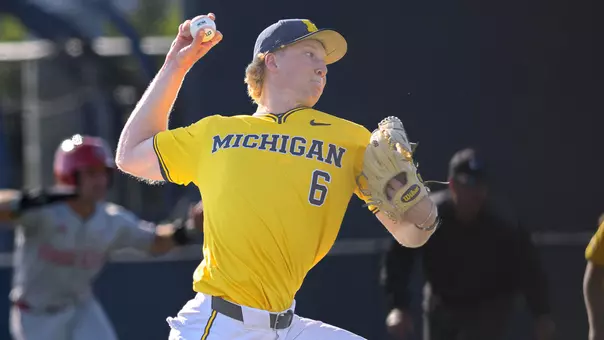
Hill struck out 229 in 177 1/3 innings for the Wolverines (2000-02), and that's what got him drafted by the Chicago Cubs in the fourth round after his junior season despite a 7-16 record and 4.92 ERA for Michigan.
He has maintained that high strikeout pace in the majors, fanning 9.6 per nine innings with 1,012 strikeouts in 950 innings. Hill does it not only with a lethal curveball that came late in his career, but by supremely commanding a four-seam fastball that, according to FanGraphs, averages 89.0 mph this season and has never been higher than 92.9 mph in his career.
The curve has been the difference-maker for him.
Hill posted a 24-22 record and 4.72 ERA during an up-and-down career with six MLB teams from 2005-14.
However, since the Boston Red Sox signed him off that independent league team on Aug. 14, 2015, and literally prompted his learning curve, Hill has pitched like a top-of-the-rotation starter.
He is 42-21 with a 3.00 ERA since then, and was at his best when not allowing a hit through nine innings at Pittsburgh in 2017 before becoming the only MLB pitcher to lose a no-hitter on a walk-off homer that came off the bat of Pirates second baseman Josh Harrison leading off the 10th inning.
While he was with the Red Sox, assistant pitching coach and vice president of pitching development Brian Bannister convinced Hill to rely on his breaking ball by offering a study of analytics that said it would lead to "more success" for him.
"The idea of throwing more curveballs came about in 2015 when I was talking to Brian Bannister," Hill told me for a 2017 MGoBlue.com story. "He was giving me some statistics about the breaking ball and about my breaking ball in particular. He talked about swing-and-miss rate and all the new, quantified statistics that are out there on spin, spin rate and all that.
"He taught me how to use all that in my own game, and he was able to sell me that if I threw that pitch at a higher percentage, more than likely I was going to have more success. He also mentioned a word that was interesting, which was 'shape.' I'd never really heard a breaking ball explained that way.
"So, I started seeing a lot of different options and opportunities."
He explained "shaping" his breaking ball to be "oblong, short, slow or quick" depending on what he wanted against a particular hitter in a particular situation while also taking into account what was working best for him on a given day.
Now, Hill has a new pitch to compliment the fastball and curveball that he's both thrown at identical 48.2 percent rates this season.
When I asked Hill about any possible repertoire tweaks after his last start against Cleveland, he smiled on the Zoom call and said, "Yeah, we added a cutter in there today. I don't know if you guys saw that, but we threw a couple cutters in there, and they were really good. When the curveball and the fastball are marrying each another, and playing well with each another, yeah, it is difficult for the hitters to make that decision. I know it's only two pitches, but you can have one pitch that's a curveball and have six different pitches if you would like (depending on how he shapes it).
"I've definitely leaned on that pitch my entire career. But when you get to this level, it's not really about trying to -- yes, there are adjustments -- but knowing what you do well is something that you really have to improve on and keep improving on. So, strengthening my strength is extremely important. But also now mixing in that cutter, and it's a quality pitch I believe, will continue in this next month to be very important as another element to the repertoire."

Kershaw (left) and Hill
Hill credited former teammate and three-time National League Cy Young Award winner Clayton Kershaw with teaching him the cutter, a pitch synonymous with New York Yankees Hall of Fame closer Mariano Rivera. Hill also noted Twins pitching coach Wes Johnson for helping him refine the cutter, which breaks toward the pitcher's glove-hand side as it reaches home plate.
"And he's honestly the best pitcher of our generation," Hill said of Kershaw. "So, seeing how he throws it, and trying to mirror that, or have something that is within the range of what his is, I think that would be sufficient enough."
Did Indians batters give him double takes after he threw them the pitch they'd never seen from him before?
"Yeah," said Hill. "I think it was (Jose) Ramirez, who I believe fouled it off his leg."
Hill's shoulder also is healthy and gaining strength.
"I felt great," said Hill. "Ryan (Jeffers, Minnesota's starting catcher) did a great job behind the dish tonight. We played really good defense, I thought, and we've been doing that throughout this new year. They made some great plays, and I tip my hat to those guys. I thought the ball came out well. I thought the ball came out of my hand well tonight, and the more you can do that, the more successful you will be. As the game wore on, I had a better feel for the curveball. I was able to throw strikes when I wanted to, and the results were there."
Four of his five strikeouts came on the curve.
Hill continued, "I preach that to the guys. It's not about pitching to the situation to get swings and misses or create something that hasn't happened yet. The whole purpose of pitching is having the intent behind the pitch, and having the intensity behind the pitch. Certainly, I felt a lot better today, and even in the last outing (against Milwaukee) I began to feel good.
"But with this third outing of the (60-game) season, we're in a sprint. There's no time. As a competitor, you want to be competitive every single time you get the opportunity. If you're doing that, you'll get swings and misses."
Pitching in the majors in a season delayed by the COVID-19 pandemic and still being heavily impacted by it is challenging. Teams are playing only opponents from their own division, which is the American League and National League Central for Minnesota, in games void of fans. Masks are worn when possible, social distancing has created air hugs, and players and staff are asked to go straight to and from either home or the hotel to the ballpark.
"The competition is not going to change when we go out there," said Hill. "It's still as intense as ever. I think coupled with the standpoint of how well this team is put together, and what the front office has done to bring the roster together and the other (development) camp, it's just a depth that they've been able to build. I can see it's built to withstand a solid playoff run into the World Series.
"With that said, it's been, at times, challenging at the hotel. But we're obviously very fortunate to be in a position to play baseball even with (a portion) of the (162-game) season this year. It's going on right now with people that are struggling with this virus, and I feel we're very fortunate to bring some kind of reprieve on television for the fans in Minnesota and the Twins and across the country."
Hill would have liked to go longer in his last start at Cleveland, but Twins manager Rocco Baldelli decided 78 pitches were enough in a game they lost, 4-2, to a team Minnesota is battling for first place along with the Chicago White Sox.
"Hindsight is one thing, but at the time -- and still at this point -- I feel really confident that [removing Hill] was the right thing," Baldelli said. "Rich had thrown about three innings this month, and we wanted to make sure that as he builds up, he's fully ready to do it ... I think it was the wise thing, long-term."
Hill asked Baldelli "seven or eight times in the dugout if we'd let him keep going," Baldelli said.
But Hill eventually understood the decision was made with keeping him going beyond September and into another October. That's where the success of teams and pitchers are determined, and Hill is primed for one more shot at winning the World Series.