Scholar Stories: Elite 90 Winner Hill Balancing Academic Excellence, Athletic Success
1/19/2022 9:00:00 AM | Women's Cross Country, Women's Track & Field, Features
Continuing the series that began in 2016-17, each Wednesday MGoBlue.com will highlight a Michigan student-athlete and their academic pursuits. These are our Scholar-Athlete Stories, presented by Absopure.
By Kyle Terwillegar
It was supposed to be a surprise, but Alice Hill quickly suspected something was up.
Though neither she nor her teammates from the University of Michigan women's cross country team had earned any of the All-America or team awards that were about to be presented after the conclusion of the NCAA Cross Country Championships in Tallahassee, Fla., this past November, they were being urged to prepare for the ceremony.
"Coach (Mike) McGuire was very insistent that we all wore matching outfits and go over to the awards," Hill recalled. "I'm thinking, 'Why do we need to go to the awards, what's going on over there?' And then my mom came over to find me and kept telling me to fix my hair, and she was fixing my outfit. She knows something, something's up."
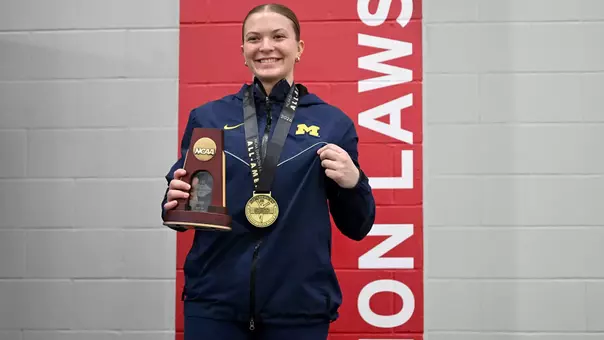
It was not until the public address commentator announced her name that the surprise fully revealed itself: she had been chosen as the NCAA Elite 90 Award Winner for women's cross country. Among the 256 competitors in the meet, including 14 who had perfect cumulative grade-point averages, she was selected as the most outstanding student in the entire field, with the tie broken by the number of credit hours completed.
"It was a real honor to receive the award," said Hill, a graduate student in the ecology and evolutionary biology program. "It was very rewarding to be acknowledged for the hard work that goes on behind the scenes. We're called student-athletes, but a lot of the press only talks about your athletic accomplishments and at the end of the day, especially for me, what's going to last -- what's going to impact the rest of my life -- is my degree and my academics.
"It's nice to show what an important part of my life that is and acknowledge that it takes up a lot of time and effort, and it can be hard to balance both."
While the announcement itself may have been a surprise to Hill in that moment, no outside observer with even a passing familiarity with her career at Michigan would be surprised to see her with the Elite 90 trophy in hand.
Already a two-time Academic All-American and the University of Michigan's 2021 Big Ten Medal of Honor winner, Hill graduated as a James B. Angell Scholar with her bachelor's degree in ecology and evolutionary biology and neuroscience with a perfect 4.00 cumulative GPA.
Along the way, she worked for three years in the Spencer-Segal Lab in the Michigan Neuroscience Institute, was first-author on a published research paper in the journal Endocrinology, and conducted award-winning senior honors thesis research.
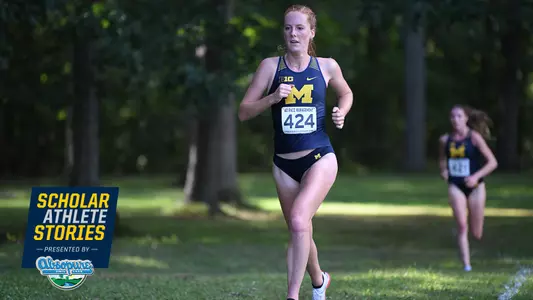
All while scoring in five straight Big Ten track and field championship meets, running on three All-America relay teams, and qualifying for both the NCAA Championships and World Athletics U20 Championships in the steeplechase.
Achieving excellence both in the classroom and on the track is not as easy as she makes it look, and she credits the support system around her for helping to maintain the balance and find the joy in all she does.
"I place a lot of internal pressure on myself and I often find that my internal standards of what I would like to achieve are what drives me or scares me more than any external standards," she said. "Relying on your support system is the best way to handle it. All my friends, my teammates and my family who I can go to to distract myself to ask advice to de-stress. It's grounding to have someone that can allow you to step back a bit and not get so worked up about things.
"In the long term, it's about having fun and enjoying it and it has taken me about four-and-a-half years to realize that. Sports is a big time investment and energy investment, so you've got to enjoy it. And the same goes with academics, you have to find a way to enjoy it."

Now a full semester into her studies in the ecology and evolutionary biology master's program as part of a small cohort of like-minded master's and PhD students, she finds herself just as busy.
Between classes -- statistics, methods of research, and effective college science education are among the topics this semester -- and her lab work and graduate student instructor work for an intro biology lab, not to mention her track obligations, she keeps a full schedule.
"I wouldn't say the workload has increased, though. I would say it's shifted," she said. "In undergrad, it was lots of different topics and different classes that felt unrelated, and you were working through the assignments in each class independently of each other. Whereas now it all feels more cohesive working towards the single goal.
"I have a few very similar classes that all focus on my area of interest in my research, and then I'm working in the lab to work towards the research and then I'm doing readings and having discussions with other people in the department is directed towards my research. I'm filling the same amount of time but in a more focused manner."
Her area of research also shifted from her undergraduate days. After focusing on neuroscience research -- how the brain works -- for most of her time at Michigan, she has opted to focus more on the evolutionary biology side -- how and why the brain evolved the way it did, and what it can tell us about ourselves -- for her graduate studies, in large part because of a study abroad trip to Tanzania in 2019.
"I just realized that I really enjoy being outside and getting to do science, not just sitting at a desk in a lab all the time," she said. "I like that part, but I want to be able to go out and get kind of dirty and hike around there and really interact with animals in the wild setting."
We went on three excursions to the national parks where you drove around and you have your clipboard and you're taking notes and observing the animals through binoculars. On one of those, we camped out there in the park. Doing the hands on research was where I thought, 'This would be great if I can find a way to get paid to do this. That's for me."
She hopes the global pandemic will not derail future planned field research to the rainforests to observe primate behavior as part of her master's degree, as part of a journey to continue to make an impact in this field of study.
"I don't have anything specifically planned out, but I feel certain that I'll probably end up doing more school afterwards," she said. "Probably a PhD, but whether that's immediately after my masters or a bit of time off from school before then, we shall see. I hope to find jobs where I get to spend a bit of time outside, while also doing research and feel like I'm contributing to the world of knowledge and science. Something that will be a bit adventurous before settling into more school."