Scholar Stories: Rowing, Engineering Journies Taking Vicars from Water to Sky
4/15/2026 2:46:00 PM | Rowing
Continuing the series that began in 2016-17, each week MGoBlue.com will highlight a Michigan student-athlete and their academic pursuits. These are our Scholar-Athlete Stories.
By Olivia Carlson
Ansley Vicars has been chasing greatness for as long as she can remember. From the beginning of her rowing career as a primary student in Great Britain to her current status as an elite Division I athlete at the University of Michigan, her experiences and interests have taken her to the finish line and beyond at record speed. In the near future, Vicars aims for new heights as she looks to the skies in pursuit of a career in aerospace engineering.
Neither engineering nor rowing is known for being easy. The combination of these disciplines may seem insurmountable, requiring unmatched levels of dedication, passion and refusal to give up in the face of difficulty. Vicars is uniquely equipped to succeed in this space where air and water merge, as her persistence and work ethic became evident from an early age.
A London native, Vicars grew up on the water. Initially, rowing served as a means to an end. Her school offered opportunities for students to gain experience with the sport before applying to secondary schools, many of which also supported rowing. Still, she grew to love the sport beyond those boundaries, joining Team Keane club and rowing for three years before competing with Tideway Scullers School for the rest of her time in secondary school, where she eventually served as captain of the Junior Women.
One of the highlights of Vicars' youth rowing career came when she was called up to represent her country in the U19 Junior World Championships in 2024, placing second as a part of the women's 8+ boat. This marked the achievement of a major goal for Vicars, who had been dreaming of competing for Great Britain at the international level since J17s -- her penultimate year of junior rowing.
The trial process, during which athletes either make the team or are cut and are placed into boats, was unattainable for Vicars at first due to injury. Still, she committed her efforts to building up her strength throughout the year leading up to her J18 (final) season. She was devastated by missing the initial selection camp, but kept grinding regardless, determined to make it to the world stage.
Receiving the last-minute call-up for her first-ever international race as part of the women's quad in the 2024 European Championships, during her A-level exams, was incredibly nerve-wracking. However, Vicars said it was also immensely beneficial for her career as it set her up well mentally for Worlds, which she believes in turn has contributed heavily to her success at Michigan.
"The racing at the international level is very different to (racing) domestically," said Vicars. "That was very useful for me, I think, to have had that experience going into the World Championship because I kind of knew that it would be quite different. The way you act at an international championship, you're not only representing your club, you're representing your country."
During her recruiting, Vicars knew she wanted to come to the United States for the next stage of her career, but was unsure of where the right fit could be. She was drawn to Michigan for a number of reasons, from the elite level of athletic competition to its renowned aerospace engineering program and what she described as an "insane alumni base."
"I [thought], if I'm going across the Atlantic for university, I'm going to go somewhere that has a really strong academic foundation and that if I want to go home (after graduating), it's a recognized university that holds weight and is internationally recognized," said Vicars.
It already takes a lot of adjustment to compete for an elite Big Ten team and study in a program as prestigious as Michigan's College of Engineering, and these differences were only exacerbated by Vicars' simultaneous transition to living on an entirely new continent. She emphasized how certain aspects of American college life took time to adapt to. As a quick learner and resilient athlete, Vicars is poised to keep growing in her academic and athletic pursuits at Michigan.
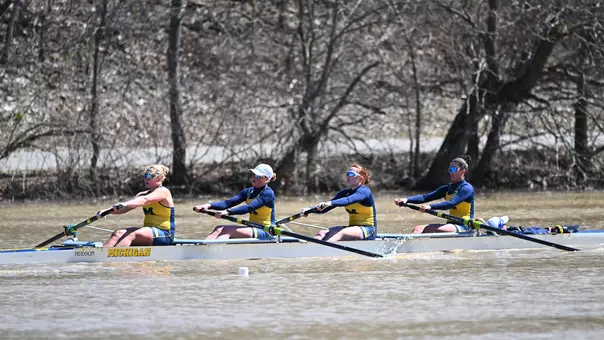
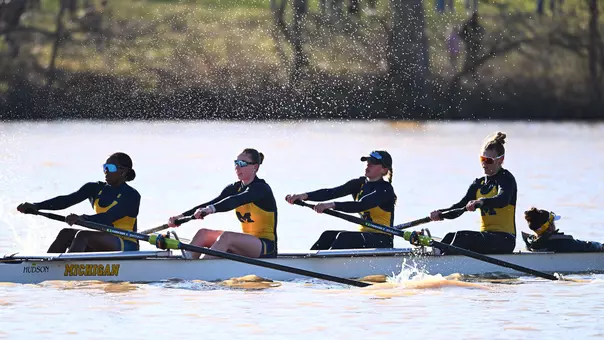
In her first year wearing the maize and blue, Vicars largely raced with the 2V4 and 3V4 boats, being promoted to the second seat of the 1V4 this year. She emphasized consistency in the way she practices, prepares and competes for races across levels. Her logic is that no matter what boat she is placed in, the way she races should not change, and she still follows the routine she began developing when she started racing at the age of 15.
This very mindset has led Vicars to success with the 1V4 so far this year. She recently placed first over Notre Dame, Oklahoma and Alabama at the Buckeye Spring Regatta last month (March 28). Tying her collegiate career back to her experience on the world stage once again, Vicars noted that she felt a lot less nervous than many of her teammates for her first race at Michigan, having had the chance to build up that confidence before the start of her time in Ann Arbor.
"(Before the European Championships), we were sitting at the start line for 10 minutes in silence. I have never been so scared in my life. I literally thought I was going to throw up. Honestly, I have never felt as nervous as that moment, because it was my first international race and I was terrified," said Vicars. "But I think that set me up really well because I have not had anything that compares to that moment. Racing here, I guess people would be nervous about their first college race. I was not."

While rowing has always been, and continues to be, a big part of Vicars' life, she is equally committed to her academic pursuits. While she is not entirely sure what path she hopes to take later in her career, Vicars is grateful for the many opportunities she has been afforded to explore different areas of the aerospace engineering major at Michigan.
"Honestly, I'm just a very go-with-the-flow kind of person, so I wouldn't say that there's a specific project or company I want to work at -- just kind of figuring out, especially as I do more aerospace classes and get more specifically into what I'm doing, what I like and what I'm good at, to kind of inform me on what I want to work on," said Vicars. "I'm also pretty interested in (Formula 1), so if I could somehow pivot throughout my career, that would be pretty cool."
Vicars had always been interested in atmospheric science, focusing more on the aeronautical side of aerospace engineering at Michigan as a result. Still, she intends to keep her options as open as possible, exploring as many different avenues as possible. Vicars also hopes to eventually earn her pilot's license, demonstrating her passion for the practical application of concepts with aerodynamics and engineering. She recalls an experience with her uncle that sparked her interest in aviation and reinforced her love for the science behind such phenomena.
"Actually, my uncle, a couple years ago, got his pilot's license and he took me up in the plane and let me sit in the front and fly it a bit too, and I was like, 'This is so cool,'" said Vicars. "I think that's definitely a part of why I want to learn how to fly -- it would just be really cool, and also to be able to understand when you're in the plane and doing the maneuvers, catch up and catch down, knowing what's happening in the plane as well is pretty cool. You get to see what you're learning and do what you're learning."
Balancing an advanced engineering curriculum with competing at the highest level of college athletics is certainly challenging, but Vicars has been able to manage her packed schedule with a little help from key mentors in her life. She credits her academic advising team with helping her handle scheduling and other logistical aspects of her life as a Division I athlete, but also notes how she still leans on some of her earliest supporters -- her coaches back home -- for guidance to this day.
Looking forward to the rest of her sophomore season and the remainder of her time at Michigan, Vicars reflected upon her love for both her sport and her field of study. She is excited to continue exploring different areas of aerospace engineering and related extracurricular activities. For instance, her involvement in the Michigan-Boeing Research in Aircraft Architecture for Cryofuel Efficiency student project team has given her firsthand experience applying her knowledge to real-world situations, in turn contributing heavily to her personal career preparation.
Emphasizing her eagerness to continue diversifying her experience and knowledge base within aerospace, Vicars offered final thoughts that are sure to resonate with many a Division I athlete: her gratefulness for where she is today.
"It's definitely a lot of hard work," she said. "They really don't play here academically, and the rowing definitely doesn't play either. I think being able to get to do that is really cool."
Whether the skies ahead of her are clear or cloudy, it does not matter: Vicars will be ready for whatever they have in store for her.

Players Mentioned