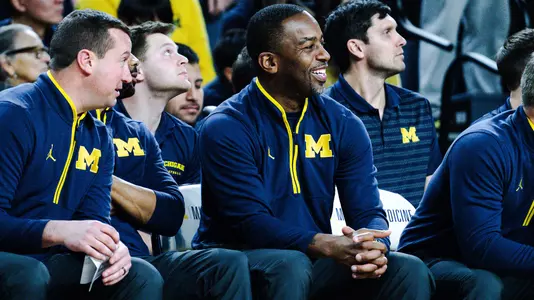
Defend the Block 386 - Mike Boynton Jr. Transcript
5/19/2026 8:13:00 AM | MGoBlue Podcasts
Brian Boesch • 00:00
One of the many goals of this Michigan basketball program is to remain at the same temperature as often as possible, and few do that better than today's guest, assistant coach Mike Boynton junior We've heard plenty of discussion around the quick turnaround from the national championship win to the opening of the transfer portal. And of course Boynton was on that front line with Dusty May, the rest of the Michigan coaching staff. Yet Boynton still made time the day of the title game, that morning and the day after the morning after. With all that was going on to hit the hotel gym between Monday and Tuesday bike sessions in Indianapolis, Boynton experienced a national championship win. But those who stay at the same temperature tend to stay in their normal routine. Michigan staff has done its best to stabilize its temperature with the preparations for the twenty six twenty seven campaign overlapping with a championship run.
Brian Boesch • 00:52
Yet Boynton did make sure to appreciate what was unfolding in March and and then in early April. I asked Boynton after the interview you're about to hear for another project I'm excited to eventually share with you about a new routine, he added. During the NCAA tournament. During pregame introductions, Boynton would walk the baseline near Michigan's bench and he would just kind of take in the moment. It was almost like he was talking to himself and he was stemming from his own advice he gave to others on staff early on this season. He said, this is special. I've had some really good moments, never anything like this. He told that to others early and to himself before the team's defining moments. Now we'll learn as time goes on how many of those baseline self talks Boynton will have when Michigan tries to defend its national title next March and hopefully next April in Detroit.
Brian Boesch • 01:46
But Boynton is a master of putting things into proper perspective and the pillars Michigan used to build this year's upcoming roster along with last year's title team prompted him to raise his level of self awareness for those big time moments, those championship opportunities. Though Boynton's temperature, as is expected around this program, remained the same. We'll talk about what happened in the dance and what has been built for next year with assistant Mike Boynton junior coming up on Defend the Block.
[music builds]
Jeff Laurence • 02:18
We're talking Michigan basketball. Welcome to Defend the Block, where we'll take you inside the basketball programs with interviews, analysis and so much more.Now here's your host, Brian Busch.
Brian Boesch • 02:31
We are with Mike Boynton junior Michigan assistant coach, now a national champion. I remember you and I caught up before the Tennessee game one of the scouts you had and I'd asked you the importance of the game, but also your approach to life, that, hey, it's not everything's bigger than one thing. Now that you're a champion as a coach, has your life, has your mindset changed at all?
Mike Boynton Jr. • 02:55
Not really. As I kind of think about it in real time as we're having this conversation, I think the way we talk about what we believe has a little bit more conviction to it, but in terms of how we do our jobs, the way we live, the way we interact with each other and the people in our program, and it's pretty much the same. And that starts with Dusty. He sets a tremendous tone for us. We talk about the temperature around our program never changing. And that's obviously, certainly you want to think about that when things aren't as good or things aren't going the way you want them to or hope they would. But I think it's equally important that you have that perspective when things are going as well as you expect them to or hope they would, because it gives you an opportunity to replicate it. And I think sometimes if you get too excited or too celebratory, you can lose sight of what it took to get there.
Mike Boynton Jr. • 03:59
All the sweat equity that went into it, all the sacrifice that went into it, because you start to feel a sense of, I've made it. And letting your guard down is one of the easiest ways to get knocked down.
Brian Boesch • 04:12
So along those lines, obviously, on the court with winning the first year, twenty seven wins, Big Ten tournament titles, Sweet sixteen this year, only three losses, program record and wins national championship. But I know in being around and watching you and the staff and the players work, there was a lot to do where from the time you got here to now have the biggest strides been taking to allow the temperature to remain the same, to allow you and this group to remember where you came from and try to keep it as balanced as possible, not resulting, as Dusty has said.
Mike Boynton Jr. • 04:45
Yeah, one of the things I believe, especially from having a perspective that I've had as being a head coach before, is I've watched Dusty basically draw this masterpiece. And I mean that not in the sense of the national championship, but the structure and the functionality day to day, of our program. Like I said, he sets a tremendous tone. He creates the vision for us. And then he's hired an elite staff, me notwithstanding, of elite workers, guys who are committed to having an egoless approach to what we do, having a servant mentality, because we all believe that our job is to try to help our players as much as we can in Every aspect of their life, but certainly in basketball. And I think, you know, the way we've worked together, Justin Joyner, who's no longer with us in a good way, Coach 'Keem, Coach Church, Coach Drew, KT, BG. I mean, all through our program there's a bunch of selfless winners and Dusty being able to identify a group of people who could come together and, and put their own individual agendas.
Mike Boynton Jr. • 06:05
Because we all have personal aspirations. Everyone, every single person has personal aspirations. But we're willing to make sure that those are secondary to what we're doing as a team. And I think because we've been successful, we've been even more committed to that, to that selflessness, to the servant mentality, to guys being willing to maybe get out of their comfort zone and try things that maybe we haven't tried before. You know, our defense has evolved, our offense has evolved and many people think that there's just this magic dust that we're sprinkling around here in Ann Arbor. And that's far from the case. In fact, we're as critical of ourselves as anything because we know that we have more that we could be doing. And I think because Dusty sets that, that growth mindset tone with us, that our staff is able to go out and execute it on a day to day basis.
Brian Boesch • 07:00
One thing I've noticed in the weeks since the national champions is just how much Dusty has done from an interview standpoint. He was traveling around some all of this. And it goes back to the word that I use that I'm maybe most impressed about Dusty is his delegation. Because when you get to this role and you're at such a high platform and having the success, the trust that he has in you, everybody else on the staff, everybody else in the program is noticeable because he can't be just like you can't be everywhere. How would you put to words Dusty's ability and trust in delegating to everyone around him to allow for the, you know, the whole to be greater than the sum of the parts.
Mike Boynton Jr. • 07:38
I think it's one of the truest measures of confidence and that you believe in what you do and you believe in empowering people to execute the things that you've set out as goals. And it goes to show a very high level sense of I self security. Like he's not concerned about whether someone else may do something well and get credit for it. You know, we don't talk about Dusty really as it relates to our defense, but he is the head coach. Like our defensive philosophy comes from him now we are tasked with implementing and communicating to our players from game to game what the specific plans from a game, game to game standpoint. But he sets the tone and we do nothing without his blessing and his encouragement. And so, you know, a lot of talk about, you know, me as a defensive coordinator and Justin and Church and I working specifically on that. It's really executing his plan and his vision for how he wants things done.
Mike Boynton Jr. • 08:47
And a lot of that obviously starts with having the right players because if you don't have that, then the plan is probably not going to work.
Brian Boesch • 08:54
And that, yeah, one hundred percent. And along those lines, why do think these players were able to do what they did? What was it about that group of individuals that allowed them to give so much? Because I, I don't think there's any argument that each one of the guys in the rotation and a few guys who weren't in the rotation could have played somewhere else and scored more, had more headlines written about them in terms of their individual performance. Why were they able to accept all that? It was before knowing the end result that this team was going to win thirty seven games, win a national championship, all that.
Mike Boynton Jr. • 09:27
Well, these guys all come from tremendous families and I think that sometimes goes flies under the radar is we have super high quality humans first and foremost. They all have tremendous parents, they come from great coaches, they've been coached by some of the best coaches, you know, that has been in our game. And so they had a great foundation coming in. And then we talk about what we expect in the recruiting process and that our ultimate goal is to be the best team. But at the same time we're going to try to help them be the best versions of themselves as players. But there's a sacrifice, there's a give and take with that. But then when you have the right kind of players who don't really care as much about their own individual accolades, Yak is probably the best example of that. Then you have something really special because your best players set the tone for you.
Mike Boynton Jr. • 10:28
Yaxel Lendeborg being a selfless star, you know, I've been around a few of them now in my career, but being a selfless star gives you a chance for everyone else to fall in line is probably the easiest way to say it. There's probably a better way to say it, but that's the easiest way that comes to my mind because then it allows other guys who maybe want a little bit more for, for themselves individually to take a step back and have a little bit more of a reflective mindset. And say, well, if that guy who's our best player doesn't mind taking three shots in a specific game because someone else has it going or because he needs to focus on defending or rebounding in this game, then the next game, when he's got it going, the other guys are willing to sacrifice. So he set a great tone for us, Him, Aday and Elliott as transfers coming in here, not wanting their own personal aspirations to be the most important thing.
Mike Boynton Jr. • 11:25
You know, allow a young guy like Trey McKenney, who didn't have any idea what this was like, to kind of be willing to sacrifice, coming off the bench, taking a role that he kind of had to grow into later in the season. You know, those guys set a great tone for him. The maturity of guys like Nimari Burnett and Roddy Gayle and Will Tschetter in their senior seasons to take a lesser role set a great tone, you know, for LJ Cason, who probably expected to step up in a role this year. And so I think this collection of that group and those guys all being comfortable in their own skin, blocking out the noise, which I'm sure came to them, you know, that they should be getting more shots, that maybe they should be making more money, even if we want to talk about, you know, that part of it, because they all could have gotten more of everything somewhere else. But, you know, to see them kind of end the way they did kind of validates that it was worth it.
Mike Boynton Jr. • 12:23
But I think they would have felt that way even if we didn't cut down the nets on April sixth.
Brian Boesch • 12:28
I'm glad you brought up the point about the guys who stayed, because a lot was made of the fact that, you know, Michigan's the first team to win a national championship with five transfer starters. Now, I did a double take on that, because I'm like, wait a minute. Nimari Burnett's been here for three years, but he still is a transfer?
Mike Boynton Jr. • 12:42
Sure, I.
Brian Boesch • 12:44
It is what it is, but I've always been saying to people since then, shouldn't the story be a lot of times when you have five transfer starters, you've got transfers behind them as well?
Mike Boynton Jr. • 12:53
Sure.
Brian Boesch • 12:53
The fact the rest of the rotation, outside of Trey McKenney, who was a commit and had been here and for the most part had been locked in or close to locked in with Michigan for a while. There's a story to be said for the fact that the guys who allowed for that or were willing to stay for that were the ones who were back in the rotation who could have gotten more like, yes, the transfer started, but this team could have had a bunch of guys start.
Mike Boynton Jr. • 13:14
Sure. I mean, Will Tschetter could have started probably on fifteen or sixteen of the teams in the conference. Roddy Gayle could have probably started on sixty seven teams that were in the NCAA tournament. Trey McKenney could have started for pretty much, you know, like, and. And it didn't matter. Like, coaches talk about this stuff all the time. Who starts is very, very trivial, man. Like, it doesn't really.
Brian Boesch • 13:39
But those same guys could have also finished games.
Mike Boynton Jr. • 13:42
Oftentimes, it was a matter of what we needed at the end of the game because they were all capable of getting the job done. I do think there needs to be a little bit of a shift in mindset. Like, we're in a different age of college athletics. We don't own these kids. Like, it's okay that they make choices that they think is best for them. As Michigan people, we should be very thankful and happy that they decided that this was the place they wanted to be this year and. And that they accomplish the goal that we all want to accomplish. But if, you know, next year there's a kid that transfers to a different school, we should support them. You know, we're going to play one in Columbus next year who was here for a year, and that's okay. It was his choice. We're happy for him. We want him to succeed. We want to beat the crap out of them when we play them. And that's just the way things are now.
Mike Boynton Jr. • 14:32
We got to kind of let go of the old mentality that everybody has to stay one place. We're all, you know, pretty driven to do the thing that we feel like is best for us at the end of the day. But when we're in it with our team, how we approach that part of it. And these guys did a tremendous job of sacrificing for one another and sacrificing. So this program could achieve the ultimate goal this year.
Brian Boesch • 14:54
More with Mike Boynton junior Momentarily. But you cannot flip a switch on sustainable energy, not without smarter storage. That's why researchers at the University of Michigan are developing a new thermal technology that converts heat into electricity with record efficiency. Using scalable storage materials like bricks and sand. This breakthrough helps turn solar and wind into steady power, a step toward making the grid more reliable, renewable, and ready for everyone, for the public good. Look to Michigan. See more solutions at Umich dot Edu slash Look, that's umich dot Edu slash Look. With Mike Boynton junior Here on Defend the Block, can you just take fans through national championship? The Win. And then it's immediately into portal discussions and retention discussions and NBA draft discussions. How did you and the rest of the staff take in all that you had to get ready for next year?
Brian Boesch • 15:52
Almost immediately after that, that net gets cut down in Indianapolis.
Mike Boynton Jr. • 15:56
Yeah. I mean, the reality is it happens immediately. But you also. We were kind of. We kind of built up to it. Right. As the season goes along, you start hearing about a die improving his profile and the rest. Improving his profile. Obviously, we thought Yax came here to do that partly. And so you kind of have some contingencies in mind. It's just that when the floodgates open, they, you know, it's like drinking out of two ends of a fire hose at the same time. Right. And so, you know, there's a little bit of distractedness to the celebration because you're trying to make sure that you're on top of the things that, you know you have to do. You're at a little bit of a disadvantage because most of the other programs have been able to prepare for. All right. What's April seventh look like for us when we wake up? And it was actually before we go
Brian Boesch • 16:51
to sleep, first world problem there. That's a really good.
Mike Boynton Jr. • 16:55
I'll take them again next year. Happily so. You know, every situation is specific to the individual that's involved. And so we have those conversations very candidly with him. We support each and every one of these kids decision to do whatever they feel like is best for their careers. Elliott Cadeau, for example. This is good for him to be going through this process a year from now. We're hopeful and we feel confident he's going to be back with us next year, even after he goes through this process. But it'll be good for him to experience what this looks like, you know, no different than what Yax did last year. Same for Morez. Regardless of what decision he makes for himself individually, this is going to be a good process. And if it results in him playing for the Chicago Bulls next year, well, we'll go to watch the Chicago Bulls play the Pistons when they come to Detroit next season.
Mike Boynton Jr. • 17:47
If it results in him playing for Michigan next year, then certainly we'll do everything we can to help him be. Be in a better position a year from now. Because our goal, our job is to help them achieve their goals also while trying to accomplish the goals that the program has in mind. But at the same time, you have to be prepared for the reality that a few of them may not come back. And how do you then put together A roster that can still be very competitive and give you a chance to compete at the highest level of college basketball. And so obviously we've done that in a few different positions with the signees that we have. And I think we're going to have a chance to have a team that looks a little bit different because we're going to be younger than we've been next year, but still very, very talented. And we'll look forward to seeing how we can put the team together to be the best version of itself.
Brian Boesch • 18:34
You mentioned the new era. I remember you and I were sitting in where we are right now, your office, talking. We couldn't say Yax's name, but there was the question of, okay, how will this roster look without Yax? And how could this roster potentially look with Yax? I feel like that's kind of what you and Dusty and anybody in coaching now kind of has to be comfortable in is the fact that a roster might not ever totally be set until we get into fall semester. Something along those lines. So how do you gauge the roster now and the potential of adding anything, anybody to it? How do you wade through those waters?
Mike Boynton Jr. • 19:12
Yeah, I mean, it's a fluid situation always. And until you get the guys here, you're. You're about ready to play. You still kind of uneasy about how it looks. And, and the reality is, even once the season starts, it takes some time. I save random pictures on my phone and I've shown it to probably about ten people. There's a picture of the. The. I think it was posted by Cincinnati. But the final score of our exhibition game against Cincinnati, and this isn't about Cincinnati, it's about us. Right? We became one of the most dominant college basketball teams in the history of college basketball. Right. Thirty seven, three, nineteen, one, ten, zero in conference play. But we gave up one hundred points on our home court to Cincinnati in October. You know, now there's some factors in there. Adai Mares don't play the axes out there for the first time figuring a story.
Brian Boesch • 20:07
Social media is not for context. The pictures are not for context.
Mike Boynton Jr. • 20:10
So it gives you an opportunity to see this thing. Yes, to your question. We will evolve depending on the roster completion, how that looks, whether we add somebody or not, because we don't know how this team is going to need to play to be successful. I mean, coming out of the exhibition game. But then we played three real games. The Oakland game was a blowout right from the beginning to end. And then we played two games against high major competition where it's like we've got some things to figure out. We won them both. But there was some questions coming out of those games that needed to, to be kind of massaged and figured out whether it was the lineup construction, whether it was the style of play. You know, we yax got benched in the game against Wake Forest for a significant part of the second half.
Brian Boesch • 21:00
Yeah. For Trey mckinney. You know, Trey was, Trey was the guy closing the lineup.
Mike Boynton Jr. • 21:04
So like, you know, hindsight, right. It gives this, this is why we try to have the same temperature. Because if you get too low in that moment and you bury Axel, we don't do what we did.
Brian Boesch • 21:14
Sure.
Mike Boynton Jr. • 21:14
You know, if we panic and we don't think we can play the three bigs because it's clunky for two or three games to start the season, maybe we figure out a different way to win, but I don't know if we dominate the way we did throughout the season. And so again, like there's a small chance we add a piece. Yeah. But there's also a chance that this is the roster. And either way, I think our staff shown that we can figure out how to massage it throughout a year to get really positive and not always excellent, but really good results at the end.
Brian Boesch • 21:48
Lastly, I would like to dig into, the championship happens. Is there a moment that sticks with you most about celebrating, appreciating, living in the fact you won a championship that stands out to you now as we reflect a little bit past it, you
Mike Boynton Jr. • 22:05
know, there was about a two minute segment that my family, my wife and my two kids, we got just the four of us together on the court and my wife, who's usually not very emotional, was overcome with emotion. And my son, who may be the least emotional person in the history of humankind, was emotional. And that one felt really fulfilling. When you think about as a coach, like the sacrifice your family makes as you do this, they don't really always get to be a part of that. And it's very rare that you win a national championship. Right. I've been doing this twenty two years now. It's the first time I've ever even played in the game. So that was pretty awesome. On a personal note, but the same thing for our staff. The number of hours we spend not just together, but even just doing the job. People think that, you know, we just show up at seven o' clock on a Wednesday night and we're gonna throw the ball up or we're gonna show up at two o' clock for practice and we're gonna practice for two hours.
Mike Boynton Jr. • 23:03
I mean it's probably closer to fifteen hour days consistently than there are eight. Right. And to obviously achieve what we did. So for that to happen for everybody was just truly amazing.
Brian Boesch • 23:16
Appreciate you sharing, appreciate the insight and enjoy the rest of the spring into the summer. We'll be catching up with you soon.
Mike Boynton Jr. • 23:21
Thanks a lot.
[music builds]
Brian Boesch • 23:30
Thanks to Mike Boynton junior For his time here on Defend the Block. We're going to have one more episode for you next Tuesday before we take a bit of a break. Only a couple weeks before we really rev up into the summer and into kind of more forward looking with the roster getting here around mid June. Of course. Dusty May will have his annual camp in Ann Arbor in mid to late June. So excited to share some of those conversations with former players, new players, players who were there last year and will be here again this season. Excited to share all of that. So one more episode for you next Tuesday. Then again, just a small little break. Didn't take one after the national championship. Didn't want to. There was too much to talk about. But we will take a bit of a hiatus before really revving up Defend the Block getting ready for next season. So thanks to Coach Boynton and thanks to all of you for listening to this edition of Defend the Block. Go Blue.
Jeff Laurence • 24:24
Thanks for listening to today's edition of Defend the Block, part of our Michigan Athletics Podcast network, M GO Blue Podcasts. The preceding has been a Learfield presentation of the Michigan Sports Network.